
Cádiz Memorial
Cádiz Memorial, also known as the Prince Regent’s Bomb, is a French mortar from the early 19th century mounted on a decorative brass monster. It is located at Horse Guards Parade in Westminster, London. The monument was first shown to the public on 12 August 1816. Since 1 December 1987, it has been listed as a Grade II British monument. The memorial also became the subject of several early 19th-century satires and cartoons, largely because the word “bomb” sounded like “bum,” prompting jokes about the Prince Regent’s rear.
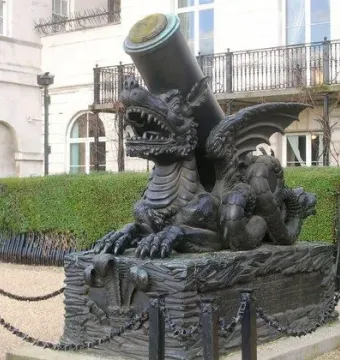
February 2007 © R. Sones · CC BY-SA 2.0
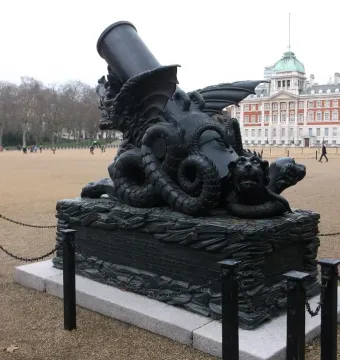
December 2015 © Harry Mitchell · CC BY 4.0
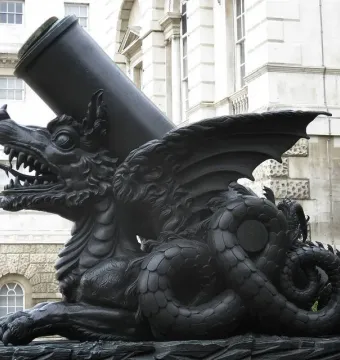
October 2009 © mira66 · CC BY 2.0
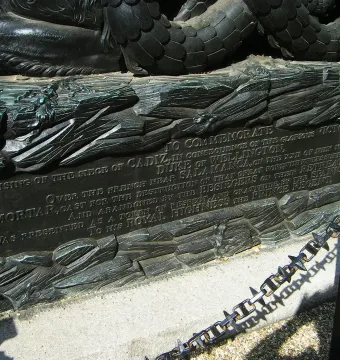
September 2009 © hugh llewelyn · CC BY-SA 2.0
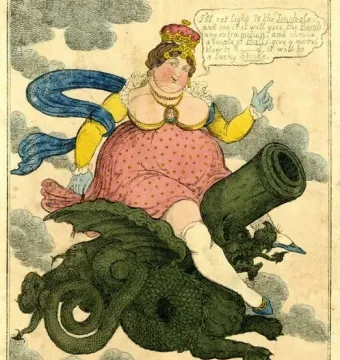
© J. Lewis Marks · Public domain
Identification | |
| Title | Cádiz Memorial |
| Type | memorial sculpture featuring a captured French siege mortar mounted on a decorative brass monster |
| Alternative name | Monumento a Cádiz |
| Nickname | Prince Regent's Bomb |
Historical context | |
| Date made | March 1811 |
| Place made | Seville, Spain |
| Original purpose | Cast for the destruction of Cádiz and its port as a giant siege weapon for the French army under Marshal Soult during the siege of Cádiz |
| Battle and siege context | Used during the two-year siege of Cádiz and later abandoned by the retreating French after the Battle of Salamanca |
| Capture and transfer | Captured by the Spanish Regency and presented to Rear Admiral Arthur Kaye Legge |
Creator | |
| Construction and mounting | Built and mounted by the Royal Carriage Department at the Royal Arsenal, Woolwich under the direction of the Earl of Mulgrave, Master General, at the Prince Regent's instruction |
Physical characteristics | |
| Main elements | A French mortar mounted on a brass monster with a dog figure at the rear and an elaborate bronze base |
| Base dimensions | 2.79 m by 1.37 m |
| Overall height | 3 m |
| Weight | 16 tons |
Materials | |
| Primary materials | French mortar, brass, and bronze |
| Base material | bronze |
Appearance | |
| Base form | A brass bed or platform representing the rock on which the monster rests |
| Front decoration | The Prince of Wales's feathers in high relief |
| Monster figure | Dante's reimagining of Geryon, with wings instead of multiple heads and two twin tails wrapped around the mortar |
| Rear figure | Orthrus, depicted as a dog behind the mortar |
Iconography and meaning | |
| Mythological association | Associated with Geryon and the island of Gades, linked to modern Cádiz |
| Inscription language | Latin and English |
| North inscription | Latin inscription stating that after the French were defeated by the Duke of Wellington near Salamanca and the siege of Cádiz was raised, the mortar was presented to George, illustrious British Prince, by the Spanish Parliament as a testimony of veneration, and that he ordered it to be placed in this location and decorated with these ornaments |
| South inscription | English inscription commemorating the raising of the Siege of Cádiz after Wellington's victory over the French at Salamanca on 22 July 1812, stating that the mortar was presented by the Spanish Nation to His Royal Highness the Prince Regent |
| Rear inscription | Built in the Royal Carriage Department. Earl of Mulgrave, Master General - A.D. 1814. |
| Historical event commemorated | The raising of the Siege of Cádiz |
| Related battle | The Battle of Salamanca, 22 July 1812 |
| Meaning | A token of respect, gratitude, and veneration for British assistance in the raising of the siege of Cádiz |
Location and ownership | |
| Listed status | Grade II listed monument |
| Date listed | 1 December 1987 |
| Current location | Horse Guards Parade, Westminster, London, England, United Kingdom |
| First public display | 12 August 1816 |
| Initial installation | Installed on Horse Guards Parade on the south side of the parade ground behind a square of chevaux de frise |
| Current position | Adjacent to the Horse Guards building |
History and restoration | |
| Satirical reception | The monument was the subject of many satirical verses, cartoons, and caricatures in the early 19th century |
| Reason for satire | "Bomb" was pronounced like "bum," prompting scatological puns about the Prince Regent's backside |
| Related satirical works | C. F. Lawler's The Regent's Bomb, William Hone's unveiling verse, George Cruikshank's cartoon, and S. W. Fores's A Representation of the Regent's Tremendous Thing erected in the Park |
| Later caricature trend | Later cartoonists often depicted the mortar with the Prince Regent's mistress Lady Hertford |
Other | |
| Source note | Some sources describe the monster as a Chinese dragon |