
Putto with a Dolphin
Putto with a Dolphin is a bronze sculpture by Andrea del Verrocchio, made between about 1475 and 1481. The work is conserved at the center of the old well square in Florence’s Palazzo Vecchio. The source text notes that Leonardo da Vinci is believed to have taken part in its creation. This sculpture, also referred to in French as Le Petit Ange au dauphin, is one of Verrocchio’s notable bronze works and remains in its historic Florentine setting.
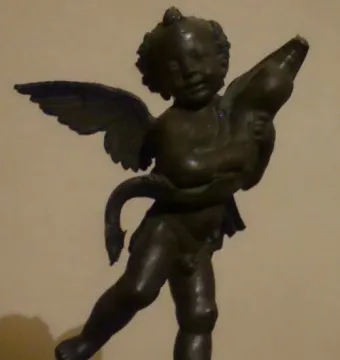
October 2007 © sailko · CC BY 2.5
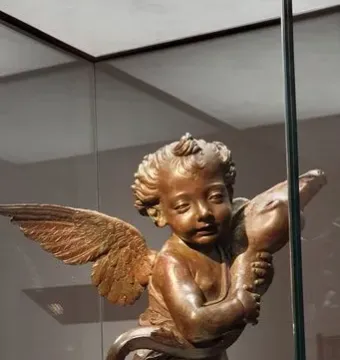
April 2019 © Yair Haklai · CC BY-SA 4.0
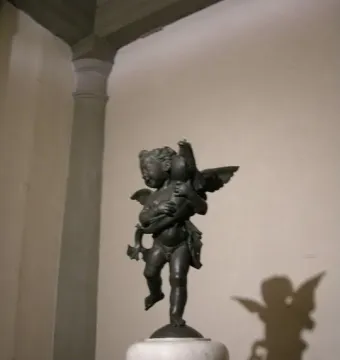
June 2009 © sailko · CC BY 2.5
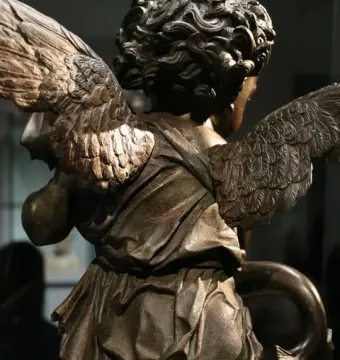
March 2019 © Sailko · CC BY 3.0
November 2012 © sailko · CC BY-SA 3.0
Identification | |
| Title | Putto with a Dolphin |
| Type | bronze sculpture and fountain sculpture |
| French title | Le Petit Ange au dauphin |
Historical context | |
| Date | c. 1470 (proposed dates range from 1465–1468 to 1480; also described as between about 1475 and 1481) |
Creator | |
| Artist | Andrea del Verrocchio |
| Attribution note | Leonardo da Vinci is said to have participated in its creation |
Discovery and provenance | |
| First recorded name | il bambino di bronzo (the bronze child) |
| Earliest documented mention | 1495 list by Tommaso Verrocchi of works made by Andrea for the Medici |
| Original intended location | Fountain at the villa of Careggi |
| Possible association | Possibly the Fountain of Love (fontana dell'Amore) |
| Patronage | According to Vasari, commissioned by Lorenzo de' Medici in person; some scholars instead link it to a wish of Piero de' Medici |
| Base hypothesis | According to Seymour, the original base may be in a fountain at Palazzo Pitti, where an elegiac distich probably alludes to Piero |
Physical characteristics | |
| Height | 67 cm |
Materials | |
| Material | Bronze |
Appearance | |
| Drapery treatment | The mantle clings to the back |
| Hair treatment | A wet tuft of hair sticks to the forehead |
| Object held | A dolphin, stylized as a large fish in the period's conventions |
| Pose | A smiling dancing putto in precarious balance |
| Depicted figure | Winged putto with a childlike expression |
Style | |
| Artistic influence | Dynamic naturalism learned from Desiderio da Settignano |
| Formal effect | The sculptor transformed the material into soft, smooth forms |
Iconography and meaning | |
| Subject | A putto strangling a fish or dolphin |
| Subject source | Derived from antiquity but reinterpreted |
Function | |
| Original function | Part of a fountain; water came out of the dolphin's mouth and nostrils, sprayed upward, and fell back down |
Location and ownership | |
| Current location | Palazzo Vecchio, Florence |
| Current position | Center of the former well square at Palazzo Vecchio, Florence |
History and restoration | |
| Later placement | Between 1550 and 1568, during Cosimo I de' Medici's renovation of Palazzo Vecchio, the statue was placed at the center of the first courtyard |
| Palazzo Vecchio function | It crowned a fountain designed by Giorgio Vasari |
| Conservation status | In 1959 the work was moved to the second floor of the palace for protection; a copy was placed in situ |
| Derivative | A terracotta version, probably by Verrocchio himself, now in a private collection |
Significance | |
| Context | Associated with Medici patronage and with the Neo-Platonic circle at Careggi |