
Pulgas Water Temple
Pulgas Water Temple is a masonry structure in Redwood City, California, designed by architect William G. Merchant. It was erected by the San Francisco Water Department to commemorate the 1934 completion of the Hetch Hetchy aqueduct and stands at the aqueduct’s final terminus. Water originally flowed through a vault beneath the temple, but new treatment requirements now divert it to a nearby plant. The name comes from Rancho de las Pulgas, an old Spanish land grant. That grant was named after the main village of the Lamchin, an Ohlone tribe that lived in the San Carlos area before the arrival of the Spanish.
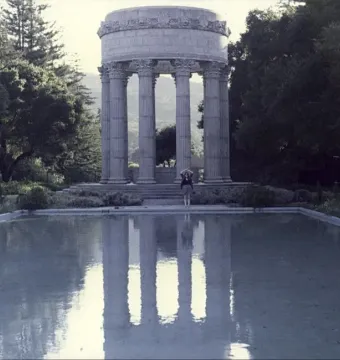
August 1988 © Bill Abbott · CC BY-SA 2.0
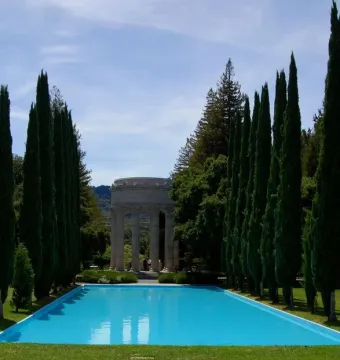
June 2010 © Mark Levisay · CC BY 2.0
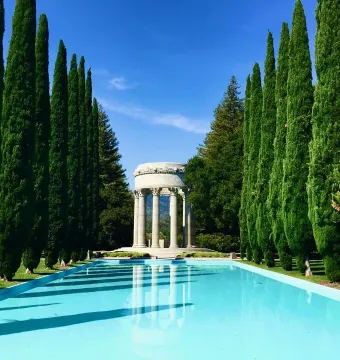
August 2015 © Robert Skelton · CC BY-SA 4.0
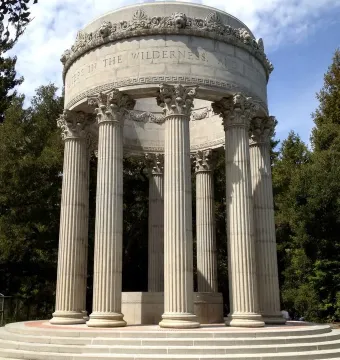
March 2013 © Ray Bouknight · CC BY 2.0
July 2014 © Bill Abbott · CC BY-SA 2.0
Identification | |
| Title | Pulgas Water Temple |
| Type | water temple; masonry structure |
| Spanish name | Templo del Agua de Las Pulgas |
Location and ownership | |
| Location | Redwood City, California, United States |
| Position relative to aqueduct | Located at the aqueduct's terminal end |
Creator | |
| Architect / designer | William G. Merchant |
| Carver | Albert Bernasconi |
Discovery and provenance | |
| Commissioned by | San Francisco Water Department |
| Origin of grant name | The grant was named because the main village of the Lamchin, the Ohlone tribe that lived in the San Carlos area before the Spanish arrived, was called Cachanigtac |
| Grant name explanation | The name appears to contain a word for vermin, which Spanish missionaries translated as Las Pulgas ('the Fleas') |
| Name origin | Named after Rancho de las Pulgas, an early Spanish land grant |
Historical context | |
| Decision made by expedition leaders | They turned around and began the return journey to San Diego |
| Historical significance of the expedition | Members of the expedition were the first Europeans to explore inland areas of California and the first to see San Francisco Bay |
| What the landmark commemorates | The camping place of the Spanish Portola expedition on November 11, 1769 |
| Previous-day route information | They had crossed Sweeney Ridge from the coast before deciding to return |
| Previous camping location of the expedition | San Francisquito Creek |
| Water supply context | San Francisco and other Bay Area communities are supplied with water from the Hetch Hetchy Reservoir via the Hetch Hetchy Aqueduct |
| Associated aqueduct | Hetch Hetchy Aqueduct |
| Purpose | Built to commemorate the 1934 completion of the Hetch Hetchy Aqueduct |
Physical characteristics | |
| Architectural form | A circle of fluted Corinthian columns surmounted by a large masonry ring |
| Completion date | 1938 |
| Reflecting pool | A reflecting pool lined with cypress trees lies just east of the building |
History and restoration | |
| Original water flow arrangement | Water originally flowed through a vault beneath the temple |
| Current water flow arrangement | Water has been diverted to a nearby treatment plant since 2004 |
| Reason for diversion | To remove chloramine added at the Sunol treatment plant before the water enters the reservoir, in order to avoid possible ecological damage |
| Further treatment location | The water is treated again with chloramine at a plant in San Bruno |
| Well cover | The well inside the temple was covered with a grate to prevent people from jumping in and riding the water down the canal |
| Replaced structure | An original structure made largely of plywood |
Materials | |
| Decorations | Carved reliefs |
| Original water feature | Water originally flowed over a small C-shaped waterfall inside the temple |
| Original water route | After the waterfall, the water continued about 800 feet (240 m) westward through a channel to Upper Crystal Springs Reservoir |
| Material | Stone masonry |
Appearance | |
| Inscription | "I will give waters in the wilderness, and rivers in the desert, to give drink to my people" (Isaiah 43:20) |
Other | |
| Nearby historical landmark | California Historical Landmark No. 92 |
| Film appearances | Kate Kline May's 1983 adaptation of Alice’s Adventures in Wonderland, Alice Underground; Oliver Stone's 1991 film The Doors |