
Tomb of Charles III of Navarre and Eleanor of Castile
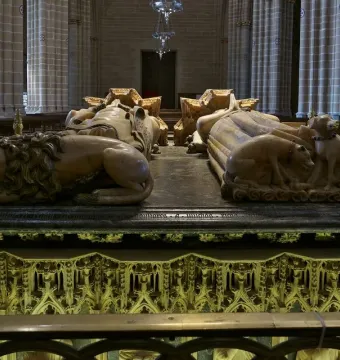
The Tomb of Charles III of Navarre and Eleanor of Castile is a royal funerary monument in Pamplona Cathedral, built in the Gothic style between late 1413 and mid-1419. It is described as one of the most representative works of Navarrese Gothic sculpture and fifteenth-century funerary art, and as the best studied and documented of the cathedral’s Gothic sculptures. The monument is a royal pantheon that also contains the remains of several other monarchs and their relatives, and it was originally equipped with a burial crypt. It is considered the masterpiece of Jehan de Lome of Tournai and his workshop, and it helped inspire later funerary sculpture in Navarre.
February 2016 © José Luis Filpo Cabana · CC BY 4.0
February 2016 © José Luis Filpo Cabana · CC BY 3.0
February 2019 © Jl FilpoC · CC BY-SA 4.0
September 2025 © Jialxv · CC BY-SA 4.0
August 2025 © Luistxo · CC BY-SA 4.0
Identification | |
| Title | Tomb of Charles III of Navarre and Eleanor of Castile |
| Type | Freestanding funerary monument; royal pantheon |
| Subjects | Charles III of Navarre and Eleanor of Castile |
| Alternative name | Mausoleum of Charles III of Navarre and Eleanor of Trastámara |
Historical context | |
| Style | Gothic; International Gothic with Burgundian influence |
| Date of construction | Between late 1413 and mid-1419 |
| Historical impact | Considered one of the most representative works of Navarrese Gothic sculpture and 15th-century funerary art; it sparked a fashion for funerary monuments in Navarre, where they had been rare |
| Art-historical significance | Considered the key work of the period of Gothic art adapted to Navarre; described as the masterpiece of Jehan de Lome and his workshop in Navarre |
Creator | |
| Artist | Jehan de Lome of Tournai and his workshop |
| Workshop composition | A team of craftsmen from France, Burgundy, the Burgundian Netherlands, Flanders, Picardy, and Reims |
| Supervision | The work was overseen by an unnamed person |
Discovery and provenance | |
| Earlier location | The monument had a different location before 1902, according to cathedral archivist José Goñi Gaztambide |
| Attribution history | Usually attributed to Jehan de Lome and his workshop since Émile Bertaux's assessment in 1908 |
| Original location | Pamplona Cathedral |
| Original place of execution | Olite, in workshops set up in the royal palace |
| Transfer to Pamplona | Transferred in several stages from January 1419 until July 1419; from August 1419 the French masons disappear from the royal works rolls in Pamplona |
Physical characteristics | |
| Structure | Independent, free-standing tomb; regular prismatic parallelepiped |
| Dimensions | 2.73 m long, 2.12 m wide, 1.08 m high |
Materials | |
| Materials | Sandstone and alabaster |
| Alabaster source | Possibly from the quarries of Sástago |
| Surface treatment | Originally painted a dark tone so the sandstone bed would appear dark; currently painted green and white to imitate marble, with some touches of colour and gilding remaining |
| Former decoration | Precious stones once decorated the tomb but are now lost |
Appearance | |
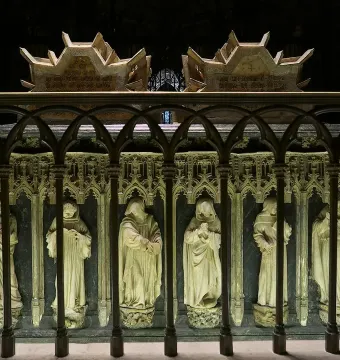
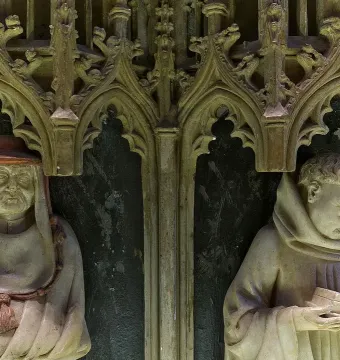
| Chest decoration | The funerary chest is carved on all sides with figures framed by architectures topped with doseletes, giving each figure its own space |
| Canopy openings | The second level is completely open, revealing windows with mullions and complex tracery |
| Canopy exterior | Articulated with flying buttresses topped by pinnacles |
| Figure costume | Dressed in the fashion of their time, with realistically rendered garments |
| Figures on chest | 28 figures in pairs on the four sides of the chest: 6 on the east side, 6 on the west side, 8 on the north side, and 8 on the south side |
| Figure size | Between 0.48 m and 0.55 m high |
| Figure supports | Standing on corbels decorated with flora, monsters, hunting scenes, and atlantes |
| Figure subjects | Cardinals, bishops, canons, monks, and lay people in complementary pairs |
| Canopy vaulting | Ribbed vaults with floral keystones |
| Canopy architecture | A Gothic-temple-like covering with three octagonal bodies and two small trapezoidal ones |
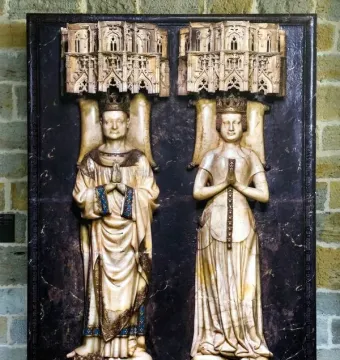
| Canopies | Large, highly refined Gothic canopies over the monarchs |
| Queen portrait | The queen's face is idealized and does not appear to be a portrait |
| King portrait | The king's face is considered a faithful portrait and may have inspired later artistic representations |
| Effigy heads | Both figures rest their heads on pillows beneath Gothic canopies |
| Queen bodice decoration | Very elaborate chain of brooches, comparable to the golden sash shown on the tomb |
| Queen attire | Elegant French court dress of the period, consisting of a tunic and a pellote with a broad semicircular neckline and close-fitting sleeves |
| King attire | Coronation robes: a long tunic, an open surplice or over-tunic with very wide sleeves and blue Greek-key borders sprinkled with fleur-de-lis, and an open mantle fastened on the right shoulder with a brooch |
| Effigy posture | The king has hands in prayer; the queen has hands joined in prayer |
| Effigies | Two recumbent crowned royal figures, the king and queen, placed atop the slab |
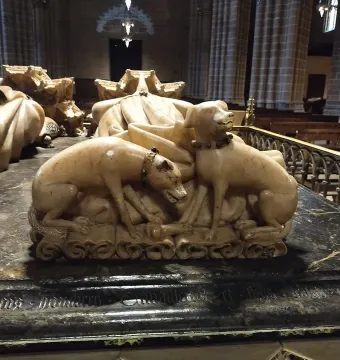
| Foot supports | The king's feet rest on a lion symbolizing strength and majesty; the queen's feet rest on two dogs fighting over a bone, alluding to human life gnawed by time and, in Gothic funerary art, fidelity |
Iconography and meaning | |
| Possible identified mourners | According to José María Jimeno Jurío, some figures can be identified as Cardinal Martín de Zalba, Cardinal Miguel de Zalba, and possibly Bishop Sancho Sánchez de Oteiza |
| Date inscription errors | The tomb inscription gives Charles III's death date as 1426 and Eleanor's as 5 March 1416, but documentary evidence gives 1425 and 27 February 1415; the errors have been taken as evidence that the epitaphs were later additions |
| Queen epitaph | Describes her as a very good, wise and devout queen |
| King epitaph | Names him as Karlos IIII and emphasizes his descent from Charlemagne and Saint Louis, his recovery of territory and patrimony, his building projects, and how he ennobled and exalted many subjects |
| Epitaphs | Two epitaphs in Navarrese Romance, carved and gilded in Gothic script on separate doseletes |
| Mourners interpretation | Some scholars have taken them to represent contemporary persons, but Clara Fernández-Ladreda Aguadé considers this unlikely |
| Canopy symbolism | The canopy represents a Gothic temple |
| Queen symbolism | The dogs under the queen allude to human life gnawed by time and, in Gothic funerary art, fidelity |
| King symbolism | The lion under the king symbolizes strength and majesty |
| Mourners | Carved mourners (plorantes) represent the funeral procession |
Location and ownership | |
| Current location | Pamplona Cathedral, Pamplona, Navarre, Spain |
| Setting | Center of the main nave, under the vault of the second bay, before the transept and facing the presbytery |
History and restoration | |
| Destruction and loss of related burials | The sarcophagi of the first four kings listed on the slab were destroyed during the War of the Navarrería in 1276; the next two, Philip III and Charles II, disappeared with the partial collapse of the Romanesque cathedral in 1390 |
| Execution timing | The king's effigy was carved while he was still alive; the queen's effigy was carved after her death |
| Commissioner's actions before construction | Charles III reportedly sent craftsmen to different places to study examples for inspiration before the work began |
| Crypt discovery | During the 1755 restoration, the interior of the monument and its vaulted burial crypt were discovered; the original entrance had been blocked by the choir staircase, plans were drawn up, and the crypt was then closed |
| Figure arrangement changes | The current arrangement of the mourners differs from the original arrangement because the tomb was transferred between locations over time; originally the figures were paired with opposing postures in a closed composition, and the two cardinals were together before later being separated into the northwestern corner |
| Restoration work | Repair and cleaning were carried out in 1755 |
| Restoration date | 1755 |
Significance | |
| Influence | Served as an initial impulse for later funerary sculpture in Navarre, though later monuments were arcosolia rather than free-standing tombs |
| Related monuments | Arcosolia in the cathedral cloister of Pamplona for Sancho Sánchez de Oteiza and Leonel de Garro, and in Tudela Cathedral for Sancho Sánchez de Oteiza and the ensemble of Francés de Villaespesa and Isabel de Ujué |
| Scholarly assessment | Described by various sources as the best studied and best documented work in the cathedral's Gothic sculpture ensemble |
| 1908 observation | In 1908 Émile Bertaux visited the monument and considered it surprisingly neglected, noting that earlier observers such as Jean-Auguste Brutails and Marcel Dieulafoy had only mentioned it in passing |