
Cenotaph of Archduchess Maria Christina
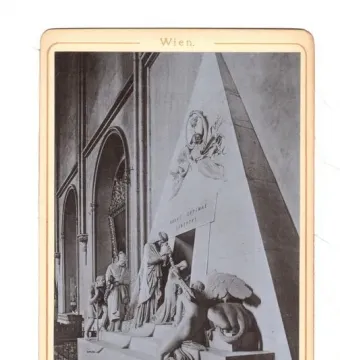
The Cenotaph of Archduchess Maria Christina is a sculptural funerary monument by Antonio Canova, housed in Vienna’s Augustinerkirche. Its plaster model is kept in the Gipsoteca canoviana in Possagno, Treviso. The work is built around a striking white pyramid with a dark opening at its center, marked by the inscription "uxori optimae Albertus". A mournful procession carries the ashes of the deceased toward the burial chamber, including figures such as the Genius of Pain, Beneficence, Happiness, and a child with a palm and medallion portrait of Maria Christina. Canova’s treatment of death reflects a distinctly Neoclassical vision.
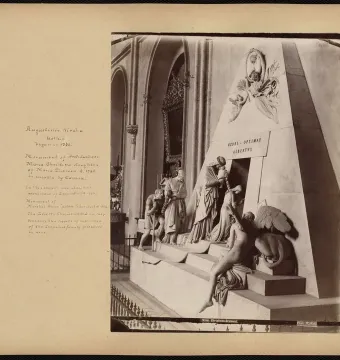
November 1892 © Tupper, William Vaughn, 1835-1898 · Public domain
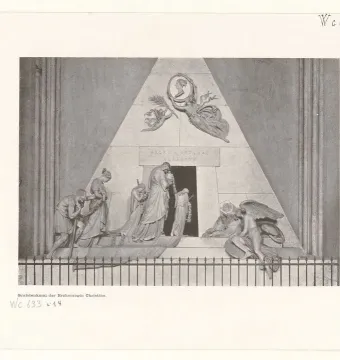
© Mayreder, Karl (18..-19..?). Auteur du texte Gerlach, Martin (1846-1918). Photographe · Public domain
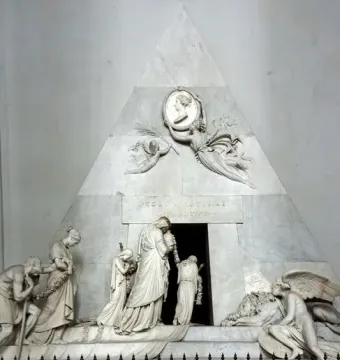
June 2015 © Dennis G. Jarvis · CC BY-SA 2.0
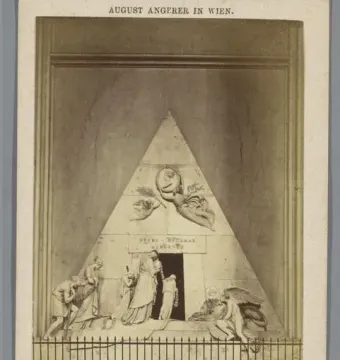
© Rijksmuseum · CC0
January 2013 © Unknown authorUnknown author · Public domain
Identification | |
| Title | Cenotaph of Archduchess Maria Christina |
| Type | cenotaph / funerary monument |
| Subject | Maria Christina of Austria |
| Original title | Monumento funerario a Maria Cristina d'Austria |
Creator | |
| Artist | Antonio Canova |
Discovery and provenance | |
| Iconographic program | A broad iconographic program devised by Duke Albert himself |
| Source of design | Canova used sketches he had made for an unrealized funerary monument to Titian Vecellio for the Basilica of Santa Maria dei Frari in Venice |
| Reused motifs | Some procession figures were adapted from earlier monuments, including the crouching lion and winged genius from the tomb of Pope Clement XIII |
| Purpose | To honor the memory of Maria Christina and her charitable character |
| Commission date | August 1798, after the death of Maria Christina on 23 June 1798 |
| Commissioned by | Duke Albert of Saxony-Teschen |
Historical context | |
| Design completed | November 1798 |
| Plaster models completed | July 1800 |
| Construction period | Built in several stages over seven years; the marble translation of the design took place over the following five years |
| Installation date | Between 12 June and 27 September 1805 |
| Completion date | September 1805 |
| Inauguration date | October 1805 |
Location and ownership | |
| Current location | Augustinerkirche, Vienna |
| Plaster model location | Gipsoteca canoviana, Possagno (Treviso) |
Physical characteristics | |
| Inscription | uxori optimae Albertus ('Albert to his excellent wife') |
| Perspective effect | The inclined supports create the illusion of a slanting wall |
| Composition | A mournful procession advances up a short staircase of three levels toward the opening |
| Architectural framing | A dark entrance framed by two inclined jambs and a massive lintel |
| Style | Neoclassical |
| Material | White marble |
| Overall form | A large white pyramid with a dark central opening |
Appearance | |
| Figural arrangement | The procession includes an urn-bearer flanked by two girls, a winged Genius of Pain, a crouching lion, Beneficence or Piety with a hidden child and blind old man, and Happiness with a winged child holding a palm branch |
| Procession mood | All figures are marked by sadness and lowered heads |
| Garland | All the figures are linked by a long garland of flowers |
| Drapery | A veil-like cloth is spread precariously over the steps and guides the procession toward the interior void |
| Medallion | A bas-relief medallion with the profile portrait of Maria Christina, surrounded by an ouroboros |
Iconography and meaning | |
| Winged genius symbolism | The tenderness of Duke Albert; also interpreted as Hypnos, suggesting death as eternal sleep |
| Depicted moment | The sculpture shows death still unfolding and summoning the funeral procession, not the moment of death's culmination |
| Cloth symbolism | It emphasizes continuity between life and death and the world of the dead |
| Upper figure symbolism | Happiness accompanied by a winged child with a palm branch |
| Beneficence figure | Beneficence or Piety accompanies a hidden child and a blind old man, holding the old man by the arm |
| Ouroboros meaning | An esoteric Masonic symbol alluding to infinity |
| Lion symbolism | Fortitude, a virtue of Maria Christina |
| Urn bearer | Virtue carries the urn containing Maria Christina's ashes |
| Medallion meaning | A neoclassical substitute for the visible statue of the deceased typical of Baroque monuments |
| Pyramid symbolism | The pyramid is a symbol of Freemasonry |
| Opening meaning | The dark opening symbolizes the passage to the burial chamber and the threshold between the world of the living and the Underworld |
History and restoration | |
| Reception | Despite some criticism from local artists, the monument achieved brilliant success |
Significance | |
| Historical significance | It strengthened Canova's already well-established European fame |
| Critical admiration | Stendhal called it the 'premier des tombeaux existants' after visiting Vienna in 1809 |
| Interpretation | It is presented as a neoclassical parallel to Ugo Foscolo's Dei sepolcri and Alla sera, expressing a view of death as serene detachment and the exaltation of the deceased's virtues and ideals rather than tragic loss |
| Comparative note | Described by Giuseppe Nifosì as the expression of the same neoclassical feeling toward death as Foscolo's poem |