
The Falling Man
The Falling Man, also known as L'Homme qui tombe, is a sculpture by French artist Auguste Rodin modeled in 1882. It is part of the emblematic The Gates of Hell. The figure represents accumulated human force plunging into the eternal void of hell. In The Gates of Hell, it appears in three different positions: at the top of the left leaf or jamb, above the right column supporting Squatting Woman to form the group I Am Beautiful, and as the central piece of Avarice at the lower end. Its unchanged musculature in different orientations shows that Rodin favored expressive effect over strict fidelity to gravity.
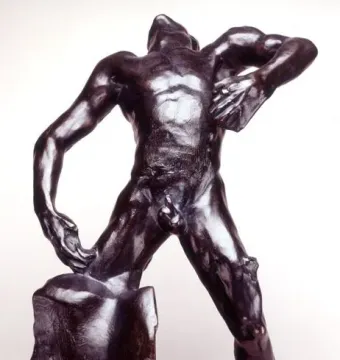
© Auguste Rodin · CC BY-SA 4.0
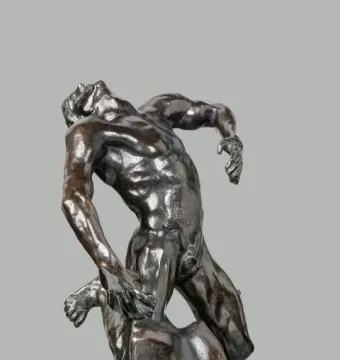
© Auguste Rodin · CC BY-SA 4.0
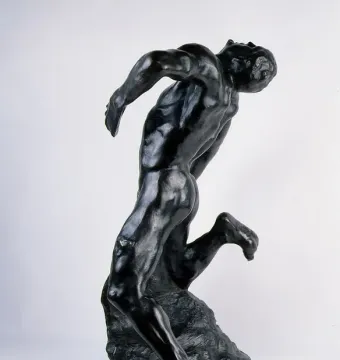
© Auguste Rodin · CC BY-SA 4.0
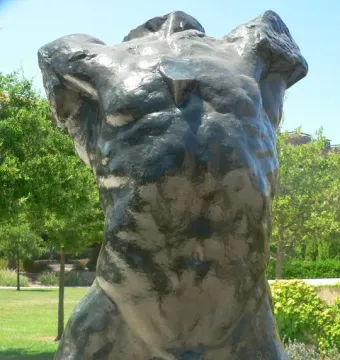
© David Monniaux · CC BY-SA 3.0
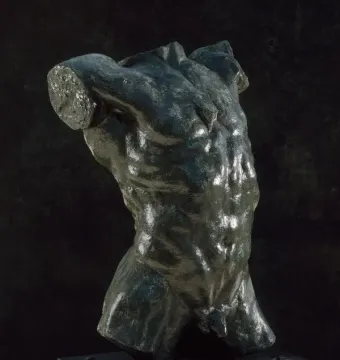
© Auguste Rodin (France, 1840-1917) · Public domain
Identification | |
| Title | The Falling Man |
| Spanish title | El hombre que cae |
| Type | Sculpture |
| Original title | L'Homme qui tombe |
Creator | |
| Artist | Auguste Rodin |
| Artist nationality | French |
Historical context | |
| Date modeled | 1882 |
| Part of | The Gates of Hell |
Iconography and meaning | |
| Interpretation | Some authors have suggested that Rodin may have suspected the commission for The Gates of Hell would be canceled |
| Depicted subject | A human figure representing accumulated human force hurled into the eternal void of hell |
Physical characteristics | |
| Pose | Arched position |
Appearance | |
| Appearance in The Gates of Hell | Appears in three places: at the top of the left leaf or left door; above the right column or pilaster supporting Squatting Woman/Crouching Woman as part of She Who Was Once the Helmet-Maker's Beautiful Wife / I am beautiful; and as the central piece of Avarice at the bottom of the Gates |
| Musculature | The figure's musculature does not change when it appears in different directions in The Gates of Hell |
Other | |
| Functional impact on The Gates of Hell | The arched position may have made the doors difficult, if not impossible, to open and close, hindering their function |
| Image views | Side view; front view |
Technique | |
| Treatment of gravity | Rodin did not take gravity into account in the representation |
Significance | |
| Art-historical significance | It anticipates modern art by privileging expressiveness over verisimilitude |