
Head of Saint John the Baptist
Head of Saint John the Baptist is a marble piece created by Auguste Rodin in 1887. It belongs to a group of works derived from Saint John the Baptist Preaching, first shown in 1880, which brought Rodin important official recognition. Rather than presenting the fragment as a conventional bust, Rodin mounted it sideways on a baptismal font to strengthen its connection to the story of Saint John the Baptist. He also separated it from the rest of the fragment known as The Walking Man, which lost any religious tendency. The work reflects Rodin’s interest in creating gestures across different instants and in suspending time abruptly. It is exhibited in Mexico at Museo Soumaya, Fundación Carlos Slim.
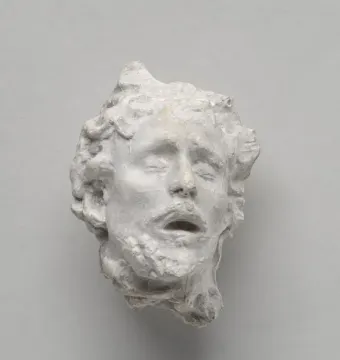
© Auguste Rodin · CC0
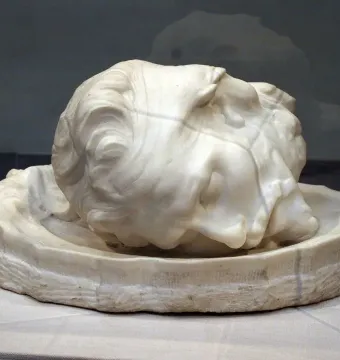
December 2007 © Marshall Astor · CC BY-SA 2.0
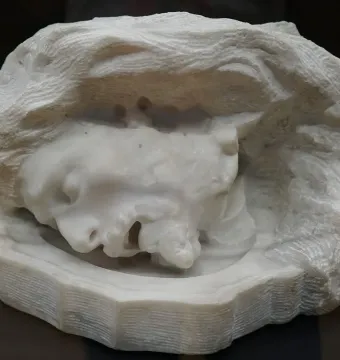
February 2019 © G.Garitan · CC BY-SA 4.0
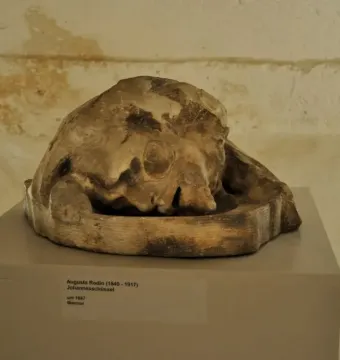
December 2012 © Meluzína · CC BY 4.0
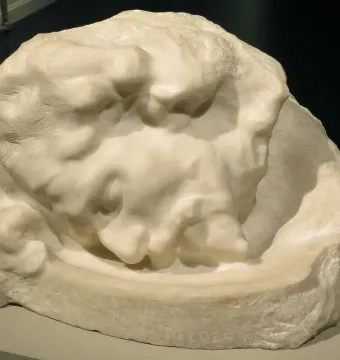
© Wmpearl · CC0
Identification | |
| Title | Head of Saint John the Baptist |
| Original title | Cabeza de San Juan Bautista |
| Type | Sculpture; fragment of a larger work |
Historical context | |
| Date created | 1887 |
| Related work | San Juan Bautista Predicando (John the Baptist Preaching) |
| First exhibited | 1880 |
| Reception of related work | Received an official mention and important recognition; critics gave it great acceptance |
Creator | |
| Artist | Auguste Rodin |
| Artist nationality | French |
| Part of series | A series of sculptures based on Rodin's Saint John the Baptist |
Discovery and provenance | |
| Relation of related fragment to religion | It lost all religious tendencies |
| Reason for separation | Rodin separated the sculpture after strong criticism of the work |
| Related fragment | The remaining fragment was later named The Walking Man |
| Relation to source work | A fragment separated from San Juan Bautista Predicando |
Physical characteristics | |
| Form | Head sculpture; not presented as a bust |
| Composition | Mounted sideways on a baptismal font |
| Artistic effect | The separation of the head from the body allowed Rodin to express gestures at various moments |
| Interpretive claim | Some authors describe it as Rodin's stopping time abruptly |
Appearance | |
| Display intention | The sideways mounting was intended to make a greater reference to the story of Saint John the Baptist |
| Thematic interpretation | The idea of stopping time is described as a counter-statement to the use of photography in gestures |
Materials | |
| Material | Marble |
Iconography and meaning | |
| Subject | Saint John the Baptist |
Location and ownership | |
| Current exhibition location | Museo Soumaya, Fundación Carlos Slim, Mexico |