
Hurlbut Memorial Gate
Hurlbut Memorial Gate is a monumental structure at the entrance to Water Works Park in Detroit, Michigan, located at East Jefferson Avenue and Cadillac Boulevard in a historic area of the city. Named for Chauncey Hurlbut, a Detroit grocer, president of the Board of Water Commissioners, and philanthropist, the gate was built in 1894. It was designated a Michigan State Historic Site in 1974 and added to the National Register of Historic Places in 1975. The monument was fully restored in 2007.
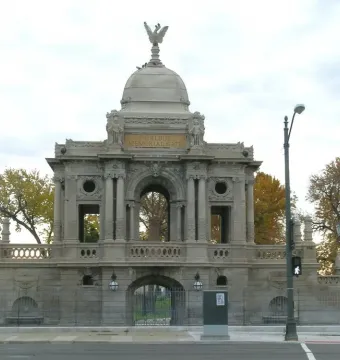
© Andrew Jameson · CC BY-SA 3.0
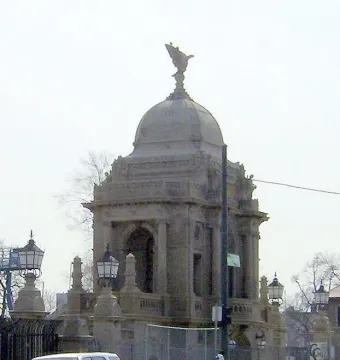
© Mike Russell · CC BY-SA 3.0
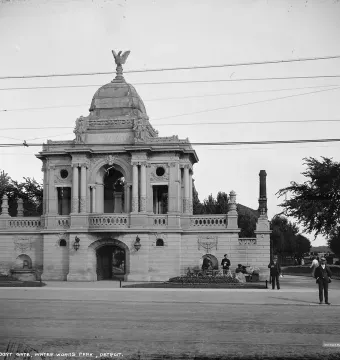
1894 © Detroit Publishing Company · Public domain
Identification | |
| Title | Hurlbut Memorial Gate |
| Original-language name | Puerta conmemorativa Hurlbut |
| Type | three-tiered triumphal arch |
Historical context | |
| Park closure and reopening | Closed in 1951, reopened in 1957 as a much smaller park, and closed again a few years later |
| Renaming reference | The siege of Fort Detroit during Pontiac's Rebellion |
| Renaming honoree | Major Henry Gladwin |
| Park renamed | Gladwin Park in 1910 |
| Park status by 1900 | The park had become the city's second most used park |
| Pumping station completed | 1879 |
| Water Works Park development began | 1868 |
| Water system development began | 1824, with a water plant at the foot of Orleans |
| Water source for municipal system | Detroit River |
| Historical context | Linked to the development of Detroit's municipal water system and Water Works Park |
| Historical context | Built in a period when monumental gates were favored at the entrances to public places, symbolically separating the park from the bustle and dirt of the city |
| Built | 1894 |
Creator | |
| Designers | Herman A. Brede and Gustave Mueller |
Discovery and provenance | |
| Cost | $30,000 |
| Commissioned and funded by | Part of Chauncey Hurlbut's fortune, left in his will to beautify Water Works Park; about $250,000 was donated after his death in 1885 |
| Named after | Chauncey Hurlbut (1803–1885), a Detroit grocer, president of the Board of Water Commissioners, and philanthropist |
Physical characteristics | |
| Dimensions | Exact length, height, and depth not provided in the source |
Materials | |
| Material | Limestone |
Appearance | |
| Decorative elements | Carved garlands, water fountains, and medallions |
| Crowning feature | An American eagle with outstretched wings |
| Stairways | Two stairways leading to a terrace twelve feet above the ground |
| Original features | A statue of Chauncey Hurlbut inside the central dome and an ornamental iron gate for vehicle entry |
| Former features removed | The statue and the ornamental iron gate are no longer present |
Location and ownership | |
| Location | East Jefferson Avenue and Cadillac Boulevard, Detroit, Michigan, United States, at the entrance to Water Works Park |
| Related site | Water Works Park (later Gladwin Park) |
| Common park name after renaming | Water Works Park remained the more common name |
History and restoration | |
| Restoration work | Damaged limestone repaired or replaced; stairway reconfigured; eagle sculpture repaired; lamps repaired and replaced |
| Restored | 2007 |
| National Register of Historic Places listing | 1975 |
| Michigan State Historic Site designation | 1974 |
Other | |
| Associated person's birth and death | Chauncey Hurlbut (1803–1885) |
| Associated person's birthplace | Oneida, New York |
| Associated person's move to Detroit | Moved to Detroit in 1825 |
| Associated person's occupations | Saddler, harnessmaker, and grocer |
| Associated person's business history | Worked as a saddler and harnessmaker for a few years, then entered the grocery business with his brother-in-law; bought out the grocery store in 1837 and continued in the trade until his death |
| Associated person's public service roles | Served on the board of the fire department, as a city alderman, as a director of the Detroit Board of Trade, and as a sewer commissioner |
| Associated person's water commission service | Served on the Detroit Board of Water Commissioners from 1861 to 1863 and again from 1868 to 1885; president of the commission from 1871 onward |
| Missionary pear trees | Twelve missionary pear trees were planted on the grounds by early French settlers, said to be named for the twelve Apostles |