
Fontana delle Rane
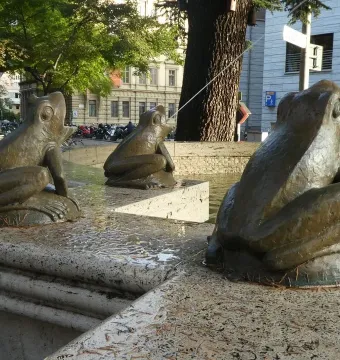
Fontana delle Rane is a monumental fountain in Bolzano, originally designed by sculptor Ignaz Gabloner and installed in 1930 in front of the city’s railway station. Its bronze frogs give the fountain its name, spraying long streams of water toward a large central basin made of stone and marble. The main basin is topped with bronze amphorae that release additional jets, and it is decorated with garlands and the city coat of arms. Heavily damaged during World War II air raids, the fountain was rebuilt after the war following the original design, with only minor changes. After being switched off and falling into disrepair in 2014, it was restored and turned back on in the summer of 2017.
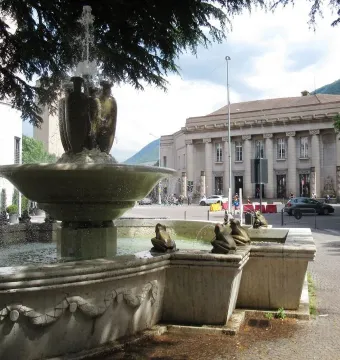
May 2024 © J.Broukal · CC BY 4.0
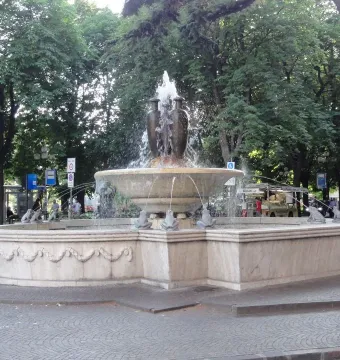
© User:Mattes · Public domain
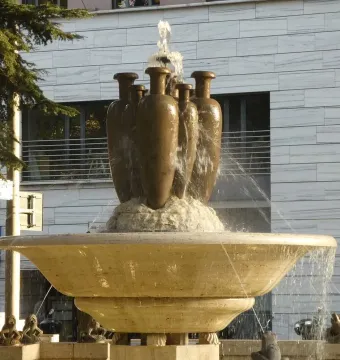
October 2024 © Rendor Thuces Al'Nachkar · CC BY-SA 4.0
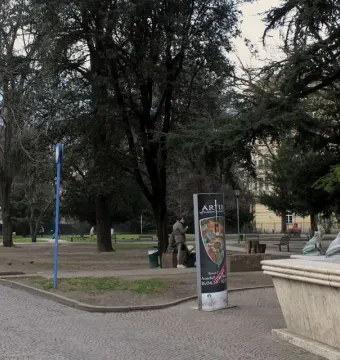
March 2015 © Vollmond11 · CC BY-SA 4.0
October 2024 © Rendor Thuces Al'Nachkar · CC BY-SA 4.0
Identification | |
| Title | Fontana delle Rane |
| Alternative names | Froschbrunnen; Fröschebrunnen; Fontana delle rane |
| Type | fountain |
Location and ownership | |
| Protection status | Placed under monument protection in 2021 |
| Location | Bahnhofsplatz, Bolzano, South Tyrol, Italy |
Historical context | |
| Original site | In front of Bolzano railway station, at the edge of the city park |
| Purpose | To enhance the station square and give it an urban character |
| Context | Connected to the redesign of Bolzano railway station completed in 1928 |
| Date inaugurated | August 1929 |
Creator | |
| Original design by | Francesco Rossi |
| Sculptural decoration by | Ignaz Gabloner |
| Construction executed by | Sicea construction company, Milan |
Discovery and provenance | |
| Built on the site of | An old excise house / customs house built in 1874 |
Physical characteristics | |
| Original central feature | A 10-meter-high fountain jet rose from the center of the upper basin |
| Lighting | 17 spotlights installed in the ground of the lower basin |
| Decorative figures | Twelve bronze frogs on the corners of the lower basin |
| Structure | Two fountain basins, with a lower basin and a higher second basin |
| Decorative elements | Nine bronze amphorae, garlands, and the city coat of arms |
Materials | |
| Materials | Bronze frogs and amphorae; artificial-stone basins; lower basin later clad in travertine |
Technique | |
| Water effect | Frogs spout water from their mouths into the upper basin; amphorae emit additional water jets |
Iconography and meaning | |
| Art-historical reference | In the tradition of the Latona Fountain in Versailles |
| Intended effect | The spray was meant to provide pleasantly noticeable cooling of the air around the fountain |
History and restoration | |
| Damage in World War II | Heavily damaged and then completely destroyed by a direct bomb hit on 29 March 1944 |
| Reconstruction | Rebuilt in 1955 according to the original design, with some small modifications, with the involvement of Ignaz Gabloner and Francesco Rossi |
| Reconstruction changes | Classical Latin inscriptions were removed; the names of Ignaz Gabloner and Francesco Rossi were placed again in inscriptions on the base of the upper fountain bowl |
| Later condition | Switched off in 2014 because of electrical system problems and fell into neglect |
| Restoration | Restored and switched back on in summer 2017; restored again in 2023 |
Significance | |
| Status | Considered a landmark of Bolzano |