
Fuente de la Abundancia
Fuente de la Abundancia, also known as the fountain of Plaza de la Cebada, was a fountain in Madrid located in that square. It was built in 1624 by the mason Pedro de Pedrosa and the stoneworker Martín Gortairy, following a design by architect Juan Gómez de Mora. The fountain was demolished on 27 March 1840 and replaced by another fountain, also now lost, by Juan Pedro de Ayegui. It appears in several engravings and in Manuel de la Cruz Vázquez’s painting La Feria de Madrid en la plaza de la Cebada. A drawing preserved in the National Library of Spain has been attributed by some authors to Alonso Cano, though Antonio Bonet Correa rejected that attribution.
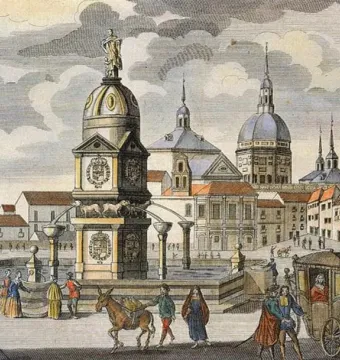
© Louis Meunier (ca. 1630-?) · Public domain
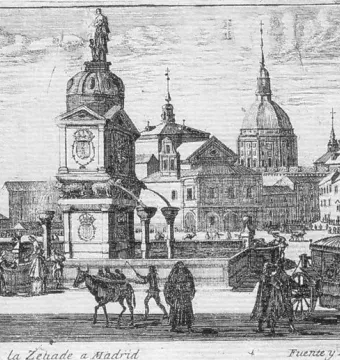
© Louis Meunier · Public domain
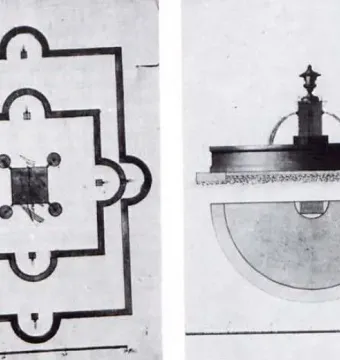
© Manuel del Olmo / Pedro Ayegui · Public domain
March 2014 © Jojagal · CC0
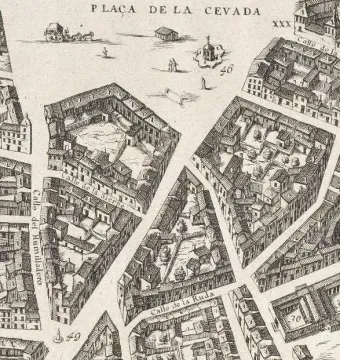
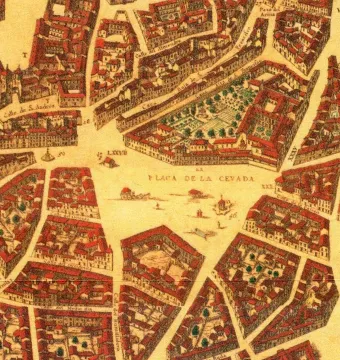
1656 © Pedro Teixeira Albernaz · Public domain
Identification | |
| Title | Fountain of Abundance |
| Type | Fountain |
| Alternative names | Fuente de la Abundancia; Fuente de la plaza de la Cebada |
Historical context | |
| Design date | 1616-1617 |
| Construction date | 1624 |
| Demolition date | 27 March 1840 |
| Replacement after demolition | Another fountain by Juan Pedro de Ayegui, now also disappeared |
Creator | |
| Later reconstruction contractor | Manuel del Olmo |
| Later restoration contractor | Jacinto de la Piedra; Pedro Rol |
| Builder | Pedro de Pedrosa and Martín de Gortayri |
| Designer | Juan Gómez de Mora |
Discovery and provenance | |
| Original location | Plaza de la Cebada, Madrid, Spain |
| Earlier location | In front of the convent of La Pasión of the Dominican order |
| Associated with | The palace of the Marquis of La Laguna |
| Designed for | Plaza de la Cebada, which was also known by the fountain's name |
| Water supply source | High Abroñigal water channel (Alto Abroñigal) |
| Water users | 15 water carriers (aguadores) |
| Water allocation | 7 to 8 reales de agua |
Physical characteristics | |
| Upper block | Structurally similar to the lower block, decorated with shields and topped with triangular pediments |
| Upper termination | Cylindrical neck topped by a half-sphere or dome |
| Top sculpture | A woman with a child |
| Bear figures | Four bears standing on the plinth, spouting water from their mouths |
| Lower block | Almost cubic, emerging from the water, with four shields on its faces |
| Form | Quadrangular fountain structure in three blocks, rising from a rectangular basin |
| Middle element | Narrow plinth acting as a ledge |
Materials | |
| Surviving figure material | Alabaster |
Technique | |
| Construction | Stonework and later rebuilding of the basin and enclosure |
Appearance | |
| Stylistic character | More sculptural than architectural |
| Influences | Herrerian influences with an early Baroque concession |
| Original design | Quadrangular classical temple with triangular pediments on each side, a dome, and a planned small obelisk finial |
| Final appearance | Slimmer structure on a stronger base, with masks carved instead of coats of arms in some later work |
| Decoration | Coats of arms alluding to Madrid and the Crown; four bears throwing water; large cups, censers, or funnels around the fountain |
Iconography and meaning | |
| Top figure meaning | Allegory of Abundance |
| Bear symbolism | Reference to one of the symbols of Madrid |
| Original finial | Small obelisk |
Location and ownership | |
| Modern replacement nearby | A molten-iron fountain inaugurated in 1999 near the former site at Calle de Toledo and Plaza de la Cebada |
| Current surviving part | Part of the fountain is preserved in La Fuentecilla fountain |
| Related fountain | La Fuentecilla fountain, a monumental fountain on Calle de Toledo built in 1815 as a tribute to Ferdinand VII |
History and restoration | |
| Basin reconstruction | The original basin was rebuilt in 1677 by Manuel del Olmo |
| Stone enclosure work | Stone enclosure around the fountain contracted on 18 January 1693 for 5,196 reales and completed in three months |
| 1754 restoration | Renovation of almost the entire fountain ordered in January 1754, contracted to Pedro Rol for 3,614 reales and completed in April 1754 |
| Demolition | Ordered by the City Council on 27 March 1840 |
| Fate after demolition | The whereabouts of the sculpture after the 1840 destruction are not well known |
| Reused elements in La Fuentecilla | Granite body, triangular pediments, and some coats of arms from the Fountain of Abundance were reused |
| Reused sculpture on La Fuentecilla | A lion with two globes symbolizing Spain's overseas possessions, rescued from the Convent of the Premonstratensians |
Significance | |
| Depictions | Shown in 17th- and 18th-century engravings, the Texeira map of 1656, and the painting La Feria de Madrid en la plaza de la Cebada by Manuel de la Cruz Vázquez |
| Drawing attribution | A drawing preserved at the National Library of Spain has been attributed to Alonso Cano, though Antonio Bonet Correa disputed this attribution as too early for Cano's style |
| Literary description | Pedro de Répide wrote that around the basin of this fountain the flower of the court's gallofa gathered in the sun |
| 19th-century descriptions | Pascual Madoz described the fountain as having two or four spouts depending on the period, and Pedro Felipe Monlau described it around 1850 as 'a pedestal with a jug' |