
George Armstrong Custer Equestrian Monument
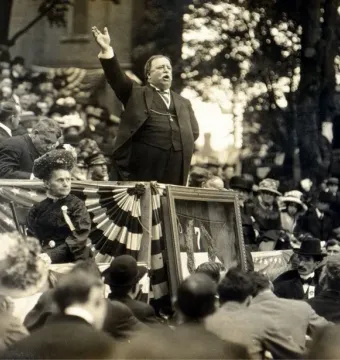
The George Armstrong Custer Equestrian Monument, also known as Sighting the Enemy, is a 1910 equestrian statue of General George Armstrong Custer in Monroe, Michigan. Sculpted by Edward Clark Potter, it shows Custer wearing his Civil War uniform, with his horse depicted in the conventional four-feet-on-the-ground pose. The statue was erected by the State of Michigan and dedicated by President William Howard Taft on June 4, 1910. It was later designated a Michigan Historic Site in 1992 and listed on the National Register of Historic Places in 1994. A rededication ceremony took place in 1955.
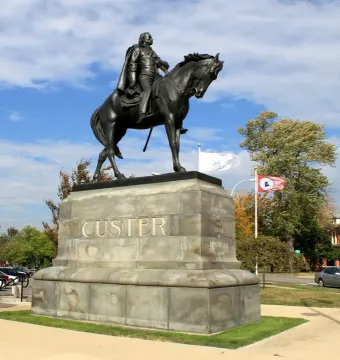
© Dwight Burdette · CC BY 3.0
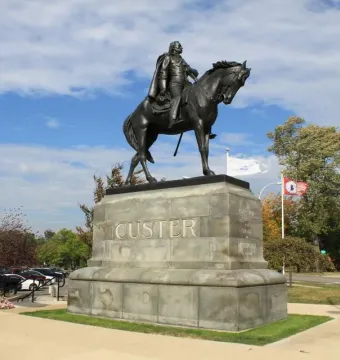
September 2010 © Dwight Burdette · CC BY 3.0
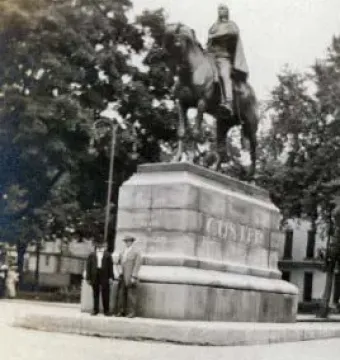
1912 © Gartner, Rudolph · Public domain
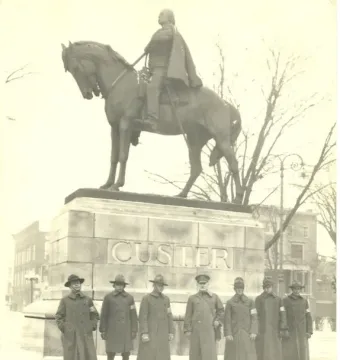
© Unknown Photographer (Little Bighorn Battlefield National Monument) · Public domain
1910 © Unknown authorUnknown author · Public domain
Identification | |
| Title | George Armstrong Custer Equestrian Monument |
| Type | Bronze equestrian statue |
| Alternative title | Sighting the Enemy |
Iconography and meaning | |
| Subject | George Armstrong Custer |
Historical context | |
| Commemorative focus | Custer's successful actions and distinguished service during the American Civil War, rather than his defeat and death at the Battle of Little Bighorn |
| Historical setting | Custer lived much of his childhood in Monroe, attended school there, and was later killed at the Battle of Little Bighorn on June 25, 1876 |
Creator | |
| Sculptor | Edward Clark Potter |
Discovery and provenance | |
| Dedication by | President William Howard Taft |
| Rededicated by | Members of the First Cavalry Division |
| Rededication date | September 3, 1955 |
| Dedication date | June 4, 1910 |
| Cost | $24,000 |
| Unveiled by | Elizabeth Bacon Custer |
| Dedicated by | President William Howard Taft |
| Unveiled | June 4, 1910 |
| Year created | 1910 |
| Commissioned and erected by | The State of Michigan |
Physical characteristics | |
| Height | 14 feet (4.27 m) |
Materials | |
| Material | Bronze |
Appearance | |
| Depicted form | George Armstrong Custer on horseback wearing his Civil War uniform |
| Horse pose | The horse has all four feet on the ground, following sculptural convention |
Location and ownership | |
| Current location | Southwest corner of Elm Avenue and North Monroe Street along the River Raisin in Monroe, Michigan |
| Original location | Middle of the brick-paved intersection of First and Washington streets in front of the courthouse in Monroe, within the present-day Old Village Historic District |
| First relocation | June 20, 1923, to Soldiers and Sailors Park along the River Raisin |
| Second relocation | August 1955, to the southwest corner of Elm Avenue and North Monroe Street |
| Current site significance | One of Monroe's most important intersections and one of the city's most recognizable objects |
| Nearby historic districts | Across Elm Street from the St. Mary's Church Complex Historic District and adjacent to the East Elm-North Macomb Street Historic District |
History and restoration | |
| Public reaction | The monument has attracted protests and opposition because of Custer's participation in total war against Native Americans |
| Likelihood of removal | Removal is considered unlikely because there is no local public support and no support from the city council |
| May 2021 resolution | The United Tribes of Michigan unanimously approved a resolution calling for removal of the statue in Monroe, Michigan |
| First relocation setting | Traffic was light in Monroe when first erected, but automobile traffic was increasing significantly |
| Condition before second relocation | Workers initially could not find the statue because it was covered in vegetation |
| Condition at first relocation site | It remained in relative isolation and was eventually obscured by brush and uncared-for trees |
| Relocation reasons | Elizabeth Custer argued the statue deserved a better location, and residents complained it was a traffic hazard as automobile traffic increased |
Other | |
| Associated person | Elizabeth Bacon Custer |
| Associated place | Monroe, Michigan |
| Associated river | River Raisin |