
Bailey Fountain
Bailey Fountain is an outdoor sculpture in Grand Army Plaza, Brooklyn, New York City, at the site of three 19th-century fountains. The bronze fountain was created in 1932 and funded by philanthropist Frank Bailey as a memorial to his wife, Marie Louise Bailey. It was renovated in 1956 and again in 2005–06. After thefts in 1974, some sculpture elements were stored for safekeeping. The Art Deco design features six monumental figures: Wisdom and Felicity at the top, a child supporting a cornucopia, the Greek mythological figure Nereus, and two Nereids emerging from the water and blowing conch shells.
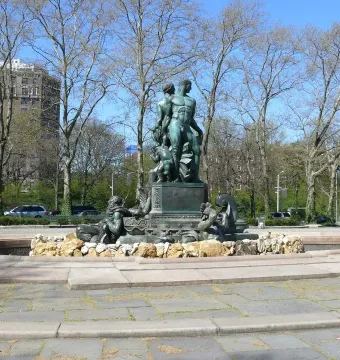
April 2012 © Ad Meskens · CC BY-SA 3.0
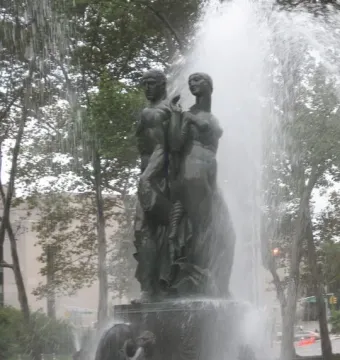
© Jim.henderson · CC BY-SA 3.0
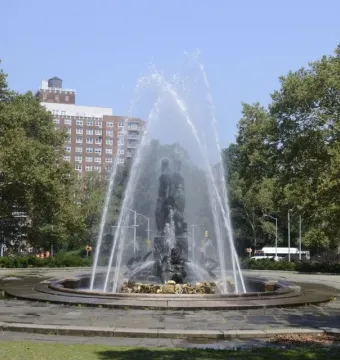
August 2017 © Opencooper · CC0
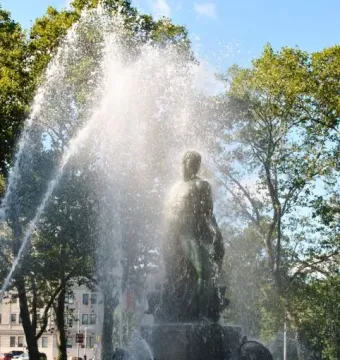
© Elisa.rolle · CC BY-SA 3.0
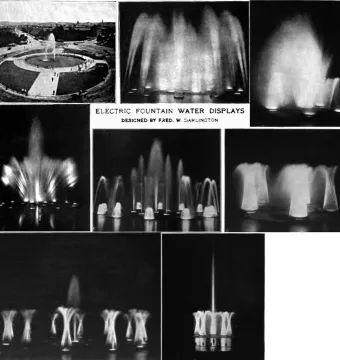
1900 © Albert Kelsey, editor · Public domain
Identification | |
| Title | Bailey Fountain |
| Alternative name | Electric Fountain |
| Original-language name | Fuente Bailey |
| Type | Outdoor sculpture; fountain |
Historical context | |
| Site | Site of three 19th-century fountains |
| Year built | 1897 |
| Year of earlier version | 1873 |
| Replaced | the 1873 fountain |
| Earlier fountain replaced | the 1867 fountain |
Creator | |
| Designer | Fredric W. Darlington |
| Earlier designer | Calvert Vaux |
| Manufacturer | Wilson & Baillie Manufacturing |
| Consulting engineer | C. C. Martin |
Discovery and provenance | |
| Landscape architect placement | Frederick Law Olmsted placed the fountain at the intersection of two broad paths arranged as a Georgian cross within grassy, treeless quadrants |
| Design presented | May 1897 to the Park Commission |
| Initial design plan | a single spout |
| Dedicated as memorial to | Marie Louise Bailey, his wife |
| Funded by | Philanthropist Frank Bailey |
Physical characteristics | |
| Structure | two-tiered, double-domed fountain |
| Dome diameter | 37.2 feet (11.4 m) |
| Composition | six monumental figures |
Materials | |
| Material | bronze |
| Materials | cast iron and molded sections of Beton Coignet |
Technique | |
| Incandescent lamps | 88 incandescent lamps on the inner edge of the concrete basin coping |
| Viewing windows | three closely spaced windows in the basin wall above the pool surface |
| Control room | an underground control room at the south of the basin |
| Nozzle placement | many nozzles were around the lamp housings |
| Nozzle types | umbrellas, ball sprinklers, sheaves of wheat, rings, fans, funnels, and pinwheels |
| Nozzles | about 2,000 nozzles |
| Colored glass | interchangeable colored gel discs projected light toward water jets |
| Underwater lighting housings | lights extended in glass cylinders projecting through the underwater roof |
| Lamp arrangement | placed in concentric rings around a central light |
| Lamp adjustment | each lamp could move within silvered parabolic reflectors to narrow or widen the 19 beams |
| Lighting circuits | 3 series circuits for dimming |
| Searchlights | 6,000-candlepower automatic focusing arc lamps |
| Water recirculation | the fountain did not recirculate or reuse the water |
| Water supply | a pump directed up to 100,000 gallons per hour into the pool from public water mains |
| Water pumping capacity | 60,000 gallons per hour |
| Lighting | gaslights in the dome visible through one of 24 colored glass windows; additional gaslights mounted in the guardrail illuminated the pool surface |
Appearance | |
| Style | Art Deco |
| Top figures | a man representing Wisdom and a woman representing Felicity |
| Wisdom figure attribute | left hand on the tiller steering the ship of Life |
| Felicity figure attribute | left hand holding a cornucopia |
| Lower figures | a chubby standing child helping to shoulder the cornucopia; Nereus |
| Side figures | two Nereids |
| Nereids depiction | upper torsos emerging from the water, heads thrown back as they trumpet with conch shells, fish tails twisting in the background |
Iconography and meaning | |
| Mythological references | Wisdom, Felicity, Nereus, Pontus the Sea, Gaia the Earth, Nereids |
| Subject matter | Ship of Life imagery |
Location and ownership | |
| Location | Grand Army Plaza, Brooklyn, New York City, United States |
| Surroundings | set within grassy, treeless quadrants |
| Electricity donors | the Brooklyn Heights and Nassau Electric railroads |
History and restoration | |
| Renovation years | 1956; 2005-06 |
| Condition in the 1890s | the fountain leaked and frequently ran dry |
| Criticism | the Brooklyn mayor criticized the fountain's water use |
| Incident | a child drowned in the fountain in June 1895 |
| First exhibition scheduled | 4 July 1897 |
| First exhibition delayed until | 7 August 1897 |
| Attendance at first exhibition | 100,000 people |
| Operation | controlled by 2 operators during scheduled night exhibitions on Wednesdays and Saturdays |
| Audience size | up to 30,000 people |
| Removal year | 1915 |
| Removal cause | construction of the IRT Eastern Parkway Line and BMT Brighton Line under the plaza left no space for the required infrastructure |
| Post-1974 status | after the 1974 thefts, some sculpture elements were stored for safekeeping |