
Monument to Nicola Demidoff, Florence
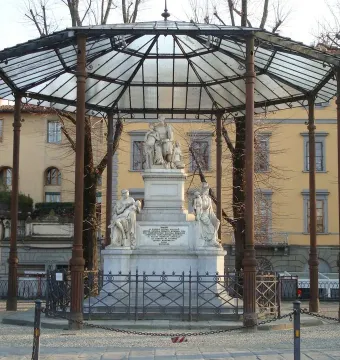
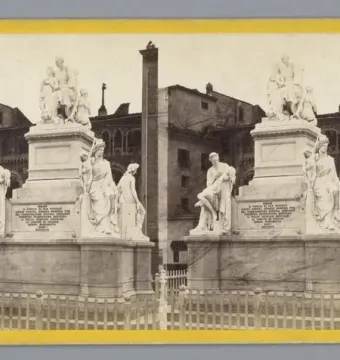
The Monument to Nicola Demidoff is a marble sculptural group by Lorenzo Bartolini, later completed with some variants by Pasquale Romanelli. Commissioned in 1830 by Paolo and Anatolio Demidoff in memory of their father Nicola, it was conceived for an indoor setting and eventually installed in Piazza Demidoff in Florence. The work was largely finished by 1850 and inaugurated in its new location in 1871, after the city accepted the donation and arranged the square as a garden. Because of its delicate materials, the monument has repeatedly required protective structures and restoration campaigns, including major work completed in 2023.
March 2010 © Cymbella · CC BY-SA 3.0
April 2008 © Yair Haklai · Attribution
© Rijksmuseum · CC0
© G.dallorto · Attribution
© G.dallorto · Attribution
Identification | |
| Title | Monument to Nicola Demidoff |
| Subject | Nicola Demidoff (Nikolai Nikitich Demidov, 1773–1828), also known as Count Demidov |
| Alternative title | Monument to Niccolò Demidoff / Monument to Nikolaj Demidov |
| Type | Monument; outdoor sculptural group |
Historical context | |
| Century | 19th century |
| Purpose | Memorial to Nicola Demidoff, commissioned by his sons in memory of their father |
| Initial project | Begun as an outdoor monument, then changed in 1837 to a mausoleum-like indoor arrangement |
| Date | Designed from 1830; completed in 1850s; inaugurated on 7 December 1871 |
Creator | |
| Architectural design | Giuseppe Martelli |
| Assembly assistance | Luigi Del Sarto |
| Completion | Completed by Pasquale Romanelli after Bartolini's death |
| Artist | Lorenzo Bartolini |
Discovery and provenance | |
| Commissioned by | Paolo Demidoff and Anatolio Demidoff |
| Original intended location | An open-air square in the park of the Demidoff villa at San Donato |
| Planned location after project change | A square chosen by Paolo Demidoff in Florence, in an area associated with the Demidoff family and their philanthropic activities |
| Donated to Florence | 1869, by Paolo Demidoff, Anatolio Demidoff's heir |
| Commissioned in | 1830 |
Location and ownership | |
| Current location | Piazza Demidoff, Florence, Tuscany, Italy |
| Setting | Piazza Demidoff, between Lungarno Serristori and Via dei Renai, on the southern bank of the Arno in the San Niccolò area of the Oltrarno; the square was landscaped as a public park by Giuseppe Poggi |
| Associated residences | Linked to the Demidoff family by the nearby Palazzo Demidoff Amici and former Palazzo Serristori; the family also had an institute at Via San Niccolò 30 |
Physical characteristics | |
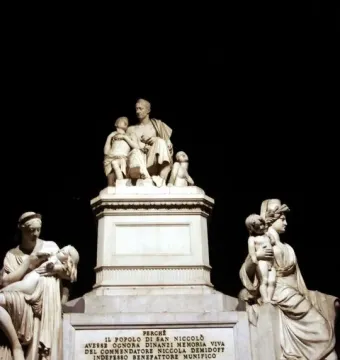
| Corner groups | Mercy (or Charity); Siberia with Pluto; the Muse of Festivities; and Truth (or Nature) revealing herself to Art |
| Condition | The monument is delicate and easily damaged by weathering, pollutants, and vandalism; the child in the northwest corner group has lost a marble arm |
| Additional relief subject | The death of Nicola Demidoff |
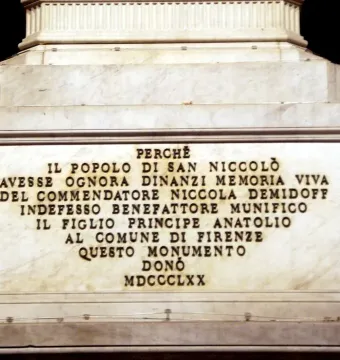
| Decorative elements | Low-relief sculptures on the plinth, an inscription, and the Demidoff coat of arms at the rear |
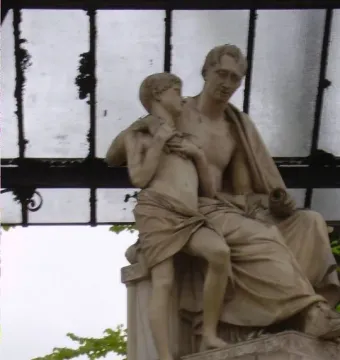
| Main group | Nicola Demidoff embracing his son Anatolio, with Gratitude beside them |
| Base | Square base with a high plinth |
| Form | Complex monument with five sculptural groups arranged on a square base and high plinth |
Materials | |
| Main material | "Zuccherino" marble |
| First version material | Ravaccione marble |
| Covering material | Glass cover with a cast-iron frame; an earlier temporary protective structure was wood and sheet metal |
Technique | |
| Material origin | Zuccherino marble from the Bettogli quarries |
| Plinth technique | Low relief |
Appearance | |
| Style | Still influenced by academic tradition, with neoclassical funerary and celebratory references |
| Stylistic references | Related to Bartolini's Fiducia in Dio and the Donati, and to the modeling of Gratitude and Truth revealing herself to Art |
Iconography and meaning | |
| Symbolism | The corner groups personify Mercy, Siberia, festive celebration, and Truth/Nature revealing herself to Art; Siberia refers to Demidoff's fortune from Siberian mines |
History and restoration | |
| Project change | Changed in 1837 to a true mausoleum with the monument placed inside an enclosed space |
| Models | Two models of the complex survive: one in alabaster at the Civic Museum of Prato and one in marble dated 1840 at the Galleria d'Arte Moderna, Palazzo Pitti |
| Construction and completion | The main group was completed by 1836; the statues were nearly finished at Bartolini's death in 1850 |
| Protection history | After criticism in 1874 a temporary wood-and-sheet-metal shelter was erected; a new protection project was drawn up in 1899 by Cesare Spighi; the current glass-and-cast-iron cover was installed in 1912 and cast by Officina del Pignone |
| Restoration | Restored at various times, including a late-1950s campaign directed by Umberto Fabbrini with Paride Bernucci, campaigns in 1976–1978 and 2002, and a restoration campaign that began in 2021 and ended in August 2023 |
| Previous interventions | The sculpture bears numerous plaster and cement fillings, especially on the figure of Truth unveiling herself to Art |
| Vandalism | In June 2018 the monument was vandalized; bird-deterrent devices were removed and the head of Pluto was smashed |
| Recent condition | It was fenced off for a long time in 2011, enclosed by scaffolding in 2012 for cover restoration, and again enclosed by scaffolding after the 2018 vandalism |
| Documentation | The monument is supported by rich photographic documentation and plaster models preserved in the Galleria dell'Accademia di Firenze (Bartolini gipsoteca); it has also been the subject of scientific analyses and research |
Significance | |
| Historical documentation | Discussed in contemporary notices in La Nazione and in later studies on Bartolini and Florentine monuments |