
Baal with Thunderbolt
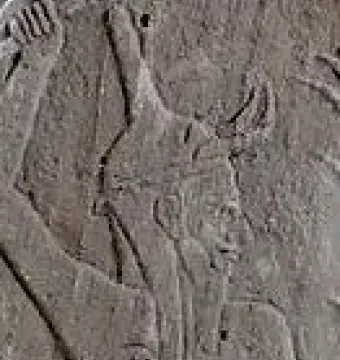
Baal with Thunderbolt, also known as Baal with Vegetation Spear or the Baal stele, is a white limestone bas-relief stele from the ancient kingdom of Ugarit in northwestern Syria. Discovered in 1932 during excavations at the Temple of Baal in Ugarit’s acropolis, it depicts Baal, or Hadad, the god of storm and rain and also agriculture, alongside a smaller male figure. Its artistic style has been described as blending Egyptian and Syrian elements, and historian Nicolas Wyatt saw it as evidence of the importance of Egyptian influence in Syrian art. It is considered the most important of the Ugaritic stelæ and is displayed at the Louvre in Paris.
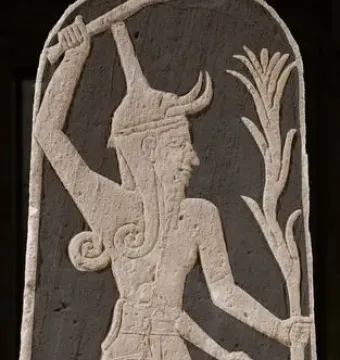
November 2012 © TYalaA · CC BY-SA 4.0
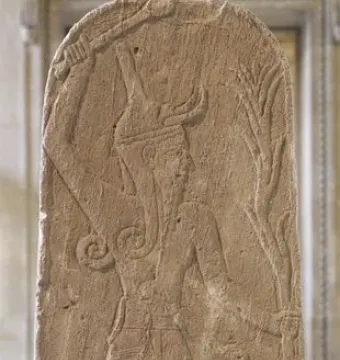
January 2026 © Shonagon · CC0
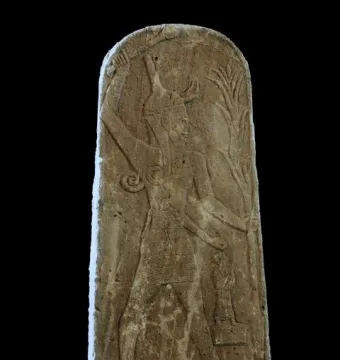
October 2007 © Rama · CC BY-SA 2.0 fr
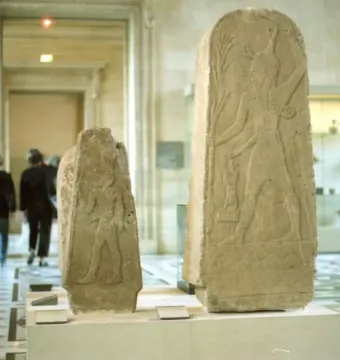
© Rama · CC BY-SA 3.0 fr
June 2011 © Jastrow · CC BY-SA 3.0
Identification | |
| Title | Baal with Thunderbolt |
| Object type | Stele |
| Alternative names | Baal with Vegetation Spear; the Baal stele; Stèle du Baal au foudre |
Physical characteristics | |
| Shape | Arched, wider at the base |
Materials | |
| Material | White limestone |
Historical context | |
| Religious significance | Baal was one of the most important gods of the Levant |
| Origin | Ancient kingdom of Ugarit, northwestern Syria (present-day northwest Syria) |
| Mythological background | Ugaritic texts from Ras Shamra describe Baal's battles against Mot, god of death and drought, and against Yam, god of the sea |
Discovery and provenance | |
| Original location | Probably inside the Temple of Baal |
| Excavation director | Claude F. A. Schaeffer |
| Discovery place | Near the Temple of Baal in the acropolis of Ugarit (Ras Shamra), on its southern slope |
| Discovery date | 1932 |
Location and ownership | |
| Current location | Louvre Museum, Paris |
Iconography and meaning | |
| Weapon at belt | Curved dagger in a sheath at the belt |
| Historical interpretation | Nicolas Wyatt identified the work as illustrating the importance of Egyptian influence in Syrian art |
| Interpretation | The king humbly submits to Baal and receives the god's protection; the size difference contrasts divine power with the king's weakness |
| Symbolism | The horned helmet and thunderbolt represent fertility; the tree-like spear symbolizes lightning and the benefits of rain |
| Additional figure | A much smaller male figure, probably the king of Ugarit, standing on a horned altar/pedestal and praying in ceremonial dress |
| Pedestal decoration | Carved mountains and sea, or wavy lines possibly symbolizing mountains and sea |
| Main figure stance | Standing on a large pedestal |
| Clothing | Striped kilt or loincloth with a wide belt |
| Hair | Braided hair with long locks falling over the back, right shoulder, and chest |
| Headgear | Horned helmet / high horned headdress |
| Main figure gesture | Right hand raised brandishing a club or battle-mace; left hand holding or planting a thunderbolt/spear into the ground |
| Main figure orientation | Facing right |
| Main figure position | Center of the stele |
| Depicted figures | Two standing male figures |
| Depicted deity | Baal (or Hadad), the Semitic/Canaanite god of storm and rain, and agriculture |
Appearance | |
| Artistic style | Blends Egyptian and Syrian artistic elements |
| Figure characterization | Baal is portrayed as a vigorous, young, graceful, athletic deity marching forward |
Significance | |
| Significance | Considered one of the most important Ugaritic stelae discovered |