
Alunda Moose
The Alunda Moose is a 15 cm-long prehistoric Swedish stone sculpture from the Neolithic. Found in Norrlövsta near Alunda in Uppland, it is made of black-green rock and is fully polished. One end shows a naturalistically shaped animal head, while the other has an implied axe blade and the corresponding shaft hole. The slender head with upright ears is that of a cow moose. Although it was not an axe, the object may have served as a symbol of status or a totem connected to the animal it depicts. It likely was not made in Sweden and belongs to a wider group of axe-shaped stone objects associated with eastern Nordic cultural contexts.
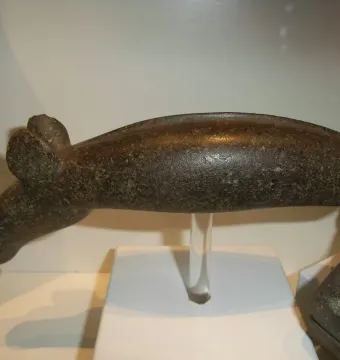
June 2009 © Notafly · CC BY-SA 3.0
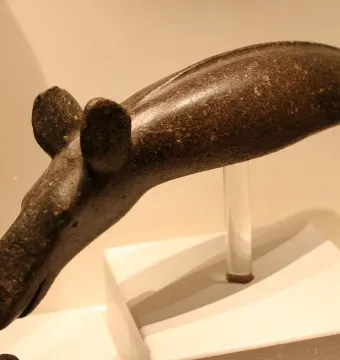
August 2019 © Ronny Ueckermann · CC BY-SA 4.0
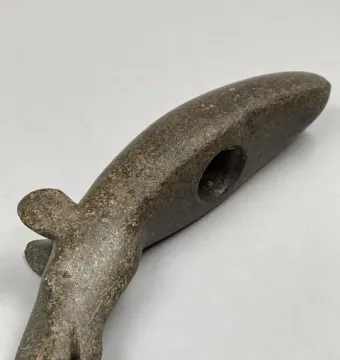
September 2023 © Kalmring, Sven, SHM · CC BY-SA 4.0
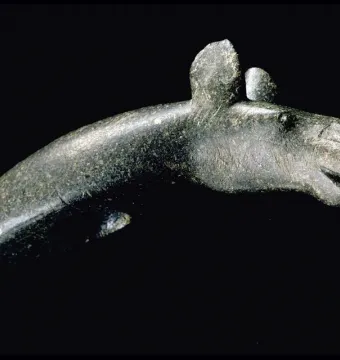
September 2010 © The Swedish History Museum, Stockholm · CC BY 2.0
Identification | |
| Name | Alunda moose |
| Alternative names | Alunda elk; Alunda axe |
| Object type | Prehistoric stone sculpture; stone axe |
Historical context | |
| Related Finnish sculpture makers | Hunters |
| Related Finnish sculpture date | Around 7000 BC |
| Related Finnish sculpture | The oldest soapstone sculpture in Finland, from the Stone Age settlement of Palojoki in Vittis |
| Another comparable object location | Huittinen, southern Finland |
| Comparative artifact findspot | Šventoji near Palanga, Lithuania |
| Comparative artifact date | 3rd millennium BC |
| Comparative artifact | A ritual staff made of antler with a similarly beautiful moose head |
| Rock art reference | At Nämforsen in Näsåker, northern Sweden, rock carvings show people carrying staffs with moose heads |
| Comparative context | Should be viewed in the same cultural-historical context as animal-headed daggers and North Scandinavian rock art |
| Distribution of related tools | Central and western Finland, Karelia, and the area between Lake Ladoga and Lake Onega |
| Related object type | Part of the group of axe-shaped stone tools known as 'Norrbottnian implements' |
| Related cultural style | Typical of groups of the northern coniferous forest belt |
| Cultural period | Nordic Neolithic |
| Date | c. 2500 BC |
Creator | |
| Maker | Hunters |
Discovery and provenance | |
| Discovery date | 1920 |
| Discovery context | Found during the excavation of a ditch |
| Discovery location | Norrlövsta in Alunda parish, Östhammar Municipality, Uppland, Sweden |
| Findspot region | Uppland |
| Likely place of manufacture | Possibly Karelia; probably not made in Sweden |
Physical characteristics | |
| Boring / shaft hole | Partially bored through from below, about halfway |
| Shape | Arched, curved |
| Length | 21 cm |
| Animal depicted | Moose (elk), specifically a cow |
| Finish | Fully polished |
| Description | One end is shaped as a naturalistic moose head; the other end suggests an axe blade with a hafting hole |
| Style | Naturalistic and elegant |
Materials | |
| Material | Greenish black diorite |
| Related material | Black-green rock |
Technique | |
| Working | Fully polished |
| Manufacture | Conically drilled from below; only partially bored through |
Iconography and meaning | |
| Interpretation | Possibly a symbol of dignity or a totem for supernatural connection with the depicted animal species |
| Function | Ceremonial axe with a symbolic function; not used as a practical axe or in battle |
Significance | |
| Assessment | Considered one of the most beautiful animal sculptures of the Nordic Neolithic |
Location and ownership | |
| Current location | Swedish History Museum |