
Double-sided Mithraic Relief
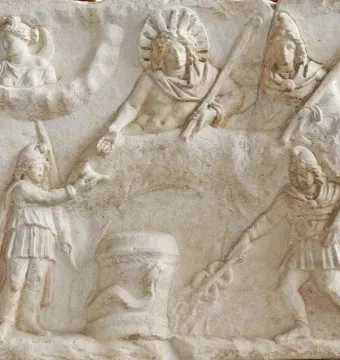
The Double-sided Mithraic Relief, also known as the Mithras of Fiano Romano, is a marble bas-relief dated to the 2nd or 3rd century AD. It depicts typical scenes from the cult of Mithras and is preserved today at the Louvre in Paris. The quadrangular relief is made of marble on a travertine base and is notable for the high quality of its workmanship, which is considered superior to that of usual Mithraic sculptures. Because of its completeness, symbolic complexity, and excellent preservation, it is regarded as one of the finest surviving examples of Mithraic art.
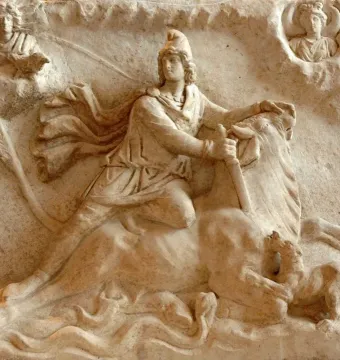
2006 © Jastrow · Public domain
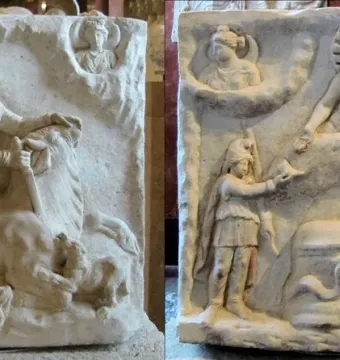
© Unknown artistUnknown artist · CC BY-SA 3.0
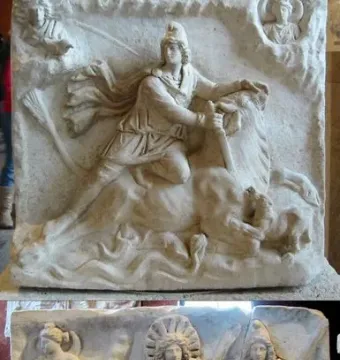
© Unknown artistUnknown artist · CC BY-SA 3.0
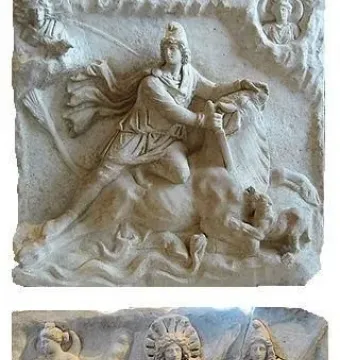
2010 © User:PHGCOM, 2006 · GFDL
· Public domain
Identification | |
| Title | Double-sided Mithraic Relief |
| Italian name | Mitra di Fiano Romano |
| Type | bas-relief |
| Object type | bas-relief |
| Alternative name | Mithras of Fiano Romano |
Iconography and meaning | |
| Subject | Typical scenes of the cult of Mithras |
Historical context | |
| Date | Between the 2nd and 3rd century AD |
| Historical period of Mithraism | From the 1st century BC to the 4th century AD |
| Historical significance of Mithraism | Very widespread and significant in the Roman Empire |
Creator | |
| Dating attribution | Dated by Franz Cumont |
Discovery and provenance | |
| Intentional concealment | It appears to have been intentionally hidden to protect it from the outrages of the enemies of paganism |
| Previous owner | Franz Cumont |
| Museum acquisition date | 1939 |
| Original find context | Found lying in a small brick container |
| Discovery context | Found during an archaeological research and excavation campaign |
| Discovery date | 1926 |
| Discovery location | Fiano Romano, Italy |
Location and ownership | |
| Current location | Musée du Louvre, Paris, France |
| Current department | Department of Greek, Etruscan and Roman Antiquities |
| Catalog number | MA 3441 |
Physical characteristics | |
| Thickness | 23 cm |
| Width | 68 cm |
| Height | 61 cm |
| Depicted on both sides | Yes |
| Shape | Quadrangular |
Materials | |
| Material | Marble |
| Base material | Travertine |
History and restoration | |
| Preservation state | Very well preserved, apparently because it had been hidden |
Significance | |
| Artistic quality | Very high, far superior to that of usual Mithraic sculptures |
| Assessment of the sculpture | Considered one of the best examples because of its completeness, complexity of symbolism, artistic quality, and excellent state of preservation |
| Evaluation by Franz Cumont | An exceptional representation that distinguishes it from ordinary images of the god of the tauroctony |
Other | |
| Specific example mentioned | The Mithra of Fiano Romano |