
General of Tivoli
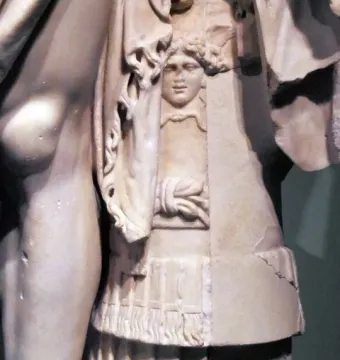
General of Tivoli is a Roman marble sculpture, 118 cm high, dating from between 90 and 70 BC. It is currently preserved in the National Roman Museum at Palazzo Massimo in Rome. The statue was discovered in 1925 among the ruins of the Temple of Hercules in Tivoli. It belongs to the Italic realist tradition of the Republican period, portraying a mature man with deep facial wrinkles in heroic nudity. The figure represents a Roman army general draped in a mantle and supported by a cuirass at his feet, decorated with a Gorgoneion. The work combines Italic verism with late Hellenistic stylistic features.
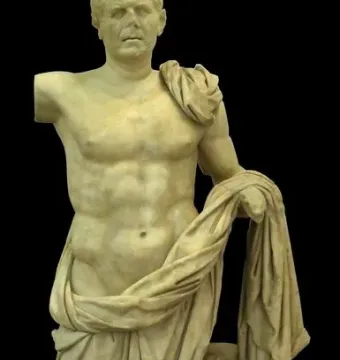
January 2010 © Alphanidon · CC BY-SA 3.0
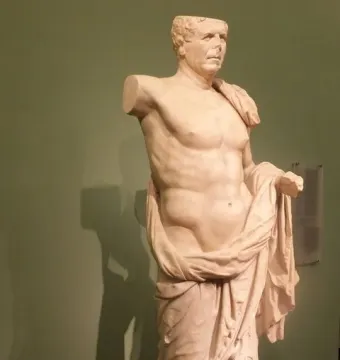
June 2014 © Amphipolis · CC BY-SA 2.0
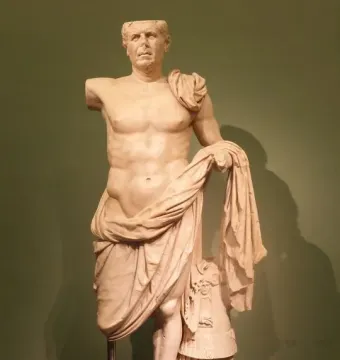
June 2014 © Amphipolis · CC BY-SA 2.0
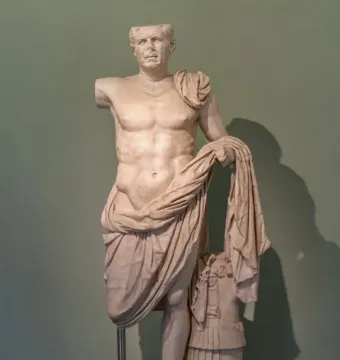
November 2024 © Fabrizio Garrisi · CC0
November 2013 © MM · CC BY-SA 4.0
Identification | |
| Title | General of Tivoli |
| Original title | Generale da Tivoli |
| Type | Statue |
| Subject | A Roman army general |
Historical context | |
| Date | Between 90 and 70 BC |
| Period | Republican era |
Creator | |
| Interpretation by Henri Stierlin | The statue may represent the consul Caius Marius, founder of the Temple of Hercules Victor at Tivoli |
Discovery and provenance | |
| Discovery date | 1925 |
| Discovery location | Among the ruins of the Temple of Hercules in Tivoli |
Physical characteristics | |
| Height | 188 cm |
| Condition | Missing the upper part of the head, the right shoulder and arm, and the right leg below the knee |
Materials | |
| Material | Marble |
Technique | |
| Stylistic tradition | Italican realist current of the Republican period combined with late Hellenistic currents |
Appearance | |
| Figure type | Heroized figure |
| Pose and clothing | Wrapped in a toga or mantle descending from the left shoulder to the hips |
| Support element | Supported by a cuirass placed at his feet |
| Armor decoration | Gorgoneion at the center |
| Possible original attribute | Probably leaning on a spear held in the right hand |
| Facial expression | Deep wrinkles on the forehead, small sunken eyes, open mouth |
| Head position | Slightly inclined toward the right shoulder |
| Body type | Powerful musculature |
| Character conveyed | Extremely strong and resolute |
Location and ownership | |
| Current location | National Roman Museum, Palazzo Massimo, Rome |