
Monument to Viriato, Zamora
Monument to Viriato, Zamora is a sculptural work by the Zamora-born artist Eduardo Barrón González, located in Viriato Square in Zamora, Spain. It depicts the shepherd-chieftain Viriato in bronze, confronting the Roman consuls. The monument was erected at the end of 1903 in a square then known as Cánovas del Castillo, which later came to be popularly called Viriato Square. The ensemble consists of an upright statue, a granite pedestal, and a fence. An inscription on the pedestal reads Terror romanorum, attributed to Orosius, meaning “Terror of the Romans.” Twenty years passed between the sculpture’s execution and its installation in the square.
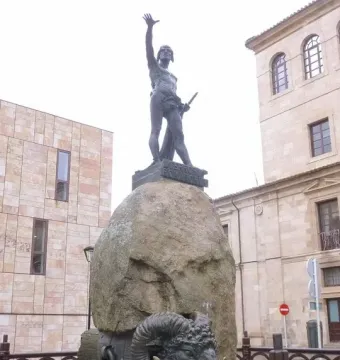
December 2016 © Zarateman · CC0
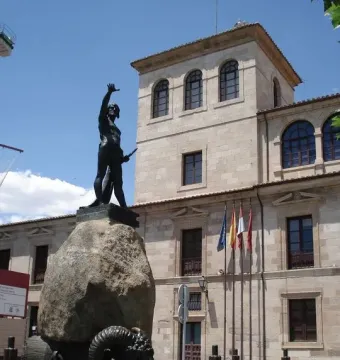
May 2009 © Jomajima · Public domain
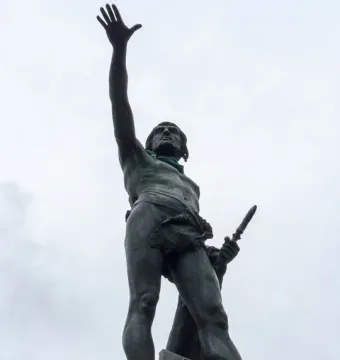
August 2013 © Turol Jones, un artista de cojones · CC BY 2.0
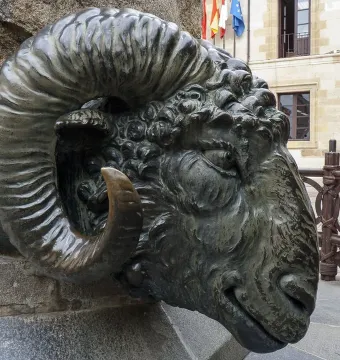
August 2013 © Turol Jones, un artista de cojones · CC BY 2.0
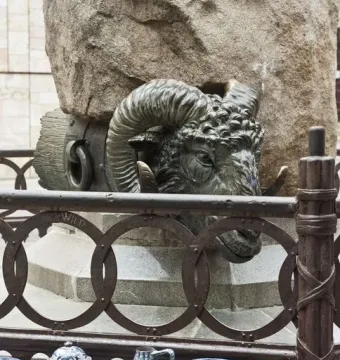
June 2012 © Javierlparada · CC BY-SA 3.0
Identification | |
| Title | Monument to Viriato, Zamora |
| Type | Sculptural ensemble |
| Subject | Viriato (Viriathus) |
Historical context | |
| Date | Executed in 1883; erected in late 1903 / at the end of 1903; unveiled by passers-by on 12 January 1904 |
| Purpose | Originally intended for the National Exhibition of Fine Arts of 1884; later promoted as a public monument for Zamora in gratitude for a scholarship funded by the Provincial Council of Zamora in Rome |
Creator | |
| Sculptor | Eduardo Barrón González |
| Sculptor's origin | Zamora |
Discovery and provenance | |
| Reduction | A bronze reduction made in 1885 is in the Museum of Zamora, Sala de la Ciudad; another reduction is owned by the Museum of Romanticism, Madrid |
| Acquisition date | Since 1971, when the Museo del Prado absorbed the collections of the Museum of Modern Art |
| Current custody | On deposit with the City Council of Zamora |
| Inventory number | E612 |
| Award | Silver medal |
| Current owner | Museo del Prado |
| Exhibited at | National Exhibition of Fine Arts of 1884; plaster model shown at the Museum of Modern Art, and the original at the Royal Academy of Fine Arts |
| Bought by | The Spanish State |
| Inscription on base | "El Barrón" and "Roma 1883" |
| Cast at | Alessandro Nelli's workshops in the Vatican, Rome |
Physical characteristics | |
| Components | Standing bronze statue, granite pedestal, fence, and a battering ram at the base |
| Figure height | 2 metres |
| Figure posture | Standing, almost naked, full-body figure with right arm extended as if rallying troops |
| Arm and hand position | Left forearm holds a tunic and the left hand grasps a sheathed sword |
| Patina | Green |
Materials | |
| Pedestal origin | Made from a granite block from , one of the claimed birthplaces of Viriathus |
| Pedestal material | Granite |
| Additional bronze element material | Bronze |
| Figure material | Bronze |
Technique | |
| Cast date | 1903 |
| Pedestal transport | Brought from the Arcillo quarries in two pieces by ox-drawn cart |
Appearance | |
| Sword hilt | The sword handle is unusually long and has prompted phallic interpretations from certain angles, especially in photographs taken from the plaza's cobblestone pavement |
| Battering ram | A bronze battering ram emerges from the front side of the granite block |
Inscription and meaning | |
| Pedestal inscription | Terror romanorum |
| Inscription attribution | Attributed to Orosius |
| Inscription meaning | "Terror of the Romans"; an epithet for Viriathus in Orosius' chronicles |
Location and ownership | |
| Current position within square | One of the corners |
| Original position within square | Center of the square |
| Square later name | Viriato Square |
| Original site within city | The square in front of the Palace of the Counts of Alba and Aliste |
| Square former name | Cánovas del Castillo Square |
| Location | Viriato Square, Zamora, Spain |
History and restoration | |
| Installation | Placed at the end of 1903 |
| Official inauguration | Never officially inaugurated |
| Public unveiling | Noticed by passers-by on 12 January 1904 |
| Relocation | Moved about 6 meters west during remodeling works in 1971; plane trees were planted in its former place |
| Public reception | The pedestal was heavily criticized in the early 2000s and compared to a "castaña pilonga" (a dried chestnut) |
Significance | |
| Historical reference | Viriato confronted the Roman consuls |
| Political interpretation | The posture was interpreted as a Roman salute and later embraced by the Falange during the Francoist dictatorship |
| Status | Considered a symbol of modern-day Zamora |