
Diptych of Stilicho
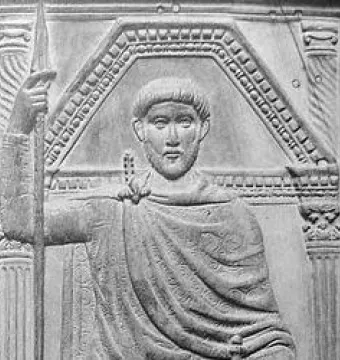
The Diptych of Stilicho is a consular diptych made around the year 400 for Stilicho, magister militum of Emperor Honorius. It is preserved in the Treasury of Monza Cathedral, where it was donated by King Berengar I around 900. The work consists of two ivory panels, probably made by Milanese craftsmen for Stilicho’s first consulship. It depicts Stilicho, his wife Flavia Serena, and their son Eucherius standing frontally in a solemn, highly idealized composition. Stilicho appears armed with a spear and shield, while Serena wears Roman matron dress and Eucherius holds the writing tablet he received as a notary.
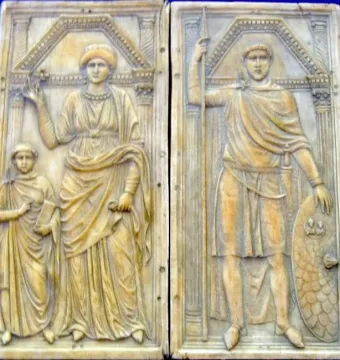
June 2006 © User:Bullenwächter · CC BY-SA 3.0
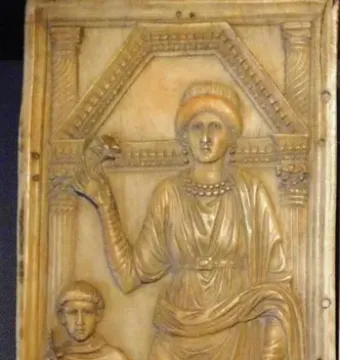
April 2017 © User:O.Mustafin · CC0
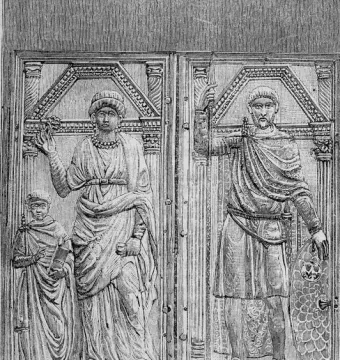
1891 © Unknown authorUnknown author · Public domain
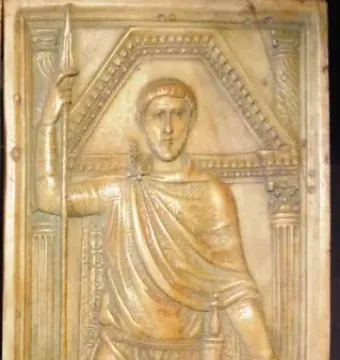
April 2017 © User:O.Mustafin · CC0
1932 © Marsyas · Public domain
Identification | |
| Title | Diptych of Stilicho |
| Type | consular diptych |
Historical context | |
| Date | around AD 400 |
| Period | Late Imperial period |
| Artistic style | So-called Theodosius Renaissance, a classicizing revival connected with the restauratio of the golden age of the empire under Theodosius |
| Original function | Consular gift offered by consuls on the occasion of their installation |
| Commissioned for | Stilicho's first consulship |
Creator | |
| Possible workshop origin | Possibly made by Milanese craftsmen |
Discovery and provenance | |
| Donation | Donated to the Treasury of the Cathedral of Monza by King Berengar I around AD 900 |
Location and ownership | |
| Current location | Treasury of the Cathedral of Monza |
Materials | |
| Material | Carved ivory panels with a wooden interior coated with wax for writing |
Technique | |
| Construction | Two hinged tablets |
| Technique | Highly refined carved ivory reliefs |
Physical characteristics | |
| Composition | Three front-facing, standing family figures framed by a delicate architectural structure |
| Style | Refined carving with clearly perceptible body volumes beneath the garments and natural drapery folds |
Appearance | |
| Pose | Front-facing and static |
| Spatial effect | The architectural frame isolates the figures in a privileged space |
| Temporal effect | The figures are presented as outside time |
| Sacral characterization | The figures appear almost like sacred apparitions |
Iconography and meaning | |
| Subject | Stilicho, his wife Serena, and their son Eucherius |
| Stilicho depiction | Bearded, armed with a sword, spear, and shield, with one foot resting on the ground; wearing a precious long-sleeved knee-length tunic, a rich inlaid mantle fastened on the right shoulder with a fibula and girding the sword, and sandal shoes |
| Serena depiction | Holding a rose; wearing traditional Roman matron's dress with a Byzantine hairstyle, covered hair, a precious cap, and jewels |
| Eucherius depiction | Young figure in a toga holding the writing tablet received upon his appointment as notary in 395 |
| Shield imagery | Portraits of Honorius and Arcadius in relief on Stilicho's shield |
| Intended message | Emphasize the consul's importance as defender of the empire and as a soldier in the service of Honorius and Arcadius |
| Imperial ideology | Idealized and sacred representation of court figures reflecting the sacred character of imperial power |
| Theological interpretation | Imperial power is presented as ordained by God for the salvation of mankind |
| Roman costume evolution | Roman garments already show Byzantine characteristics |
| Jewelry and accessories | Precious brooches, and Serena's gem-decorated belt and jewels |