
Fountain of the Genius of Fieravecchia
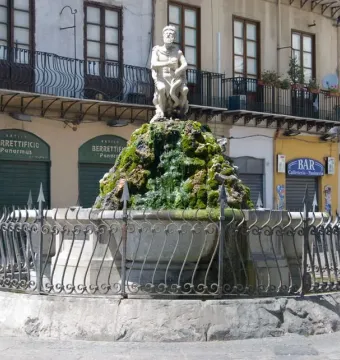
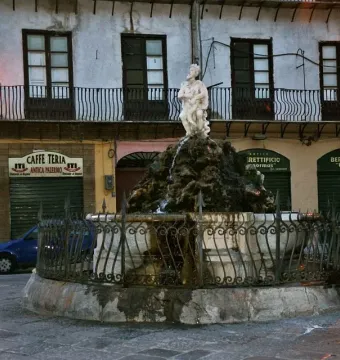
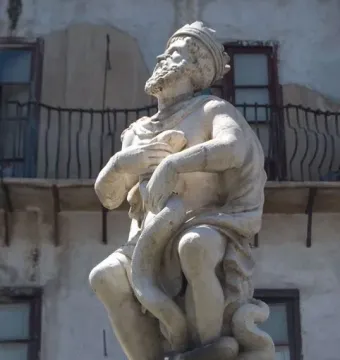
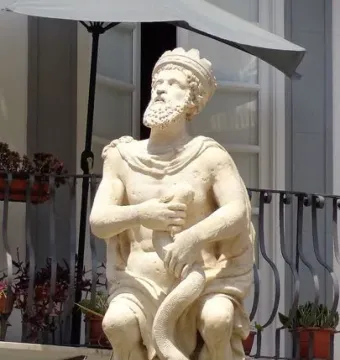
The Fountain of the Genius of Fieravecchia is a historic fountain in Piazza Rivoluzione, formerly Fieravecchia, in Palermo’s Kalsa quarter in Sicily. It features the Genius of Palermo, a seated crowned figure shown allowing a large snake to feed from his breast, placed atop a mossy mountain-like base. The fountain and statue were installed by Luigi Moncada, Prince of Paterno and Duke of Montalto, and the marble font had previously stood in the port area near a monastery of Discalced Mercederians. After the statue was removed following the Sicilian revolution of 1848, it was restored in 1860 after Garibaldi’s liberation of Sicily, becoming a patriotic symbol. The square later took the name Piazza Rivoluzione.
2010 © Palazzo Isnello - Flickr · CC BY-SA 2.0
April 2007 © Bjs · CC0
2010 © Palazzo Isnello - Flickr · CC BY-SA 2.0
July 2019 © Effems · CC BY-SA 4.0
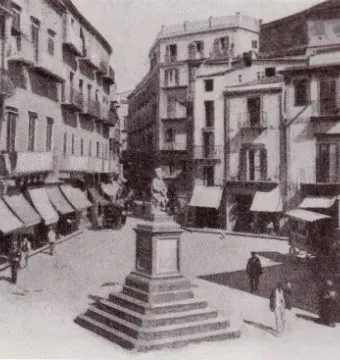
© Unknown authorUnknown author · Public domain
Identification | |
| Title | Fountain of the Genius of Fieravecchia |
| Italian names | Il Genio di piazza Rivoluzione; Fontana del Genio; formerly Genio del Molo; Genio della Fieravecchia |
| Type | Fountain with a statue |
Historical context | |
| Subject | The Genius of Palermo, the city’s ancient tutelary deity and secular protector |
| Historical significance | Its symbolic value was established during the Palermo uprisings that preceded the Risorgimento, and it became particularly important in defining the modern meaning of the Genius of Palermo as the city’s secular protector |
| Patriotic significance | The fountain and statue became a patriotic symbol of Palermo’s desire for freedom |
| Religious counterpart | Presented as complementary to Palermo’s religious protector, Santa Rosalia |
Creator | |
| Original artist | Anonymous sculptor |
Discovery and provenance | |
| Early names | Genio del Molo; Genio della Fieravecchia |
| Relocation to | Piano della Fieravecchia, in the center of the former market |
| Relocation from | Fontana del Molo Nuovo |
| Original location | The basin of the third fountain of Molo Nuovo, near the Cippo Smeriglio and the Convent of the Mercedarians |
| Original creation date | 16th century |
| Relocation date | 1687 |
Location and ownership | |
| Current location | Piazza Rivoluzione, ancient quarter of Kalsa, historic center of Palermo, Sicily, Italy |
| Square name history | The piazza was known as Fieravecchia since the early 13th century and was renamed Piazza Rivoluzione in 1860 after the statue and fountain were reunited |
| Former market location | Fieravecchia market near Via Alloro in Palermo |
| Surroundings | The square borders the church of San Carlo dei Milanesi and is one block east of the Palazzo Valguarnera Gangi and the Regio Teatro Santa Cecilia; it is also at the intersection of Via Aragona, Via Schiavuzzo, Via Piazza Teatro Santa Cecilia, Via Divisi, and Via Garibaldi |
| Current setting | The square is surrounded by restaurants and bars |
Physical characteristics | |
| Basin | Low circular basin edged by an iron fence, with a square marble inner basin with a high rim and four circular extensions projecting from the corners |
| Composition | A marble statue of the Genius of Palermo placed atop a rocky, mossy mound in a basin |
| Pose and attribute | A sitting, impassive king with a large serpent feeding from his breast, held in his arms |
| Figure depiction | A mature, bearded, crowned man with a mantle, eyes raised toward the sky, facing south |
Materials | |
| Statue material | Carrara marble |
| Basin material | Marble |
| Pedestal material | Marble |
History and restoration | |
| Related event symbol | Used as the symbol of the Palermo contemporary art event Il Genio di Palermo from 1998 to 2005 |
| Plaque inscription at base | This marble, feared symbol of liberty, removed from the eyes of the people by the restless tyranny, the victorious people restored |
| Commemorative plaques | Four plaques on the sides of the basin commemorate the uprising of 12 January 1848 and the statue’s return to the square; the church-side plaque also commemorates the gathering of insurgents around the improvised tricolor and the proclamation of freedom and democratic constitutions, and notes the 1st centenary of 12 January 1848 |
| Restoration funding | Financed by members of Coop Alleanza 3.0 as part of the Opera Tua initiative, with Fondaco Italia and the Municipality of Palermo as collaborators |
| Restoration | The fountain was restored at the end of the 19th century and thoroughly restored in 2019 |
| Return to square | 7 June 1860, after Giuseppe Garibaldi arrived in Palermo, the people brought the statue back to the square and reunited it with the fountain |
| Relocation in 1852 | Carlo Filangieri, lieutenant of Sicily for the Bourbon government, moved the statue to the municipal warehouses of Spasimo to prevent its use as a political symbol |
| Removal of statue | Removed by the Bourbon administration after the Sicilian revolution of 1848 |
| Statue installation | 17th century |
Significance | |
| Monument count | One of eight monumental representations of the Genius of Palermo; more than half a dozen similar stone monuments exist in Palermo |
| Related monument | Another fountain depicting the Genius of Palermo exists at Villa Giulia |
| Regional recognition | Included in the Sicilian Regional Charter of Places of Sicilian Identity and Memory (8410/2009) in 2009 |
Other | |
| Related demolished fountain | The Piazza del Piano della Fieravecchia once had a fountain dedicated to Ceres, later moved to the Marina promenade and destroyed in 1816 |