
Centauresse et Faune
Centauresse et Faune is a bronze sculpture created as a model in 1849 and cast in Paris by Quesnel in 1850. It shows a female centaur carrying a humanoid male faun on her back, along with bacchic details such as grapes, cups, and a small leopard. The sculpture is named, signed, and dated on its base. It was exhibited twice at the Paris Salon, first as a plaster model and later as the finished bronze, where it attracted critical attention for its technical execution and for its unusual inversion of the traditional motif. The sculpture is currently located in front of the main entrance of the Parc de la Tête d'or in Lyon, France.
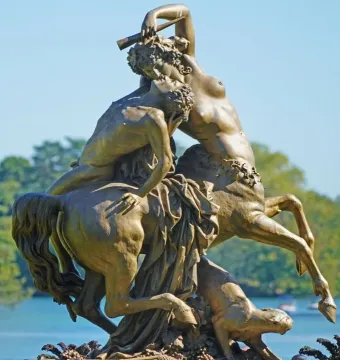
1849 © Augustin Courtet · CC BY 2.0
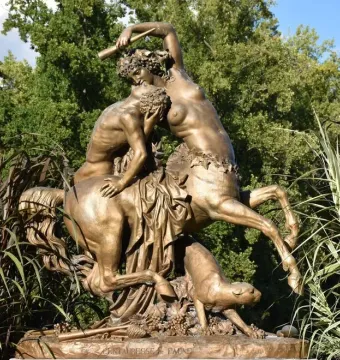
September 2021 © Delfin Le Dauphin · CC BY-SA 4.0
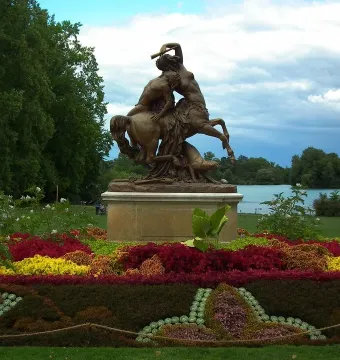
July 2011 © Mirej · CC BY-SA 3.0
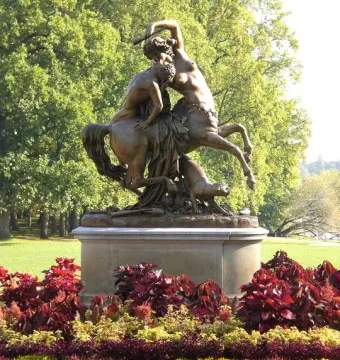
September 2007 © Romainberth · CC BY-SA 3.0
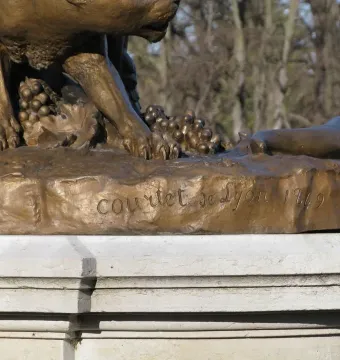
February 2011 © Symac · CC BY-SA 3.0
Identification | |
| Title | Centauresse et Faune |
| Alternative title | Centauress and Faun |
| Type | sculptural group |
Creator | |
| Caster / foundry | Parisian founder Quesnel |
| Artist's birth and training | Born in Lyon in 1821; graduated from the Lyon fine arts school |
| Artist | Augustin Courtet |
Historical context | |
| Creation date | 1849 |
| Original form | plaster model |
| State commission | In 1850, the French state ordered a bronze version from the model for 10,000 F (Franc germinal) |
| Cast date | 1850 |
| Early career exhibition and award | First displayed at the 1847 Paris Salon; awarded a second-class sculpture medal at the 1848 Paris Salon |
Discovery and provenance | |
| Exhibition history | Exhibited at the Paris Salon in 1849 as a plaster model and in 1852 as the final bronze |
Location and ownership | |
| Original installation site | Garden of the Palais Saint-Pierre, in a prominent location of the cloister courtyard of what is now the Museum of Fine Arts of Lyon |
| Ownership | Held by the French interior ministry, then donated to the city of Lyon soon after 1852 |
| Relocation | Moved in April 1952, after being returned to the state, to the Parc de la Tête d'Or in Lyon |
| Current location | In front of the main entrance of the Parc de la Tête d'Or, at the Porte du Lycée, southwest entrance, Lyon, France |
| Current status | Has remained there since 1952 |
Physical characteristics | |
| Dimensions | Height and width not stated in the fragment; mounted on a stone pedestal not included in the measurements |
Materials | |
| Material | bronze |
Technique | |
| Sculptural form | round sculpture (ronde-bosse), intended to be viewed from all sides |
Appearance | |
| Central figures | A centauress carrying a faun on her back |
| Centauress depiction | Head and torso of a young woman above the body of a horse; rearing, with only the back-left hoof touching the ground |
| Centauress attributes | Ivy garland at the transition between woman and horse body; long drape carried by her right arm; wine cup in her left hand |
| Faun depiction | Young nude male; thrown back across the horse's back with his right leg over the croup and his left leg hanging down; left hand on the horse's loins and right arm around the centauress's neck |
| Additional animal and action | A young leopard frightened by the movement, jumping on an amphora and spilling wine |
Iconography and meaning | |
| Bacchic symbolism | Grapes, cups, vines, and other unspecified objects associated with Bacchic imagery |
| Theme | A reversal of the traditional motif of a male centaur carrying away a nymph, often by force |
| Interpretation | The centauress carries away a faun who appears eager to follow of his own will |
| Gender motif | Centaurs are most often depicted as male |
History and restoration | |
| Condition and restoration | The bronze surface became visibly corroded over time and was restored shortly before 2012 |
Significance | |
| Historical significance | One of the first publicly funded artworks dedicated to classical topics in France |
| Reception | Generally praised for technical execution, but the subject matter was controversial and often puzzling to critics |
| Critical responses | Critics included F. Mercey, Adolphe Breulier, and J. Dubochet; publications mentioned were La Revue des deux Mondes, Revue Archéologique, and L'Illustration |
| Critical points | The composition and craftsmanship were often praised, especially the pose of the faun and the garland, while the centauress's anatomy and the awkward transition to the horse body were debated |