
Attic Funerary Relief
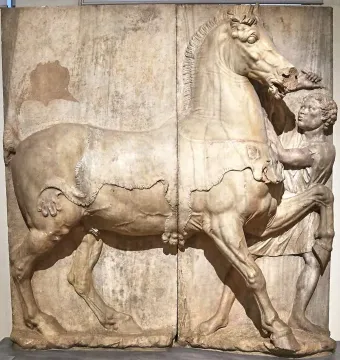
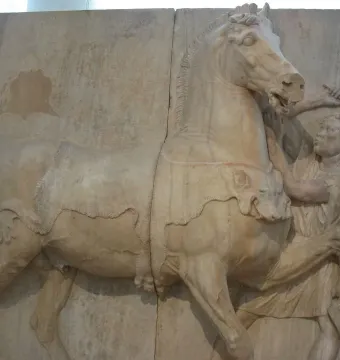
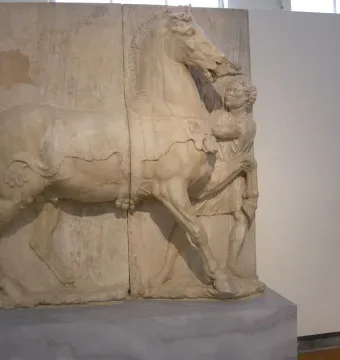
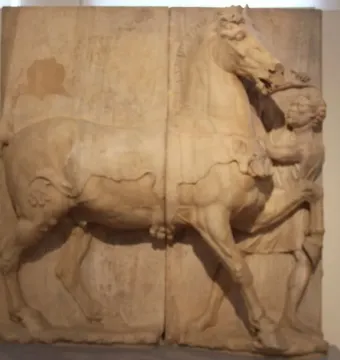
The Attic funerary relief is a Pentelic marble grave relief now displayed in the National Archaeological Museum in Athens, inventory number 3344. Found in 1948 near the Larisa metro station, it preserves two slabs, with a third section on the left presumed to be missing. The relief shows a horse running to the right, with a groom at the front left raising a whip as if to strike it. The groom wears a chiton and high boots and is identified as an exotic foreign slave, probably from Africa, most likely Ethiopia. Its date is disputed: it is usually placed at the end of the 4th century BC, though some scholars date it to the 1st century BC and connect it with a monument for Mithridates VI.
May 2018 © George E. Koronaios · CC BY-SA 4.0
March 2009 © Tilemahos Efthimiadis · CC BY 2.0
© Unknown artistUnknown artist · CC BY 2.5
July 2016 © Gary Todd · CC0
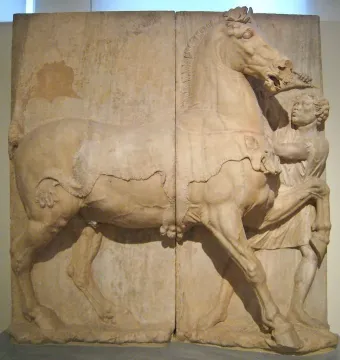
March 2009 © Sharon Mollerus · CC BY 2.0
Identification | |
| Title | Attic funerary relief |
| Type | Attic grave relief |
| Alternative name | Funerary relief of Mithridates |
Location and ownership | |
| Current location | National Archaeological Museum, Athens (NAMA) |
| Inventory number | 3344 |
Materials | |
| Material | Pentelic marble |
Historical context | |
| Date | Disputed; commonly dated to the late 4th century BC, but other datings place it in the 1st century BC |
Discovery and provenance | |
| Discovery location | Near the Larissa metro station |
| Discovery date | 1948 |
Physical characteristics | |
| Dimensions | About 2 m high and 1.9 m wide |
| Preservation state | Well preserved; only minor damage, with part of the horse's nose/muzzle missing |
| Preserved parts | Two panels are preserved; a third left-hand panel is assumed, which would have included at least the horse's tail |
Appearance | |
| Human action | He is drawing back a whip to strike the horse |
| Boy hair | Short hair |
| Boy clothing | Chiton and high boots (endromides) |
| Horse pose | The horse's head is turned and inclined out of the relief to the right; the left foreleg is raised and bent, the right foreleg is extended and planted on the ground, and the hind legs rest on the ground, with the left hind leg only minimally worked out from the background |
| Human figure | A stable boy stands at the left front of the composition |
| Horse accessory | A panther skin is draped over the horse's back and extends to its chest |
| Main motif | A horse moving to the right |
Iconography and meaning | |
| Boy identity interpretation | The curls identify him as an exotic foreigner |
| Boy ethnicity hypothesis | Probably an African slave, most likely from Ethiopia |
| Historical iconography | Arabs and Africans had been depicted in Greek art since the 4th century BC |
| Earlier dating interpretation | If dated earlier, the relief is thought to have belonged to a larger grave naiskos |
| Later dating interpretation | If dated later, it is often associated with the funerary monument of King Mithridates VI Eupator of Pontus |
| Associated historical figure | King Mithridates VI Eupator of Pontus |
| Dating basis | The broad dating range reflects differing interpretations rather than a settled chronology |
Other | |
| Cultural context | Greek art |