
Monument to the Belgian Pioneers in Congo
The Monument to the Belgian Pioneers in Congo is an allegorical monument in Parc du Cinquantenaire/Jubelpark in Brussels, Belgium. Designed by sculptor Thomas Vinçotte, it was crafted between 1911 and 1921 to commemorate the Congo Free State. The monument honours Belgian “pioneers” — soldiers described as having brought civilisation to the Congo — especially in connection with the Congo–Arab War of 1892–1894 and raids against Arab slave traders in present-day East Congo. It does not portray Leopold II, but it prominently includes a bilingual quote from him justifying the colonial project. The inscription and the monument’s context have been the subject of ongoing controversy.
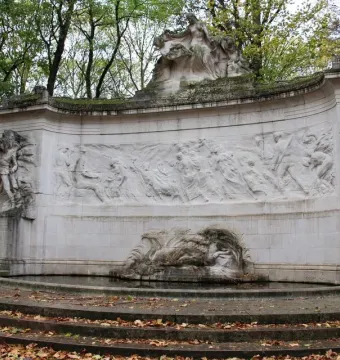
© Fred Romero · CC BY 2.0
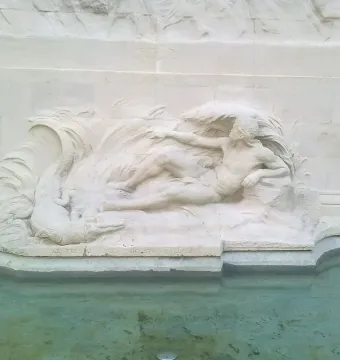
March 2014 © Olnnu · CC BY-SA 3.0
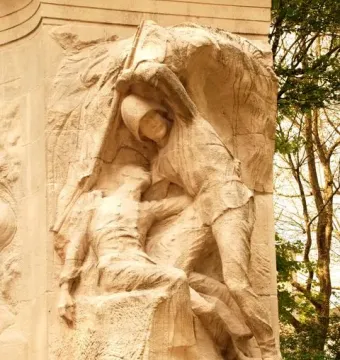
© EmDee · CC BY-SA 3.0
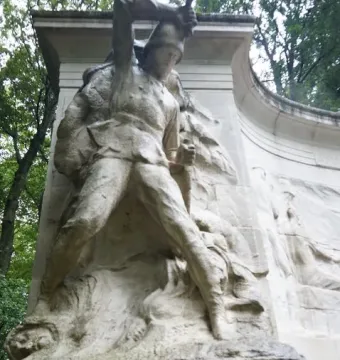
March 2016 © Sam.Donvil · CC BY-SA 4.0
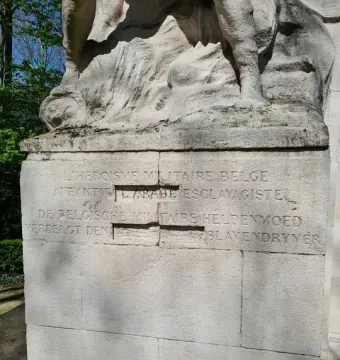
April 2022 © CBJH · CC0
Identification | |
| Title | Monument to the Belgian Pioneers in Congo |
| Type | Allegorical monument |
| French title | Le Monument aux pionniers belges au Congo |
Historical context | |
| Planning | Planned in 1909, the day after the death of King Leopold II |
| Commissioning | Commissioned in 1911, two years after the death of King Leopold II |
| Construction oversight | A national committee was founded in 1911 to oversee the monument's construction, under the auspices of King Albert I |
| Historical focus | Belgian raids against Arab slave traders in East Congo |
| Historical context | Related to the colonization of the Congo and the Congo–Arab War (1892–1894) |
| Purpose | To commemorate the Belgian pioneers, including explorers, missionaries, and soldiers, associated with the colonization of the Congo and the Congo Free State |
| Subject | Belgian pioneers in the former Belgian Congo |
Creator | |
| Designer | Thomas Vinçotte |
| Technical advisor | Ernest Acker |
Discovery and provenance | |
| Financing | Partially financed by the Belgian state, the City of Brussels, and public subscription |
| Selection method | Chosen directly without a competition |
Materials | |
| Material | Euville white limestone |
Physical characteristics | |
| Overall form | Semi-circular monument with a large curved wall divided into five sculptural scenes |
| Composition | A large bas-relief frieze in three parts, plus allegorical and narrative sculptural groups |
| Execution | Sculpted on site |
Appearance | |
| Style | Romantic work with elements of Art Nouveau |
| Art-historical context | Although contemporary with Expressionism and Modernism, the work remains linked to the pre-war world |
Iconography and meaning | |
| Main frieze | Three-part bilingual bas-relief, read from right to left: The Explorers, The Missionary, and Les Belges au Congo |
| Top sculpture | La race noire accueillie par la Belgique / Het zwarte ras door België onthaald: a seated white woman with a torch lifts her veil toward an African woman presenting her child |
| Left-side group | A group of Arabs throwing a slave to the ground, subdued by a Belgian soldier |
| Right-side group | A Belgian soldier protecting his mortally wounded officer |
| Congo River figure | A languishing Congolese youth lying in vegetation with a crocodile at his feet, representing the Congo River |
| Signature | Vinçotte's signature is at the bottom right |
Location and ownership | |
| Protection status | Listed as a historic monument; protected at the same level as the rest of Parc du Cinquantenaire |
| Location | Parc du Cinquantenaire / Jubelpark, Brussels, Belgium |
History and restoration | |
| Completion date | 1921 |
| Unveiling | Unveiled in 1921 by King Albert I and Queen Elisabeth |
| Delay | Completion was delayed by the First World War and Vinçotte's poor health |
| Inscription on entablature | J'ai entrepris l'œuvre du Congo dans l'intérêt de la civilisation et pour le bien de la Belgique. Ik heb het Congo werk ondernomen in het belang der beschaving en voor het welzijn van België. Léopold II, 3 juin 1906 |
| Inscription on cornice | Opgericht ter eere der eerste belgische baanbrekers / Monument élevé aux premiers pionniers belges |
| Congo River inscription | Le fleuve Congo / De stroom Congo |
| Inscription changes | The word 'Arab' in the slave-trader inscription was removed in 1988 after a complaint by the Arab League, restored in 1992 at the request of the Cercle royal des anciens officiers des campagnes d'Afrique, removed again in 2005, restored again in 2020 by two Vlaams Belang politicians, and removed again shortly afterward |
Significance | |
| Controversy | Since the 1980s, the monument has become increasingly controversial, especially because of its glorification of Belgium's colonial past and the 'Arab slave trader' inscription; the controversy is heightened by the nearby Great Mosque of Brussels, about 150 m away |