
Mourning Parents
Mourning Parents is a two-part sculptural group by German artist Käthe Kollwitz, dedicated to her youngest son Peter, who was killed in the First World War in 1914. Made of Belgian granite, it is regarded as Kollwitz’s major sculptural work. After 18 years of work, the group was first shown in Berlin’s National Gallery in summer 1932 and then installed on 23 July 1932 at the German military cemetery Esen-Roggeveld in Belgium. It was later moved after the cemetery’s reorganization and is now on the German war cemetery in Vladslo, West Flanders, near Peter Kollwitz’s grave.
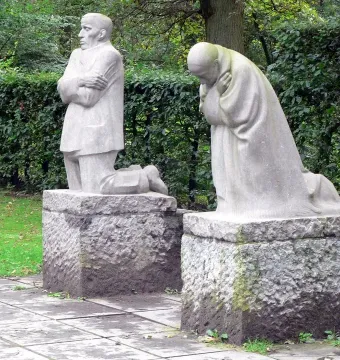
August 2006 © Käthe Kollwitz · Public domain
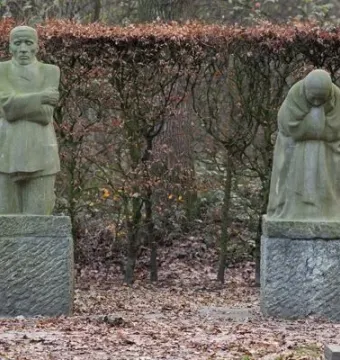
December 2020 © PMRMaeyaert · CC BY-SA 4.0
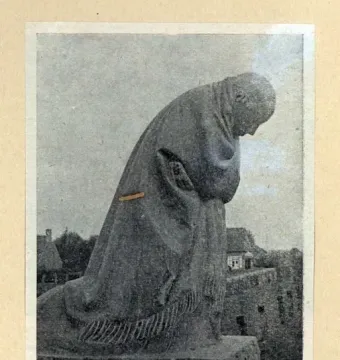
© Unknown authorUnknown author · Public domain
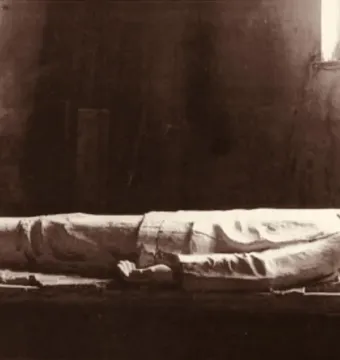
© Unknown authorUnknown author · Public domain
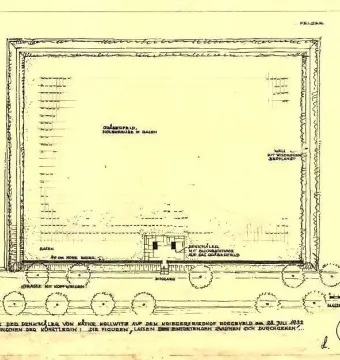
1932 © Unknown authorUnknown author · CC BY 3.0
Identification | |
| Title | Mourning Parents |
| Original German title | Trauerndes Elternpaar |
| Polish title | Opłakujący rodzice |
| Type | Two-part figural group |
Historical context | |
| Created as | A memorial to Käthe Kollwitz's son Peter and to all the fallen in war |
| Dedicated to | Peter Kollwitz, Käthe Kollwitz's youngest son, who died in the First World War at age 18 |
| Peter Kollwitz's death | Killed during the First Battle of Ypres in October 1914, on the night of 22–23 October during the attack on Diksmuide |
| Planning and creation | Work began on 1 December 1914 and continued for 18 years |
| Original memorial plan | Planned as the central element of a three-part memorial with a lying figure of Peter and an inscription, both later omitted |
Creator | |
| Other artists involved | August Rhades and Fritz Diederich executed the stonework; Joseph Beuys executed the father's figure in the 1959 copy and Erwin Heerich executed the mother's figure |
| Artist professions | German painter, graphic artist, and sculptor |
| Artist | Käthe Kollwitz |
Discovery and provenance | |
| Surviving early documentation | Only a photograph of the initial plaster sculpture survives, preserved in the Landesarchiv Berlin |
Materials | |
| Original material | Plaster |
| Final material | Belgian granite |
| 1959 copy material | Muschelkalk |
Technique | |
| Initial model | First modeled nude, then clothed in 1915/16 |
Physical characteristics | |
| Form | Life-size kneeling parent figures |
| Composition | Father and mother shown as a pair of standing stones? No |
Appearance | |
| Father figure | Kneeling upright with head raised, looking downward, arms embracing the chest; sunken cheeks, tightly closed lips, and a bitterly downturned mouth |
| Mother figure | Kneeling and bent forward, hunched in on herself, with eyes closed, one collar pulled up to her face and hands gripping her coat |
| Portrait features | The figures were given the facial features of Käthe Kollwitz and her husband Karl Kollwitz, reportedly inspired by an idea from Ernst Barlach |
Iconography and meaning | |
| Subject | Grieving parents mourning their son Peter |
| Omitted son figure | The planned central figure was a dead soldier lying on his back with his head hyperextended backward; the same motif later reappeared in Pietà Mother with Dead Son |
Location and ownership | |
| First public presentation | Summer 1932 at the Berlin National Gallery |
| Original installation date | 23 July 1932 |
| Installed at | The burial place of Peter Kollwitz |
| Current location | German soldiers' cemetery in Vladslo, West Flanders, Belgium, about 20 kilometers south of Ostend |
| Nearby burial | Peter Kollwitz is buried a few meters away at the same cemetery |
| Relocation | Moved to Vladslo in 1956 when the cemetery at Roggeveld was dissolved and graves were reburied |
| Current setting | The figures stand on pedestals in the cemetery entrance area |
| Original installation | German soldiers' cemetery Esen-Roggeveld in Belgium |
History and restoration | |
| Related quote | "Saatfrüchte dürfen nicht vermahlen werden" ("Seeds for sowing must not be ground") |
| Protection status | The Belgian state placed the entire site under monument protection on 18 March 1997 |
| 2014 cast | A cast was erected on 20 September 2014 at the German War Cemetery in Rshew by the Volksbund Deutsche Kriegsgräberfürsorge in memory of Peter Kollwitz (1921–1942), who fell near Rzhev in World War II |
| 1959 copy | A copy was unveiled in 1959 by Federal President Theodor Heuss at the ruins of St. Alban's Church in Cologne |
| Installation supervision | Käthe and Karl Kollwitz personally supervised the installation, with Albert Einstein helping secure approval |
| Artist reaction | Kollwitz was hurt by the disregard from communist newspapers and became active in peace activism |
| Reception in Germany | Some Germans objected that the work lacked heroic references; the Nazi press mocked it, saying German mothers do not look like this |
| Reception in Belgium | Seen by some Belgians as enemy figures on their soil; they were given the nicknames "Mette" and "Pette" or "Manten" and "Kalle" |
| Display before installation | Exhibited in the vestibule of the Berlin National Gallery |
| Original intended inscription | "Hier liegt die Jugend" ("Here lies youth") |
Significance | |
| Art-historical status | Considered Käthe Kollwitz's major sculptural work |
| Visitor interest | About 70,000 visitors per year |
Other | |
| Documentary film | Saatfrüchte sollen nicht vermahlen werden, directed by Kurt Tetzlaff, produced by DEFA in 1967, 18 minutes, East Germany |