
Washington Monument
The Washington Monument in Philadelphia is a large-scale bronze and granite sculpture created by German sculptor Rudolf Siemering in 1897. It features an equestrian statue of George Washington atop a multi-level pedestal with allegorical and historical figures. The monument was originally placed at the Green Street entrance to Fairmount Park and was relocated in 1926 to the Eakins Oval in front of the Philadelphia Museum of Art. Commissioned by the State Society of the Cincinnati of Pennsylvania and given to the city of Philadelphia, it combines bronze bas-reliefs, a pink Swedish granite base, and four corner fountains representing major rivers.
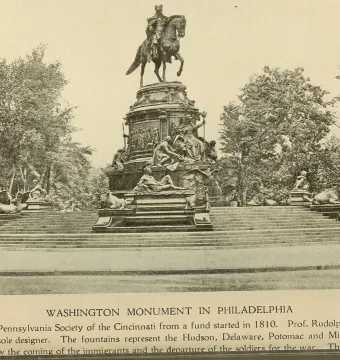
1916 © Internet Archive Book Images · No restrictions
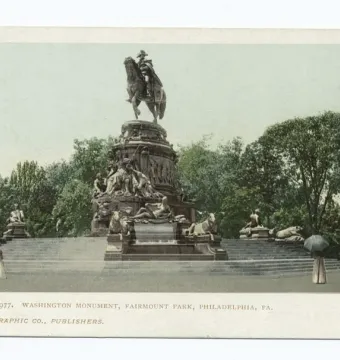
© Detroit Publishing Company · Public domain
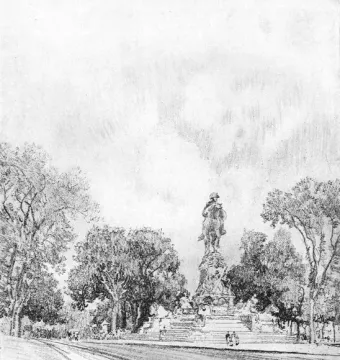
1914 © Elizabeth Robins Pennell · Public domain
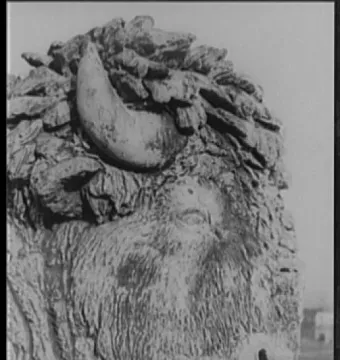
1938 © Carl Van Vechten · Public domain
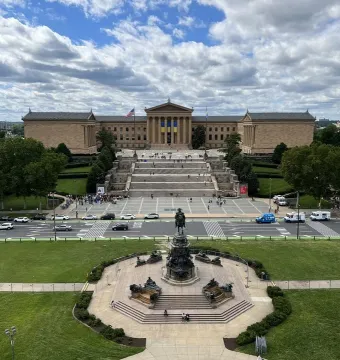
June 2022 © DerekPhilipAu · CC BY-SA 4.0
Identification | |
| Title | Washington Monument |
| Subject | George Washington |
| Type | Monumental memorial ensemble with equestrian statue |
Location and ownership | |
| Location | Eakins Oval, Philadelphia, Pennsylvania, United States, at the end of the Benjamin Franklin Parkway in front of the Philadelphia Museum of Art |
| Original planned location | Washington Square, Philadelphia |
| Original location | Green Street entrance to Fairmount Park |
| Current location | Eakins Oval in front of the Philadelphia Museum of Art |
| Commissioned by | State Society of the Cincinnati of Pennsylvania |
| Presented to | The city of Philadelphia |
Historical context | |
| Relocation date | 1926 |
| Centennial restoration | Four-year restoration completed in 1997 for the centennial |
| Transferred to | the Fairmount Park Commission by Mayor Charles F. Warwick |
| Main oration by | Judge William W. Porter of the State Society of the Cincinnati |
| Unveiled by | President William McKinley |
| Relocation reason | As part of the City Beautiful plan |
| Dedicated on | May 15, 1897 |
| Benjamin Franklin Parkway designed in | 1917 |
| Park commissioners approved site | 1895 |
| Initial resolution date | July 4, 1810 |
| Contract signed | October 19, 1881 |
| Negotiations began | 1880 |
| Proposal date | 1879 |
| Second fund established | 1824 by citizens of Philadelphia |
Creator | |
| Background | Artist of the Berlin School of sculpture |
| Proposed by | Rudolf Siemering |
| Sculptor known for | the Leipzig Victory Monument in Leipzig's market square |
| Sculptor residence | Berlin |
| Sculptor nationality | German |
| Sculptor | Rudolf Siemering |
Physical characteristics | |
| Fountains | Four fountains beneath the allegories |
| Higher level figures | Four over-life-size allegories |
| Number of pedestals in the staircase | Eight |
| Left hand | Holds the horse's reins |
| Stair arrangement | Thirteen-step staircase around a central elevated base |
| Base | Pink Swedish granite base with surrounding staircase |
| Central pedestal | Bronze pedestal |
| Number of steps | 13 |
| Right hand | Holds a command staff |
| Pose | Mounted on horseback |
| Top figure object | Spyglass in his right hand |
| Top figure clothing | Traditional military uniform, cape, and tricorner hat |
| Top figure orientation | Facing southeast toward Philadelphia City Hall |
| Main figure | Equestrian statue of George Washington |
| Structure levels | Three levels |
| Clothing | Uniform of the Continental Army |
Materials | |
| Side relief material | Bronze bas-reliefs |
| Main material of staircase | Swedish granite |
| Pedestal material | Bronze |
| Base material | Pink Swedish granite |
| Materials | Bronze and granite |
Appearance | |
| Additional figures | Allegorical and historical figures |
| Animal figures | Life-sized figures of North American fauna, including two wapiti deer, two bison, two moose, one bear, and one bull |
| Female figure at the front | Personification of America with trident and cornucopia |
| Companion figures on front | Two uniformed figures kneeling at her feet, one offering a laurel wreath and the other the Declaration of Independence |
| American eagle | American eagle with outspread wings below the front group |
| Front animal | American eagle below America |
| Depicted people | Four Native Americans shown reclining behind the fountains |
| Animal role | Native animals guard the fountains on each side |
Iconography and meaning | |
| Fountain symbolism | The four major rivers of the United States: the Delaware, Hudson, Mississippi, and Potomac |
| Historical context | Ideas for a monument to Washington arose in Philadelphia partly because the Declaration of Independence was issued there on July 4, 1776, and the Constitutional Convention met there in 1787 |
| Inscription above pedestal | Erected by the State Society of the Cincinnati of Pennsylvania |
| Relief themes | The march of the army and the westward march of emigrants |
| Top figure meaning | Washington's service as commander-in-chief of the Continental Army during the American Revolutionary War |
| Step symbolism | Thirteen steps symbolize the thirteen original states |
| Represented theme | The country during Washington's time |
| Purpose | Memorial |
| Bottom level meaning | The natural world during Washington's time |
Technique | |
| Face model | Based on a copy of a life mask of Washington |
| Reference material | Other photographs and lithographs were also provided to the sculptor as models |
| Stylistic features | Realistic formal language with neo-Baroque elements |
| Artistic tradition | European equestrian statues and national monuments |
| Main artistic influence | Christian Daniel Rauch |
| Comparison to another work | Parallels to Rauch's equestrian statue of Frederick the Great |
History and restoration | |
| Listed on | Philadelphia Register of Historic Places |
| Listing date | June 29, 1971 |
| Relocated in | 1928 |
| Listed as | Washington Fountain, Eakins Oval |
| Moved from | the entrance to Fairmount Park |
Discovery and provenance | |
| Presented by | Major William Wayne, president of the State Society of the Cincinnati and a direct descendant of Revolutionary War general Anthony Wayne |
| Monument committee member | John Sartain |
Other | |
| Duplicate casts location | Floraplatz in the Berlin Tiergarten |
| Duplicate casts date | 1901 |
| Post-atelier event | After a visit to Rudolf Siemering's studio, Wilhelm II saw the animal figures and ordered new casts of them |