
Flygarmonumentet
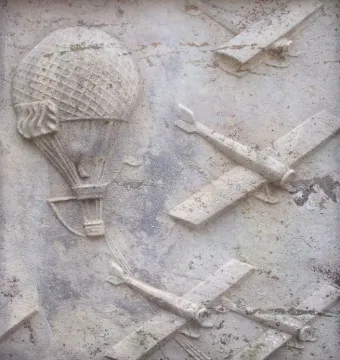
Flygarmonumentet, also known as the Aviator Monument, is a memorial in central Stockholm’s Karlaplan square. Created by the Swedish sculptor Carl Milles and installed in 1931 at the initiative of the Royal Swedish Aero Club, it honors Swedish aviators and pioneers of flight who died in North Pole expeditions between 1898 and 1917. The monument shows a large bronze eagle with spread wings, as if about to fly. It stands 1.85 meters high, with a wingspan of almost one meter. The base includes reliefs of Icarus, aviators, and early military aircraft, along with two information plaques. The monument was dismantled during construction of the Karlaplan metro station and returned to its original site in 1967.
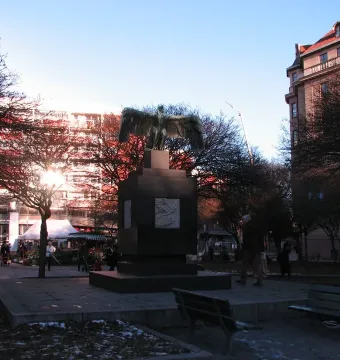
November 2016 © Егор Журавлёв · CC BY-SA 2.0
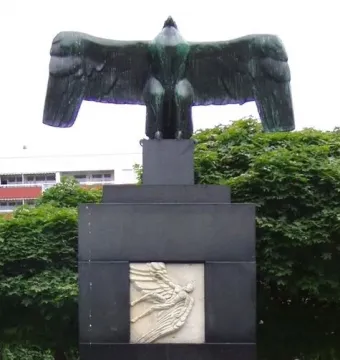
© Hedlund · Public domain
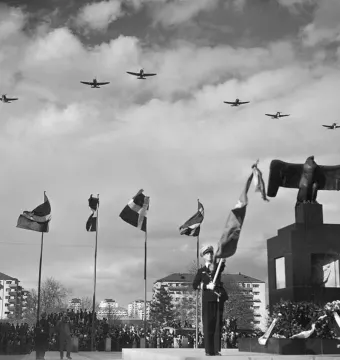
May 1941 © Karl Sandels · Public domain
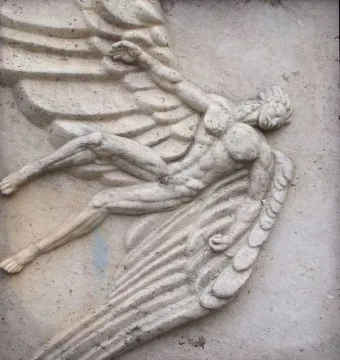
2009 © Holger.Ellgaard · CC BY-SA 3.0
2009 © Holger.Ellgaard · CC BY-SA 3.0
Identification | |
| Title | Flygarmonumentet |
| English name | The Aviator Monument |
| Type | Monument; sculpture |
Historical context | |
| Commemorates | Swedish aviation pioneers and aviators who died in North Pole expeditions and other early aviation expeditions between 1898 and 1917 |
Creator | |
| Artist | Carl Milles |
| Artist nationality | Swedish |
| Commissioned by | The Royal Swedish Aero Club |
Discovery and provenance | |
| Construction period of base and pedestal | 1927–1931 |
| Unveiled by | Prince Carl of Sweden, Duke of Västergötland |
| Unveiled on | 15 May 1931 |
| Installed | 1931 |
| Gift from | the Swedish Aeronautical Society |
Location and ownership | |
| Location | Karlaplan, central Stockholm, Sweden |
| City | Stockholm |
| Country | Sweden |
| Square | Karlaplan |
| Artist's political views | Carl Milles did not deny his admiration for Adolf Hitler |
| Interpretation controversy | The monument has long been controversial; some interpreted it as reflecting Carl Milles's admiration for Nazism because the eagle resembles the Nazi symbol |
Physical characteristics | |
| Interior feature | A shallow interior space containing an urn |
| Contains | An urn holding the medals of all deceased Swedish pilots |
| Wingspan | Almost 1 m |
| Informational plaques | Two |
| Depth | 185 cm |
| Width | 750 cm |
| Depicted subject | A large eagle with outspread wings, preparing to take off |
| Height | 1.85 m |
Materials | |
| Base and pedestal material | Polished diabase |
| Information panels material | White marble |
Appearance | |
| Base reliefs | Icarus, balloonists, and early military airplanes |
| Symbolic feature | An eagle with outstretched wings |
Iconography and meaning | |
| Artist's view of the symbol | Carl Milles thought an eagle would be an excellent symbol |
| Later interpretation | Now seen more as a tribute to all who died in the sky |
| Original purpose | To honor fallen pilots and aviation pioneers, including Salomon August Andrée, Elsa Andersson, Knut Frænkel, and Nils Strindberg |
History and restoration | |
| Artist letter | In a letter to his wife, Milles said he hoped Hitler would have enough health and strength to continue his "beautiful" work |
| Use in the 1940s | Young Swedish Nazis used the monument as a meeting and gathering place and celebrated Nazi holidays there |
| Protest activity | Young socialists covered the monument with graffiti in protest against Nazis |
| Threats | There were threats to burn the square |
| Use by the Swedish Air Force | Used for wreath-laying ceremonies |
| Removal and reinstallation | Dismantled during construction of the Karlaplan metro station and re-erected in 1967 |
Significance | |
| Artist quotation on interpretation | Milles said universal agreement on what the monument symbolizes would never be achieved |