
Vulcan statue
The Vulcan statue is a cast iron sculpture of the Roman god Vulcan, standing as a symbol of Birmingham, Alabama’s iron and steel industry. Created by Italian-born sculptor Giuseppe Moretti as Birmingham’s entry for the 1904 Louisiana Purchase Exposition in St. Louis, it is the largest cast iron statue in the world and one of the tallest statues in the United States. The figure was made from 29 cast-iron components and originally displayed at the World’s Fair, where it won a Grand Prize. After a long and complicated history of relocation, repair, and restoration, Vulcan was re-erected in 2003 atop Red Mountain in Vulcan Park, where it remains a major landmark and overlook for the city.
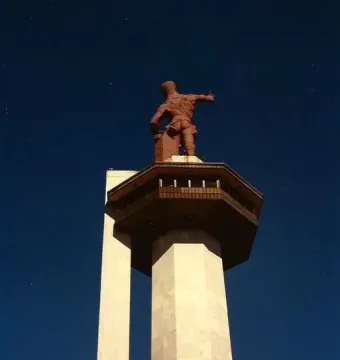
March 2014 © Druid85 · CC BY-SA 3.0
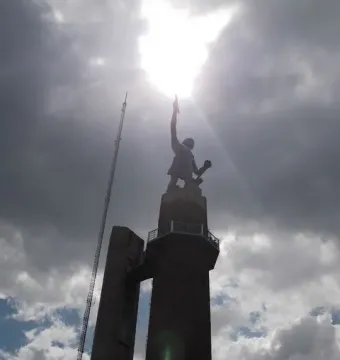
© Javier Campos-Gomez · CC BY-SA 3.0
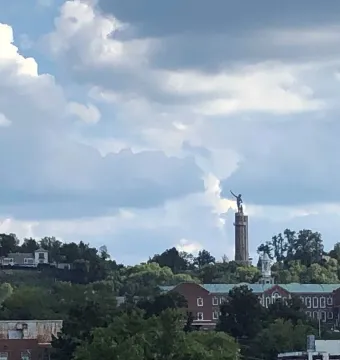
September 2019 © Mgsmith68 · CC BY-SA 4.0
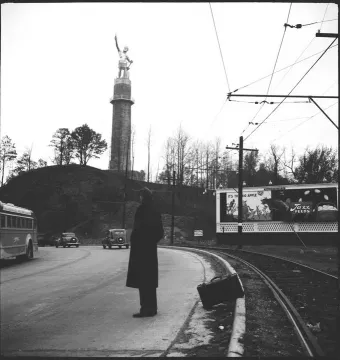
© Annemarie Schwarzenbach · Public domain
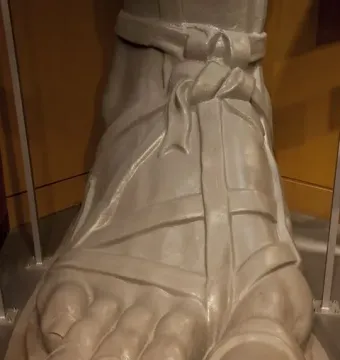
© Carol M. Highsmith · Public domain
Identification | |
| Title | Vulcan |
| Subject | Vulcan, the Roman god of fire and metalworking |
| Alternative name | The Magic Man (by some) |
| Type | Statue |
Iconography and meaning | |
| Depicted attributes | Ironworking equipment; an anvil, a hammer, and a spear point |
| Symbolic role | City symbol of Birmingham, Alabama, United States; symbol of the Birmingham region; symbol of one of the largest black metallurgy centers in the United States |
Historical context | |
| Historical context | Reflects Birmingham's roots in the iron and steel industry |
Creator | |
| Sculptor | Giuseppe Moretti, an Italian-born sculptor |
| Commissioned by | Commercial Club of Birmingham |
| Design began | 1903 |
| Design method | Used a 183 cm tall model to study the form |
Discovery and provenance | |
| Purpose at the fair | Represented Birmingham's mineral wealth and manufacturing capabilities |
| Award at the fair | Grand Prize |
| Master model | Clay model made in an unfinished church in Passaic, New Jersey |
| Model transport | Divided into sections and transported by rail to the Birmingham Steel and Iron Company in Birmingham |
| Casting preparation location | Birmingham Steel and Iron Company |
| Created for | Birmingham's entry for the 1904 Louisiana Purchase Exposition (World's Fair) in St. Louis, Missouri |
Physical characteristics | |
| Size ranking | Largest cast iron statue in the world |
| Weight | Not specified in the source fragment |
| Rank among statues | Among the tallest statues in the United States |
| Chest circumference | About 7 meters |
| Waist circumference | About 6 meters |
| Pedestal height | 37 meters; 38.4 meters in the later sandstone pedestal |
| Height | 56 feet (17 meters) |
Materials | |
| Material | Cast iron |
| Castings | Grey iron castings made entirely from locally produced iron in Birmingham |
| Pedestal material | Local sandstone; later faced with Alabama marble |
Technique | |
| Construction | Hollow sculptural structure made of 29 cast-iron components fastened internally with connecting flanges |
| Support structure | Originally self-supporting with no internal framework; later re-erected on a steel armature |
| Heaviest section | The head |
| Assembly details | Iron forgemen designed and executed the connection details |
Location and ownership | |
| Designating organization | Greater Birmingham Convention and Visitors Bureau |
| Adjacent facilities | Interactive history museum examining Vulcan and Birmingham's story |
| Views | Views of Birmingham |
| Park size | 10-acre (4 ha) urban green space |
| Operating organization | Vulcan Park Foundation |
| Designation | Official Birmingham Information Center |
| Associated city | Birmingham, Alabama, United States |
| Location | Vulcan Park and Museum, Birmingham, Alabama, United States |
| Park | Vulcan Park |
History and restoration | |
| Centennial redevelopment | In 1971, for Birmingham's centennial celebration, the area around the statue was rebuilt; the pedestal was clad in Alabama marble, and an elevator, observation deck, gift shop, snack bar, and covered walkway were added |
| Restoration award | National Preservation Honor Award from the National Trust for Historic Preservation in 2006 |
| Reopening | Officially reopened in 2004, celebrating Vulcan's 100th birthday |
| Reinstallation | Re-erected in June 2003 atop the tower on a steel armature and reoriented to the east |
| Tower work | The original tower was cleaned and repaired; the 1971 additions were demolished in 2002; Vulcan's head and right arm were displayed at the Birmingham Museum of Art while the tower was prepared |
| Storage during restoration | Stored in Vulcan Park's parking lot until fall 2001 |
| Restoration | Dismantled in October and November 1999 for restoration; some parts, including the lost spear point, were recast; coated with a durable paint system with a light-gray finish coat called 'Vulcan Gray'; park and pedestal were restored to their 1938 appearance |
| Engineering study | By 1990 an engineering study found the structure was in danger of collapse |
| Structural deterioration | Concrete inside the statue up to the chest deteriorated because concrete and cast iron expanded and contracted at different rates |
| National Register listing | Listed on the National Register of Historic Places on July 6, 1976 |
| Paint color in 1970s | Rust red |
| Nearby facilities | WAFM-TV (now WVTM) and WBRC later had studios and towers on Red Mountain; radio and television company antennas were installed nearby in 1949 |
| Advertising use | Used for advertising for many years, with items such as an ice cream cone, a Coca-Cola bottle, and Heinz pickles |
| 1904 World's Fair exhibition | Shipped to St. Louis as Birmingham's entry into the Louisiana Purchase Exposition, displayed in the Palace of Mines and Metallurgy |
| Post-fair condition | Dismantled and returned to Birmingham; left in pieces beside railroad tracks because freight bills were unpaid |
| Torch lighting | The neon torch glowed green except for 24 hours after each fatal traffic accident, when it glowed red |
| Initial Birmingham installation | Installed at the Alabama State Fairgrounds without a spear, which was lost en route from St. Louis |
| Inspection and repainting | Taken apart for inspection in the late 1920s, painted flesh-colored, and reassembled in the early 1930s |
| Relocation in 1936 | Moved to a newly created city park atop Red Mountain in Birmingham |
| New spear and pose | A new spear was fabricated, and the left hand held a hammer at his side |
| Dedication | Vulcan Park was dedicated in a nine-day festival beginning May 7, 1939; opening night crowd was 5,000 and the Vulcan Queen was Evelyn Tully |
| Traffic safety modification | In 1946 the Birmingham Junior Chamber of Commerce made Vulcan a symbol of traffic safety; the spear was replaced by a neon torch |
Significance | |
| Visitor count in 2004 | More than 100,000 visitors |
| Significance | One of the tallest statues in the United States |
Other | |
| Humorous feature | Naked buttocks; referenced in the novelty song 'Moon Over Homewood' as 'mooning' Homewood, Alabama |
| Photograph dates mentioned | 1935, 1990, and 2006 |
| Foundation mission | Preserve and promote Vulcan as a symbol of the Birmingham region; advance knowledge and understanding of Birmingham's history and culture; encourage exploration of the region |
| Services offered | Information on transportation services, restaurants, events, and other cultural offerings in Birmingham |