
George Washington
George Washington is a marble statue by Antonio Canova depicting the American president dressed as a Roman general. Commissioned by the state of North Carolina in 1815, the work was completed five years later and installed in the North Carolina Senate on 24 December 1821. It was Canova’s only work made for the United States. Both the building and the sculpture were destroyed by fire on 21 June 1831. The plaster model of the statue is preserved at the Canova Gypsotheca in Possagno.
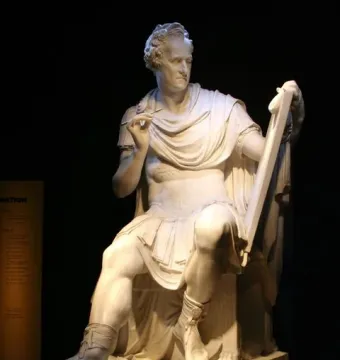
© RadioFan · Public domain
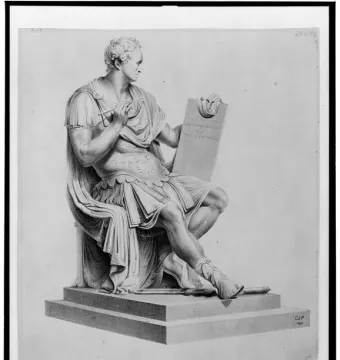
© Popular Graphic Arts · Public domain
© Popular Graphic Arts · Public domain
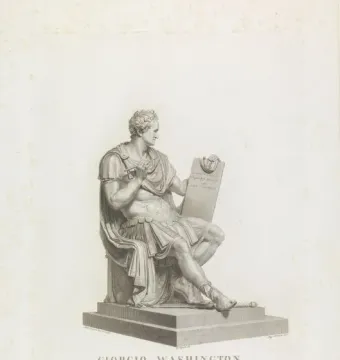
1796 © Rijksmuseum · CC0
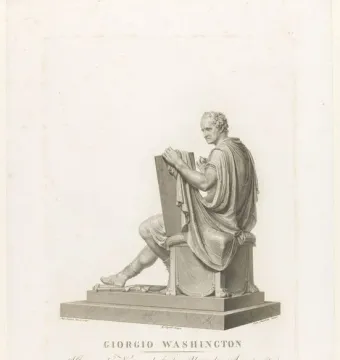
© Rijksmuseum · CC0
Identification | |
| Title | George Washington |
| Type | life-size marble statue |
| Alternative title | Monument to George Washington |
| Common name | Giorgio Washington; George Washington |
Historical context | |
| Date completed | 1820 |
| Date installed | 24 December 1821 |
| Date commissioned | December 1815 |
Creator | |
| Artist | Antonio Canova |
| Artist nationality | Venetian-Italian |
| Artist movement | Neoclassical |
| Pedestal maker | Raimondo Trentanove |
| Pedestal maker relationship | Canova's student; son of Antonio Trentanove |
Discovery and provenance | |
| Model for the head | Marble bust of George Washington by Giuseppe Ceracchi; Thomas Appleton owned a plaster copy |
| Model location | Gipsoteca Canoviana in Possagno |
| Transport | Sent from Italy by a United States Navy ship requested by Governor Miller; delivered to Boston by Commodore William Bainbridge on 22 July 1821; arrived in Raleigh on 24 December 1821 |
| Work began | 1817 |
| Preparatory works | Several sketches and maquettes (modellos or bozzettos) were made |
| Work location | Canova's studio in Rome |
| Governor involved in commission | William Miller |
| Negotiated by | Thomas Appleton, American consul in Livorno, Italy |
| Commissioned by | the state of North Carolina |
| Adviser | Thomas Jefferson |
Physical characteristics | |
| Material | Carrara marble |
| Pose | Seated |
| Pedestal | Separate pedestal of white marble with four bas-reliefs, made by Raimondo Trentanove |
Appearance | |
| Objects at feet | A sword and a baton |
| Inscription | An epigraph was engraved on the tablet, and an inscription in Italian was on the base, but the texts are not given in the fragment |
| Objects held | A tablet in the left hand and a quill in the right hand |
| Depiction | Dressed all'antica as a Roman general in ancient Roman military armor |
Iconography and meaning | |
| Pedestal relief 1 | The surrender of British General Charles Cornwallis at Yorktown, with Washington in victory |
| Pedestal relief 2 | Washington's resignation as commander-in-chief of the Continental Army to Congress |
| Pedestal relief 3 | Washington's election as President of the United States |
| Pedestal relief 4 | Washington with a plow at Mount Vernon, like Cincinnatus returning to private life |
| Interpretation | A modern Cincinnatus drafting his farewell address to the nation |
Location and ownership | |
| Original installation site | Rotunda of the North Carolina Senate building (State House) in Raleigh, North Carolina |
| Original installation ceremony | Installed at an official ceremony attended by Governor Jesse Franklin and the legislature; dedicated by Colonel William Polk |
| Current location of original | Destroyed |
History and restoration | |
| Viewer comment | In March 1825, the Marquis de Lafayette said the likeness was much better than he had expected |
| Marble copy | A marble copy by Romano Vio was made in 1970 and is in the rotunda of the North Carolina State Capitol in Raleigh; the Capitol stands on the same site as the former state house |
| Replacement plaster replica | A plaster replica was sent by the Italian government in 1910 and is now at the North Carolina Museum of History |
| Cause of destruction | Destroyed by fire during fireproofing work when workers accidentally set the roof on fire while soldering nail heads to zinc sheets |
| Artist did not see installation | Canova died in Venice in 1822 before the sculpture was installed in North Carolina |
| Contemporary description of fire | Described as a "terrible conflagration" / "Awful conflagration!" in The Raleigh Register on 23 June 1831 |
| Destroyed object(s) | The sculpture and the Senate building (state house) |
| Destruction date | 21 June 1831 |
Significance | |
| Distinction | The only work Canova made for the United States |
Other | |
| Related exhibition | Canova's George Washington, Frick Collection, 23 May 2018 to 23 September 2018, then Musei Canova, 10 November 2018 to 22 April 2019; included sketches/models and a full-size plaster model borrowed from Museo Canova in Possagno |
| Related artists | Giuseppe Ceracchi (marble bust of Washington); R. Trentanove (bas-reliefs on the pedestal) |
| Related image | Lithograph of the original statue and pedestal in the rotunda of the North Carolina State House |