
Jardin d'émail
Jardin d'émail (1968–1974), also known in English as Enamel garden, is an outdoor sculpture by Jean Dubuffet at the Kröller-Müller Museum in Otterlo, the Netherlands. It was designed specifically for the museum and presented as a work of art that visitors can touch, walk through, and even play in. The sculpture is made from concrete, glass fiber reinforced epoxy resin, polyurethane, and paint. In 2020, it was closed for restoration because its surface was in poor condition. The restoration involved complete removal of the painted surface, careful replication of the artist’s original paint scheme and pattern, and the use of photogrammetry to reproduce hand-painted markings across the large surface area.
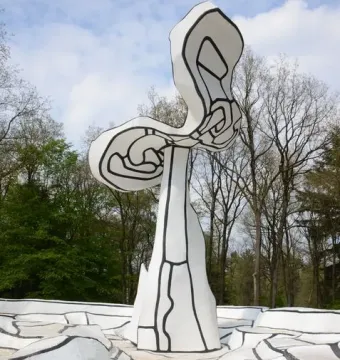
© Henk Monster · CC BY 3.0
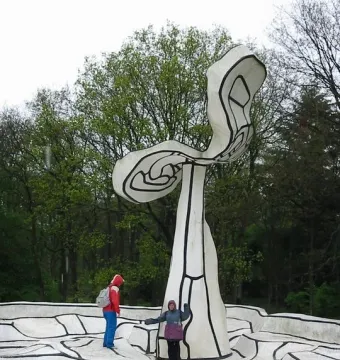
© nl:Gebruiker:Pampiertje · CC BY-SA 3.0
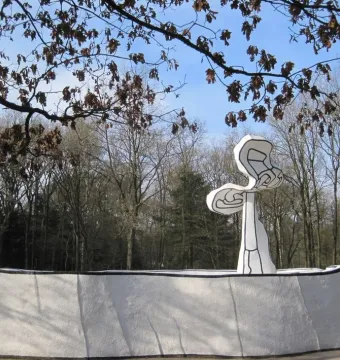
March 2014 © Kumpusch · CC BY-SA 3.0 nl
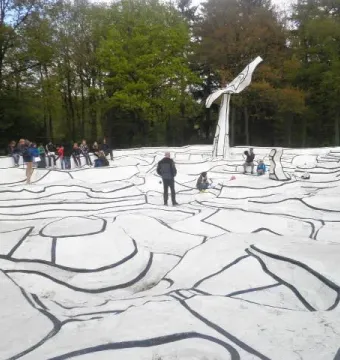
May 2012 © Dqfn13 · CC BY-SA 3.0
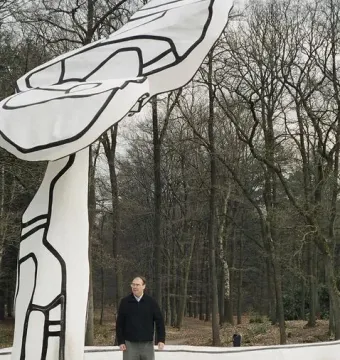
January 2005 © Phillip Capper · CC BY 2.0
Identification | |
| Title | Jardin d'émail |
| English title | Enamel garden |
| Type | outdoor monumental sculpture |
Historical context | |
| Date | 1968–1974 |
Creator | |
| Artist | Jean Dubuffet |
| Based on plans | Plans made by Dubuffet in 1968 |
Creation and design | |
| Designed for | Kröller-Müller Museum |
Physical characteristics | |
| Dimensions | Not specified |
| Surface area | Very large |
Materials | |
| Materials | Concrete, glass fiber reinforced epoxy resin, polyurethane, and paint |
| Paint scheme | Black and white |
| Paint/coating | Painted with polyurethane |
Technique | |
| Method | Photogrammetry was used for restoration planning |
Appearance | |
| Relationship to surroundings | Strong contrast with the surrounding nature |
| Stylistic features | Instinctive lines emphasizing relief |
| Style | Part of the Hourloupe series |
Iconography and meaning | |
| Artist's intention | To create a permanent confrontation between the Hourloupe anti-nature and the surrounding nature |
| Interpretive description | "A garden of artifices in a garden of real trees and real grass" |
Location and ownership | |
| Location | Garden of the Kröller-Müller Museum, De Hoge Veluwe National Park, near Otterlo, Netherlands |
| Accessibility | Visitors can enter, touch, walk through, and play in the installation |
History and restoration | |
| Restoration year | 2020 |
| Restoration status | Closed during restoration |
| Condition before restoration | Surface was in poor condition |
| Restoration work | Complete removal of the painted surface and precise replication planning |
| Restoration aim | To reproduce the artist's hand-painted markings |
| Restoration note | The artist's original paint scheme and pattern were followed |
Significance | |
| Work type | Total artwork / installation |
| Sensory experience | Stimulates all senses |