
Paisley War Memorial
Paisley War Memorial, also known as Paisley Cenotaph, is a war memorial in the centre of Paisley, Renfrewshire, Scotland. Unveiled in 1924, it was upgraded from Category B to Category A listed status in 1997. Designed by architect Sir Robert Lorimer, it features a bronze equestrian sculptural group by Alice Meredith Williams on a tall granite plinth made from stone imported from Shap Fell in Cumbria. The memorial was commissioned after the First World War and funded by public subscription. Its inscription commemorates the men of Paisley who died in the Great War, with a later inscription added after the Second World War.
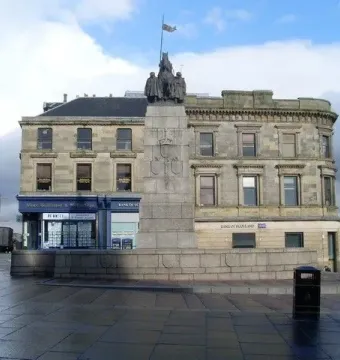
March 2009 © Stephen Sweeney · CC BY-SA 2.0
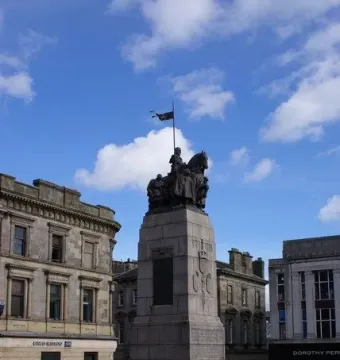
September 2006 © Raymond Okonski · CC BY-SA 2.0
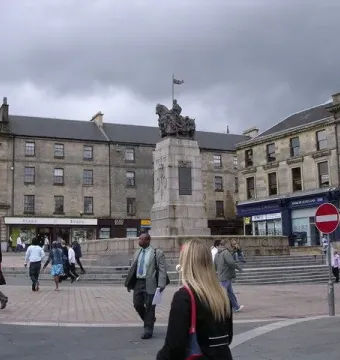
June 2006 © Iain Marshall · CC BY-SA 2.0
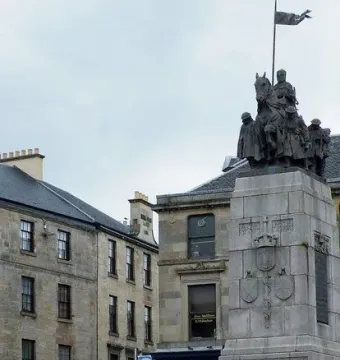
June 2009 © Thomas Nugent · CC BY-SA 2.0
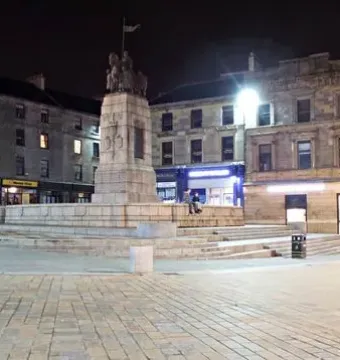
November 2013 © Thomas Nugent · CC BY-SA 2.0
Identification | |
| Title | Paisley War Memorial |
| Type | War memorial |
| Alternative name | Paisley Cenotaph |
Location and ownership | |
| Location | Centre of Paisley, Renfrewshire, Scotland, in an open area between High Street, Gilmour Street, and Moss Street |
Historical context | |
| Dedicated to | The 1,953 men of Paisley who gave their lives on land and sea in the First World War |
| Commissioned after | The First World War |
| Competition for design | Open competition with 195 entries |
| Funding | £14,000 raised by public subscription |
| Unveiled | 27 July 1924 |
| Listed status | Category B listed in 1980; upgraded to Category A in 1997 |
Creator | |
| Casting foundry | JW Singer & Sons |
| Competition entry title | The Spirit of the Crusaders |
| Associated model location | National Museum of Wales, Cardiff |
| Stone carving | Allen & Sons |
| Architect of base | Sir Robert Lorimer |
| Sculptor | Alice Meredith Williams |
| Builder | Neil McLeod & Sons Limited |
Physical characteristics | |
| Base quantity | About 200 tons |
| Base form | High stone pedestal/foundation |
| Base source | Imported from Shap Fell in Cumbria |
| Base material | Grey granite |
| Material | Bronze sculpture |
| Plinth form | High rectangular stone plinth rising on four steps from a stone platform with a retaining wall on three sides, open to the west |
| Main structure | Bronze equestrian sculptural group on a high rectangular stone plinth |
Appearance | |
| Depicted subject | A medieval knight in armour mounted on a horse, accompanied by four infantry soldiers in First World War battledress with muddy boots, greatcoats, and helmets |
| Depicted motif | Equestrian motif |
| Knight's emblems | The knight carries a shield and pennant bearing the St Andrew's saltire for Scotland |
| Decorative carvings | Arms of the burgh of Paisley, of St Andrew, and of St George carved into the front (south) and rear (north) faces of the plinth |
| Plaques | Bronze plaques mounted on the east and west faces |
| Inscriptions | "TO THE GLORIOUS MEMORY/ OF THE 1,953 MEN OF PAISLEY/ WHO GAVE THEIR LIVES ON LAND/ AND SEA IN THE GREAT WAR"; "AND IN GRATEFUL REMEMBRANCE OF THE/ MEN AND WOMEN OF THIS BURGH WHO/ GAVE THEIR LIVES FOR THEIR COUNTRY/ IN THE WORLD WAR 1939-1945" |
History and restoration | |
| Unveiling ceremony | Unveiled before a crowd of 20,000 people by Mrs Macnab, a widow who lost three sons in the Great War, with prayer by Rev. Dr A. M. MacLean of Paisley Abbey; Provost Glover and former Provost John Robertson were present |
| Later collaboration | After this memorial, Alice Meredith Williams collaborated with Sir Robert Lorimer on sculptures for the Scottish National War Memorial in Edinburgh |