
Lycosoura Demeter
Lycosoura Demeter is a surviving remnant of a colossal sculpture of Demeter created by the sculptor Damophon in 180 BC for the Temple of Despoina in ancient Lycosura, now in Arcadia, Greece. It belonged to a local mini-pantheon that also included Artemis, the Titan Anytos, and Despoina, whose true name was unknown according to Pausanias. The cult statues were believed to have stood about 6 meters high and were also depicted on Roman provincial currency issued by Megalopolis. The bust is now housed in the National Archaeological Museum, alongside the bust of Artemis, designated NAMA 1734.
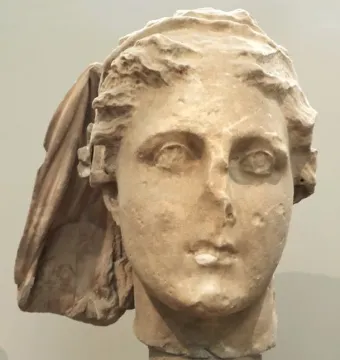
July 2023 © Francesco Bini · CC BY-SA 4.0
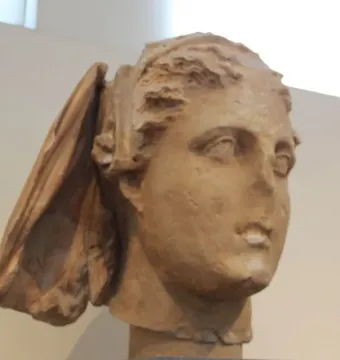
July 2016 © Gary Todd · CC0
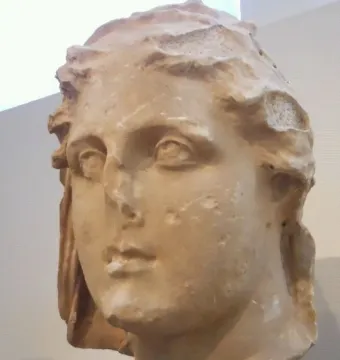
March 2010 © Erik Drost · CC BY 2.0
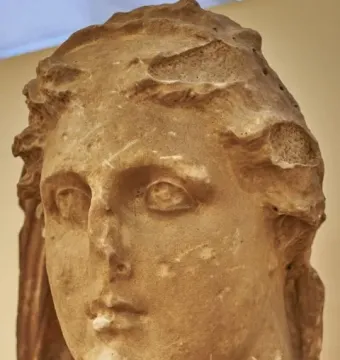
October 2021 © George E. Koronaios · CC BY-SA 4.0
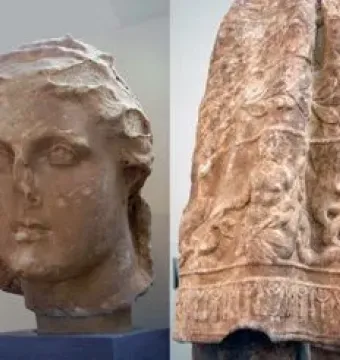
2007 © Nefasdicere · CC BY 2.5
Identification | |
| Title | Lycosoura Demeter |
| Subject | Demeter |
| Type | Acrolith fragment of a colossal sculpture |
| Alternative title | Demeter of Lycosura |
Creator | |
| Sculptor | Damophon |
Historical context | |
| Date created | 180 BC |
| Created for | Temple of Despoina |
| Original location | Ancient Lycosura, Arcadia, Greece |
| Associated sanctuary | Sanctuary of Despoina |
| Associated cult group | A prominent mini-pantheon in the city |
Iconography and meaning | |
| Estimated height of cult statues | About 6 meters |
| Ancient documentation | Depicted on Roman provincial coins issued by Megalopolis |
| Religious interpretation | The sanctuary deities are considered chthonic and part of the Eleusinian Mysteries |
| Historical source | Pausanias, Description of Greece (Hellados Periegesis) |
| Despoina name | 'The Mistress'; her true name remains unknown |
| Associated deities | Demeter, Artemis, Anytos, and Despoina |
Discovery and provenance | |
| Excavation location | Lycosura, 7 km west of Megalopolis |
| Excavation date | Summer 1889 and the turn of the century |
| Recovery context | Fragments recovered from the Sanctuary of Despoina, together with fragments of Artemis, Anytos, and Despoina's chest and robe |
| Recovered fragments | Fragments of Artemis, Anytos, and Despoina's chest and robe |
| Museum transfer | Heads of Demeter, Artemis, and Anytos were transferred to the National Archaeological Museum |
| Museum inventory numbers | Demeter head no. 1734; Artemis head no. 1735; Anytos head no. 1736; portion of Despoina's mantle no. 1737 |
Location and ownership | |
| Current location | National Archaeological Museum |
| Related museum object | Bust of Artemis, NAMA 1734 |
| Current location of related parts | Torsos and arms kept at the local Lycosura Museum |
Physical characteristics | |
| Pose / hold | Pausanias says Demeter held a torch in her right hand and rested her left hand on the statue of Despoina |
| Shared throne and footstool | Demeter and Despoina would have shared a throne and a footstool made from a single block of marble |
| Preserved part | Bust |
| Appearance | As a matron, Demeter has a queenly presence |
| Prominence | One of the main focal objects of the pantheon |
| Adornment | Holes carved in the head for a metal diadem |
| Hair | Wavy locks |
| Face treatment | The face is carved in a single piece; unlike Artemis, its eyes are not inlaid |
| Height | 75 cm |
| Veil | The veil is well preserved |
Materials | |
| Construction | Composite sculpture made of multiple materials |
| Head material | Local marble |
| Hands material | Local marble |
| Feet material | Local marble |
| Chest material | Wood |
| Clothing material | Wood |
Other | |
| Nearby find | A kore of Persephone was found in a nearby sanctuary |