
Monumento ao Conde de Porto Alegre
Monumento ao Conde de Porto Alegre is a public monument in Porto Alegre, Brazil, dedicated to Manuel Marques de Sousa, Count of Porto Alegre. It was first erected in 1885 in Praça da Matriz, in front of the government palace, and moved to its current site in Praça Conde de Porto Alegre in 1912. The present work shows the count in full military dress, holding his hat in his right hand and his gloves in his left, standing beside a small plinth on a tall granite pedestal with a marble plaque bearing his coat of arms and title. The statue was originally commissioned from Gustavo Saenger, but the final work was carried out by Adriano Pittanti’s workshop, with possible involvement by Carlo Fossati.
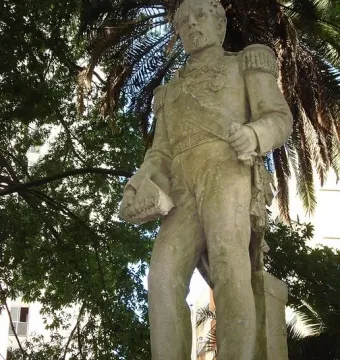
2008 © User:Tetraktys · CC BY-SA 3.0
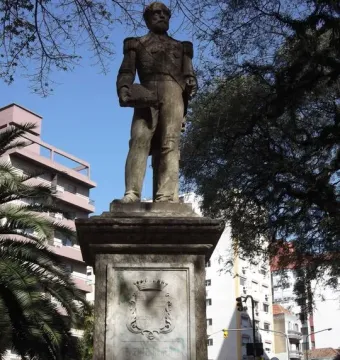
August 2011 © Eugenio Hansen, OFS · CC BY-SA 3.0
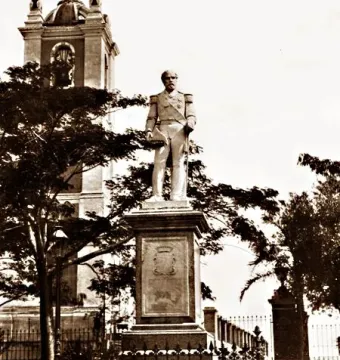
1902 © Escultura de Aurélio Pittanti e Carlos Fossati. Fotografia de autor desconhecido · Public domain
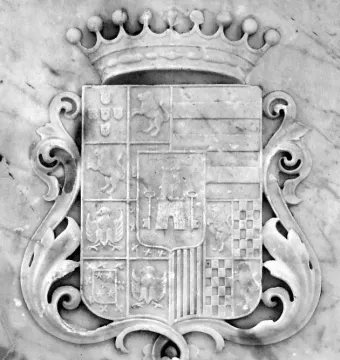
2008 © Tetraktys · CC BY-SA 3.0
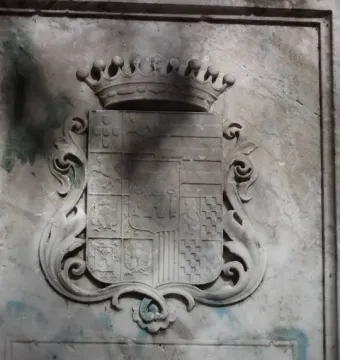
August 2011 © Eugenio Hansen, OFS · CC BY-SA 3.0
Identification | |
| Title | Monumento ao Conde de Porto Alegre |
| Type | Public monument |
| Subject | Manuel Marques de Sousa III, Count of Porto Alegre |
| Nickname of honoree | Centaur of Gloves |
| Alternative title | Monumento al Conde de Porto Alegre |
Historical context | |
| Initial project | A grand monument with a 2.2-meter statue of the honoree, a 6-meter pedestal in the form of an ornate Corinthian column with a laurel wreath, the count's coat of arms and a national emblem, an inscription plaque, and two allegorical figures at the base representing Peace and War |
| Initial project fate | Abandoned for unknown reasons |
| Initial estimated completion time | Two years |
| Initial estimated cost | Ten contos de réis |
| Initial project presentation date | 10 December 1878 |
| Commission | Commissioned after a public competition |
| Honoree's role at Tuiuti | Hero of the Battle of Tuiuti |
| Honoree's military associations | War of Cisplatina, Ragamuffin War, War against Oribe and Rosas, Battle of Tuiuti during the Paraguayan War |
| Historical significance | First monument installed in Porto Alegre |
Creator | |
| Initial designer | Gustavo Saenger, marbler and sculptor from Cacimbinhas |
| Final workshop | Adriano Pittanti's workshop |
| Artist | Adriano Pittanti |
| Assistant | Carlos Fassatti |
| Alternative authorship claim | According to Paschoal Fossati, the statue was made by Carlo Fossati, who was entrusted with the undertaking, made the model, and carried out much of the transfer to marble; Domenico Pittanti may have helped in the final stage |
| Authorship status | The article's author considers the alternative claim credible but does not adopt it due to lack of other historical proof, though he leans toward accepting it |
Discovery and provenance | |
| Model origin | Based on a maquette conceived in Italy |
| Model preservation | Preserved by the Câmara family |
Location and ownership | |
| Former square name | Praça General Marques |
| Reason for relocation | The square was renamed from Praça General Marques to Praça Conde de Porto Alegre by intendente José Montaury |
| Renamed square | Praça Conde de Porto Alegre |
| Original location | Praça da Matriz, in front of the government palace, Porto Alegre |
| Relocated by | Intendente José Montaury |
| Current location | Praça Conde de Porto Alegre, Porto Alegre, Brazil |
| Current location since | 1912 |
Physical characteristics | |
| Form | Life-size statue of the count |
| Depicted attire | Formal military dress |
| Pose | Holding his hat in the right hand and his gloves in the left hand, leaning against a small plinth behind his left leg |
| Pedestal | Tall stone pedestal |
Materials | |
| Plaque material | Marble |
| Pedestal fabrication location | Rio de Janeiro |
| Pedestal material | Granite |
| Statue material | Marble |
Appearance | |
| Front plaque | Marble plaque with the count's coat of arms and title |
| Pedestal description | The pedestal has a laurel wreath, the count's coat of arms, a national emblem, and an inscription plaque |
Iconography and meaning | |
| Possible interpretation of pose | Possibly alluding to his nickname, "Centauro de Luvas" |
| Dedicated to | Manuel Marques de Sousa III, Count of Porto Alegre |
History and restoration | |
| Inauguration date | 1 February 1885 |
| Inauguration attendance | Large public crowd, Princess Isabel, the president of the province, municipal councilors, the consular corps, and other high authorities |
| Critical reception | Praised for the perfect resemblance of the subject and the refined technique of the marble work |
| Year erected | 1885 |
| Original installation date | 1885 |