
Relief of a Runner
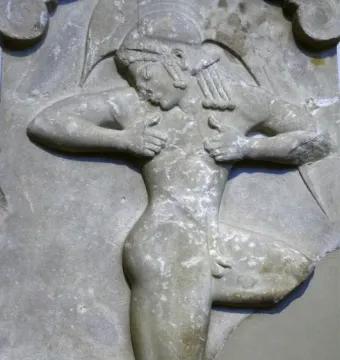
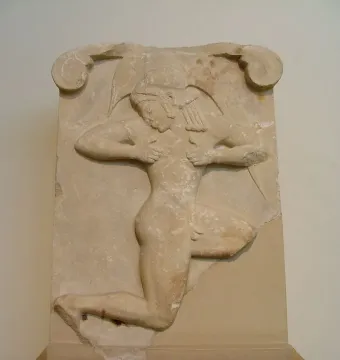
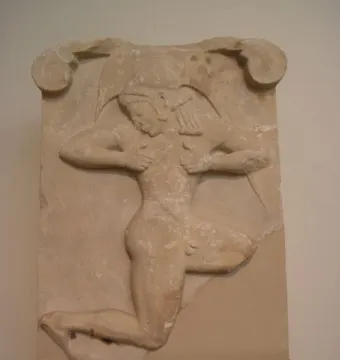
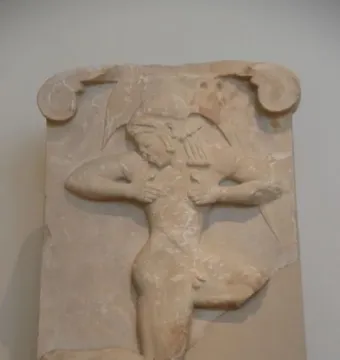
Relief of a Runner is an early Classical relief in the Archaeological National Museum of Athens (NAMA), inventory no. 1959. Dating to around 500 BC, it is carved from Parian marble and preserves only part of its original trapezoidal form, with the upper section and lower right corner missing. The young nude man wears only an Attic helmet and is shown in a dynamic left-to-right movement, with his head turned back. His body combines a forward motion with a frontal upper torso, making the work important for understanding the development of Attic art between the archaic and classical periods. The relief was found in 1901 near the Theseion in Athens and may once have formed part of a grave monument or the side of a base for one.
July 2007 © ANA BELÉN CANTERO PAZ · CC BY 2.0
· CC BY-SA 4.0
· CC BY-SA 2.5
July 2016 © Gary Todd · CC0
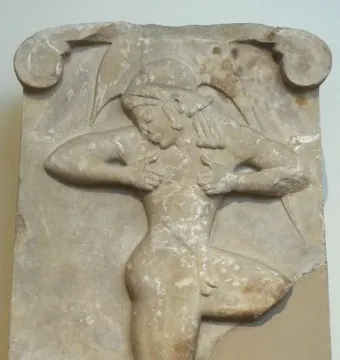
March 2014 © Zde · CC BY-SA 3.0
Identification | |
| Title | Relief of a Runner |
| Type | Relief sculpture on a stele |
| Object type | Funerary monument fragment |
| Alternative title | Hoplitodrome stele |
Historical context | |
| Date | circa 500 BC |
| Style period | Late Archaic period of Greek sculpture |
Creator | |
| Creator | Unknown |
Discovery and provenance | |
| Current location | National Archaeological Museum, Athens |
| Inventory number | 1959 |
| Discovery place | Near the Theseion / Thiseion district (Hephaesteion), Athens |
| Discovery date | 1901 or 1902 |
Physical characteristics | |
| Shape | Trapezoidal |
| Condition | Heavily damaged; the upper part and the lower right corner are missing |
| Preserved decorative elements | Two volutes in the upper corners are preserved |
| Dimensions | 1.02 m high and 73 cm wide; slightly smaller than life-size |
Materials | |
| Material | Parian marble |
Technique | |
| Relief technique | Low relief |
Appearance | |
| Arms position | Strongly bent and raised high, with the hands held in front of the chest |
| Musculature | Musculature is only lightly indicated, giving an athletic impression |
| Hair treatment | Hair shown in several braided strands, fastened at the ends with shell-like or bead-like ornaments; similar shell-like locks appear at the forehead beneath the helmet |
| Headgear | Attic military helmet |
| Head position | Turned backward to the left and slightly inclined downward |
| Body orientation | Lower body turned to the right; upper body shown in a separate twist, with the chest and shoulders nearly frontal |
| Movement | The figure moves from left to right |
| Depicted figure | A young nude man |
Iconography and meaning | |
| Subject | A runner, possibly in an armed race |
| Alternative interpretation | Possibly a pyrrhichist, a dancer in the armed pyrrhic dance |
| Action | The runner appears to look back at his pursuers while moving forward |
| Nudity | The nudity is symbolic rather than literal |
| Helmet meaning | The helmet suggests the runner should be imagined armed and armored |
| Form and motif | The shape of the stone and the motif closely fit and appear to have shaped one another |
| Body movement | The body's contortions are characteristic of the period and were a novelty at the time |
Location and ownership | |
| Probable original context | Funerary monument |
History and restoration | |
| Function | Its purpose is uncertain |
| Possible function | Possibly a small funerary stele serving as a monument in itself |
| More probable function | Probably one side of a base made for a larger funerary monument |
Significance | |
| Art-historical significance | Important for the study of Attic art; marks the transition from Archaic rigidity to more dynamic Classical art |