
Harvey W. Scott
Harvey W. Scott is a bronze sculpture by Gutzon Borglum depicting American pioneer, newspaper editor, and historian Harvey W. Scott (1838–1910). Modeled in 1930 and sculpted in 1933, it is among Borglum’s final works and was donated by Scott’s family. The statue was installed on Mount Tabor in Portland, Oregon, where it remained until it was toppled in October 2020. The memorial’s dedication drew 3,000 people, including Governor Julius Meier and Portland mayor Joseph K. Carson. It has been vandalized multiple times and was long featured in Portland guides. The city is now deaccessioning the statue and plans to replace it with a sculpture of York.
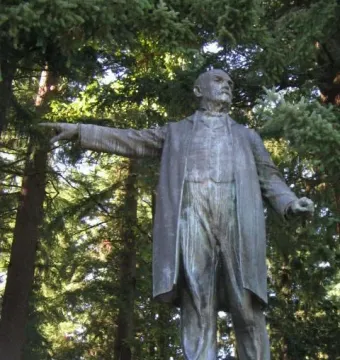
September 2007 © Cyborgjohnson · Public domain
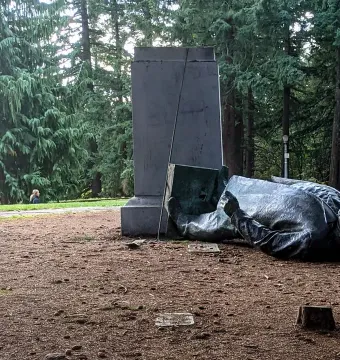
October 2020 © Ted Timmons · CC BY 4.0
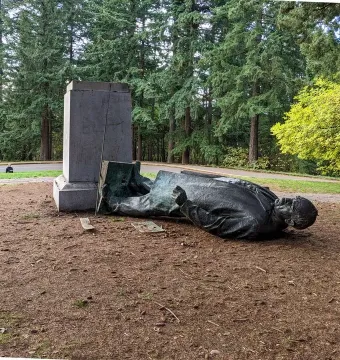
October 2020 © Ted Timmons · CC BY 4.0
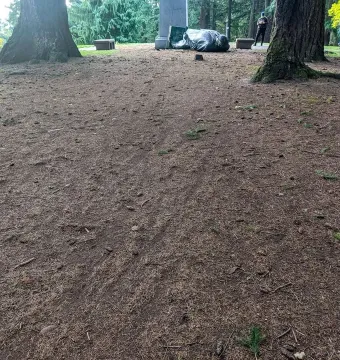
October 2020 © Ted Timmons · CC BY 4.0
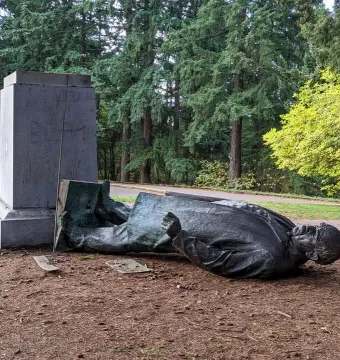
October 2020 © Ted Timmons · CC BY 4.0
Identification | |
| Title | Harvey W. Scott |
| Alternative names | Harvey Scott; Harvey W. Scott |
| Type | Bronze statue |
| Memorial type | Memorial |
Iconography and meaning | |
| Gesture meaning | Pointing westward toward downtown Portland and the future |
| Subject | Harvey W. Scott (1838–1910), American pioneer, newspaper editor, and historian; long-time editor of The Oregonian |
Creator | |
| Artist | Gutzon Borglum |
| Assistant | Ivan Houser |
Historical context | |
| Modeled | 1930 |
| Sculpted | 1933 |
| Creation context | Among Borglum's final works; created while he was also working on Mount Rushmore, South Dakota |
Discovery and provenance | |
| Site approval | The arts commission approved the south slope of the dormant volcano at Mount Tabor in May 1930 |
| Site selection | Selected by Borglum and the city's arts commission; Borglum described Mount Tabor as 'the most poetic, the most beautiful of all' after a 1928 visit to Portland with his son Lincoln as guests of Leslie Scott and Colonel A. E. Clark |
| Chosen site | Mount Tabor |
| Possible sites considered | Mount Scott Park; the North and South Park Blocks; Terwilliger Boulevard; Washington Park |
| Site selection year | 1928 |
| Artist selection | Chosen by the Scott family |
| Estate executors | Leslie M. Scott and Ambrose B. Scott |
| Bequest | $20,000 from Margaret Scott's estate upon her death in 1925 |
| Gifted by | Scott's wife Margaret and other family members |
| Commissioned recipient | City of Portland |
Materials | |
| Sculpture material | Bronze |
| Base material | Granite |
| Replacement pedestal material | Bronze |
Physical characteristics | |
| Weight | 2 tons |
| Dimensions | 3.4 m × 1.1 m × 1.2 m |
| Base dimensions | 2.6 m × 1.7 m × 1.9 m |
Appearance | |
| Expression | Scowling |
| Pose | Wearing a knee-length coat and extending his right arm westward |
Location and ownership | |
| Placement within site | South side of the summit, on the south slope |
| Setting | Mounted on a basalt terrace with two concrete benches and steps |
| Orientation | Faces southeast, toward Mount Scott |
| Administration | Originally administered by the Portland Bureau of Parks and Recreation; later by the City of Portland and Multnomah County Public Art Collection through the Regional Arts & Culture Council |
| Condition | Vandalized multiple times; inspected in 1993 by the Smithsonian Institution's Save Outdoor Sculpture! program and considered well maintained |
| Original location | Mount Tabor Park, Mount Tabor, southeast Portland, Oregon, United States |
History and restoration | |
| Invocation | J. Whitcomb Brougher, pastor of Boston's Tremont Temple Baptist Church |
| Current status | In 2024, the city announced plans to deaccession the statue and replace it with a permanent sculpture of York |
| Post-removal development | In February 2021, a bust of York by an unknown artist appeared on the pedestal; it was shown bald and bore the plaque text 'The first African American to cross North America and reach the Pacific Coast' and was toppled in July 2021 |
| Related removals | Statues of Thomas Jefferson and George Washington, and the Abraham Lincoln and Theodore Roosevelt, Rough Rider statue, were also toppled earlier in 2020 |
| Removal | Toppled in October 2020 during removals of statues in Portland amid the George Floyd protests |
| Vandalism incidents | Vandalized in May 2019 and again in November 2019, when red paint reading 'No Thanks Land' and 'Chinook Land' was added |
| Restoration | 2010 restoration costing $8,000 and partly funded by the Oregon Cultural Trust |
| Temporary storage | 1953, while the original pedestal was replaced after cracking |
| Maintenance fund | Scott Statue Memorial Fund, created in the 1940s by Scott family members with $5,000 for future maintenance |
| Formal presentation | Presented by Leslie Scott |
| Program chair | Colonel A. E. Clark |
| Received by | Mayor Joseph K. Carson |
| Unveiling | Unveiled by Elizabeth Scott, Scott's granddaughter |
| Dedication speakers | Governor Julius Meier; Chester Harvey Rowell; Joseph Schafer |
| Dedication | July 1933, in an impressive ceremony attended by about 3,000 people including numerous out-of-town dignitaries |
| Arrival of monument | July 1933 |
| Final placement decision | February 1932, by the arts commission, members of Oregon's chapter of the American Institute of Architects, and Leslie Scott |
| Temporary display | Displayed on a wooden structure at Mount Tabor's summit while the permanent granite base was being finalized; two temporary bases were used |
| Arrival in Portland | April 10, 1931 |
Significance | |
| Guidebook presence | Featured in many Portland guides as a feature of Mount Tabor |