
Memorial Passages for Walter Benjamin
Memorial Passages for Walter Benjamin is a memorial by Israeli artist Dani Karavan located in the Catalan town of Portbou, just beside the local cemetery. The sculpture commemorates the German philosopher Walter Benjamin, who died tragically in Portbou on 26 September 1940 during an unsuccessful attempt to cross the French border. Benjamin had planned to flee Nazi authorities by traveling through Spain to Portugal and then on to the United States. Stopped by border guards who refused him passage, he feared being handed over to the Gestapo and took his own life.
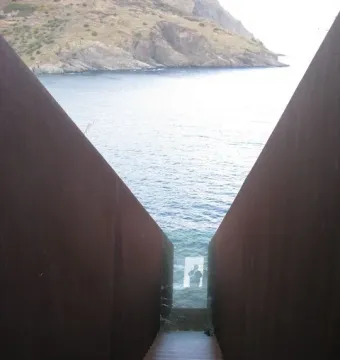
December 2009 © Wamito · Public domain
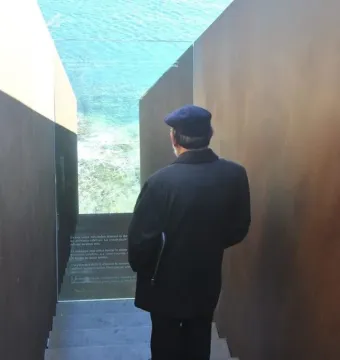
September 2010 © Generalitat de Catalunya · Attribution
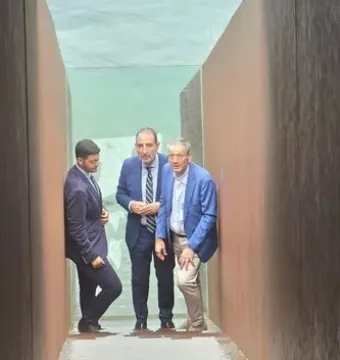
© Government of Catalonia · Attribution
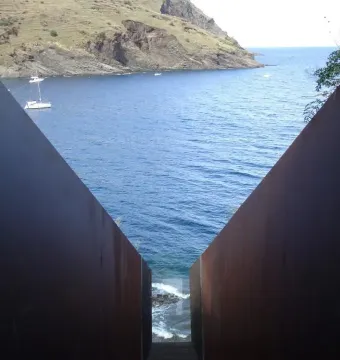
September 2014 © Guillem.rubio · CC BY-SA 4.0
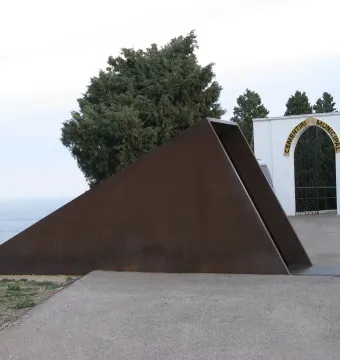
December 2009 © Wamito · Public domain
Identification | |
| Title | Memorial Passages for Walter Benjamin |
| Catalan title | Passatges |
| Official German title | "Passagen" – Gedenkort für Walter Benjamin und die Exilierten der Jahre 1933–1945 |
| Type | Memorial sculpture; memorial site |
| Original-language title | Passagen |
Historical context | |
| Subject | Walter Benjamin and the exiles of 1933–1945 |
| Commemorated person | Walter Benjamin, German philosopher |
| Historical context | Created in connection with Walter Benjamin's death and exile history; Benjamin died in Portbou on 26 September 1940 while fleeing Nazi authorities and attempting to cross from France into Spain on his way to Portugal and then the United States |
| Related route | Crossing the Pyrenees to Portbou with a small group led by Lisa Fittko on 25 September 1940 |
| Death circumstances | Benjamin died in his hotel room on the night of 26 September 1940; it is suspected that he took his own life with an overdose of morphine after learning that the refugee group would be deported back to France |
Creator | |
| Artist | Dani Karavan |
| Artist nationality | Israeli |
| Artist profession | Sculptor |
Discovery and provenance | |
| Funding | Originally budgeted very modestly; initial funding was stopped by the German Foreign Office after criticism, and the project was later financed by 12 German federal states, the regional government of Catalonia, and private donors |
| Gifted to | The municipality of Portbou |
| Estimated cost | 980,000 DM |
| Planning organization | Arbeitskreis selbständiger Kultur-Institute e.V. (AsKI) |
| Artist selection | In 1989, Konrad Scheurmann of AsKI, acting under authorization from the German Foreign Ministry, contacted Karavan and offered him the commission |
| Initiated by | At the suggestion of Federal President Richard von Weizsäcker |
| Commissioned by | The German Foreign Office and the Federal Ministry of the Interior, with the Catalan and German authorities involved |
Location and ownership | |
| Location | Portbou Cemetery, Portbou, Catalonia, Spain |
| Site | On a rocky peninsula just outside Portbou, about 20 meters above sea level, with views over Portbou Bay |
| Site significance | Built at the place where Walter Benjamin died |
| Site selection | The authorities of Portbou gave the artist complete freedom to choose the location |
| Landscape setting | Integrated into a seaside landscape |
Materials | |
| Primary materials | Rusting steel and glass |
Physical characteristics | |
| Visibility | The sea is not visible while descending; it becomes visible only at the bottom |
| Composition | Three passages in total: the tunnel passage and two walks along the path |
| Lower end | Closed with a glass plate |
| Components | A small four-step staircase ending abruptly; a square platform with a cube in its center; a northeast stair descending from the cemetery forecourt into the rock; a steel corridor open to the sky extending over the sea and ending in a glass plate; a rocky path leading to an olive tree and a viewing point |
| Access | Visitors can enter the monument |
| Steel plates height | 2.35 metres |
| Form | A descending corridor-like memorial composed of several elements distributed across the landscape |
| Steps | 87 steep steps leading down to the water |
Appearance | |
| Setting details | A rocky path leads to an olive tree and to a point where the sea and horizon can be seen through the cemetery fence |
Iconography and meaning | |
| Inscription | A quotation from Walter Benjamin's notes for his final Theses on the Concept of History, written in 1939: "Schwerer ist es, das Gedächtnis der Namenlosen zu ehren als das der Berühmten. Dem Gedächtnis der Namenlosen ist die historische Konstruktion geweiht. Walter Benjamin, G.S. I, 1241" |
| Inscription language | German, with versions in several languages including English |
| English quotation | "It is a more arduous task to honour the memory of anonymous beings than that of famous persons. The construction of history is consecrated to the memory of those who have no name." |
| Title meaning | The title alludes both to Benjamin's last failed crossing from France to Spain and to his unfinished work Passages |
| Themes | Loneliness and exile; commemoration of the anonymous rather than the famous |
History and restoration | |
| Unveiling date | 15 May 1994 |
| Related publication | "Für Walter Benjamin"; French, English, and Spanish editions were also issued |
| Related exhibition | "Grenzüberschreitungen. Walter Benjamin – Leben und Werk" |
| Reaction | The funding stoppage caused broad incomprehension in the international cultural public |
| Public criticism | The Federal Court of Audit criticized the project, apparently based on incorrect information, saying that a grave-maintenance measure had become a million-mark project; the tabloids Bild and Neue Revue sensationalized the cost |
| Unveiling attendees | Richard von Weizsäcker, Lisa Fittko, Princess Helga Maria zu Löwenstein-Wertheim-Freudenberg, Volkmar Zühlsdorff, representatives of the German authorities and the authorities of Portbou |
| Foundation stone laid | 26 September 1990, the 50th anniversary of Walter Benjamin's death |
| Construction resumed | After support from Richard von Weizsäcker |
| Construction delay | Construction was suspended because of debate in Germany over whether the project should be financed |
| Planned opening | 1992, for Walter Benjamin's 100th birthday |
| Construction start | 26 September 1993 |
| Surveying and layout | In 1990 Karavan measured the site and marked out the sculpture's layout |
| First visits | Karavan visited Portbou in October 1989 and December 1989 |
| Additional documentation | New documents about Walter Benjamin's death were discovered in the municipal archive in Portbou during the exhibition and published by AsKI in autumn 1992 |