
Vénus de Quinipily
Vénus de Quinipily is an ancient granite statue in southeast Baud, Morbihan, Brittany, in north-western France. About 2.2 metres high, it depicts a naked woman and stands before a fountain on a 2.75-metre granite pedestal, with a large basin carved from a single stone block beneath it. Its origins are uncertain, and it has been variously attributed to Greek, Roman, or Egyptian influence. The statue’s subject is also debated, with possible identifications including a Celtic deity, Cybele, or Isis. Originally erected at Castennec, it became a centre of superstitious rites for centuries. After being thrown into the Blavet river twice and recovered both times, it was altered in 1701 and installed at its present site at Quinipily.
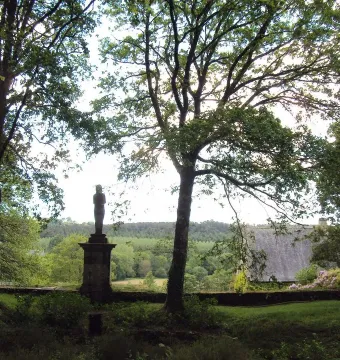
May 2014 © Erwan Corre · CC BY-SA 3.0
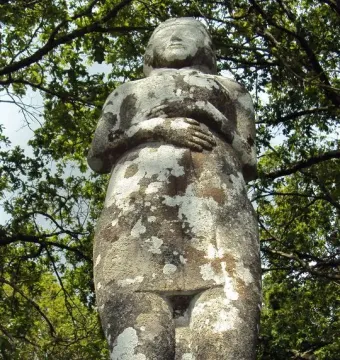
May 2014 © Erwan Corre · CC BY-SA 3.0
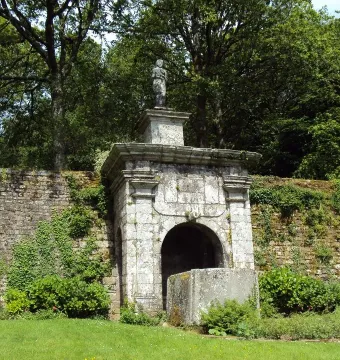
May 2014 © Erwan Corre · CC BY-SA 3.0
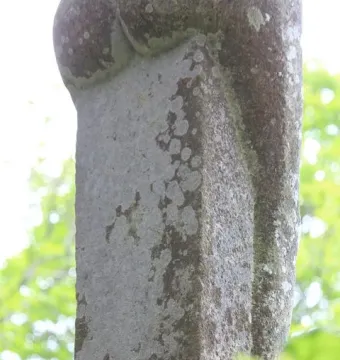
June 2014 © XIIIfromTOKYO · CC BY-SA 3.0
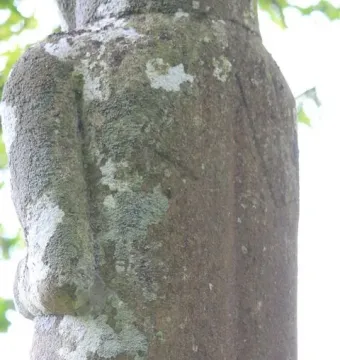
June 2014 © XIIIfromTOKYO · CC BY-SA 3.0
Identification | |
| Type | Ancient statue |
| Title | Vénus de Quinipily |
Historical context | |
| Date | Possibly around 49 BC, but the date and origin are uncertain |
| Early significance | It was said to have been a centre of superstitious rites in Brittany for centuries and a source of local healing waters |
| Historical conflict | Its history is tied to Roman, Breton, and Christian-era religious conflict and local legal disputes over ownership |
| Documented references | Mentioned in a 1668 manuscript from the National Library of Paris and in another now-lost manuscript formerly held by a notary of Baud |
Creator | |
| Attribution | Unknown; various hypotheses propose an ancient Greek, Roman, Egyptian, or Celtic origin, or a 17th-century copy made on the order of the Count of Lannion |
Physical characteristics | |
| Inscription on figure | Three letters on the fillet, variously read as I.I.T., I.T.T., J.I.T., or L.I.T.; possibly originally ILITHYIA |
| Associated trough | A monolithic granite trough or stone basin, with a very thin front wall, was also brought from Castennec |
| Fountain form | Chimney-like structure open at the front and sides |
| Clothing or accessory | A band or scarf/stole around the neck falling down the front and covering the pubic area; the only ornamentation mentioned |
| Basin or cistern | Large basin/cistern beneath the statue, carved from a single granite block and filled with water |
| Hands and feet | Fingers and toes indicated by lines |
| Face | Described as resembling Egyptian idols |
| Height | About 2.2 m (7.2 ft) |
| Head and hair | Straight hair, with a band around the head |
| Pedestal height | About 2.75 m (9 ft) |
| Figure | Nude standing woman, sometimes identified as Venus or Isis |
| Pose | Standing with arms crossed under the breasts or wrapped around the belly; legs straight and slightly apart |
| Condition | Damaged and mutilated; the original was said to have broken apart |
Materials | |
| Fountain material | Granite |
| Main material | Granite |
Location and ownership | |
| Ownership dispute | In 1701 the court confirmed Pierre de Lannion's ownership after a dispute with the Duke of Rohan |
| Associated site | Quinipily, Baud, Morbihan |
| Former location | Until an unspecified date, on the territory of the commune of Bieuzy-les-Eaux, later moved to Quinipily |
| Original location | Castennec, Bieuzy-les-Eaux, Morbihan, Brittany, on the site of a former Roman camp (Sulim), near the house of La Couarde and on the Roman road from Vannes to Carhaix |
| Current location | In front of a fountain in the park adjoining the ruins of the Château de Quinipily, about southeast of Baud, Morbihan, Brittany, north-western France |
| Current setting | Placed in front of a large, dilapidated monumental fountain in the park of the château |
Discovery and provenance | |
| Provenance | Associated with Castennec and later transported to Quinipily; it was twice thrown into the Blavet River and recovered |
History and restoration | |
| Reported restoration controversy | Some accounts claim Pierre de Lannion was deceived by the cult around the statue, restored it in 1696, and set it on a pedestal with Latin inscriptions |
| Transport to Quinipily | Transported to Pierre de Lannion's château at Quinipily in 1696; the basin/trough was transported with it |
| Restoration hypothesis | It has been proposed that the original statue did not survive the 1696/1697 restoration and was secretly replaced by a new one |
| Alteration | Substantially altered in 1701; some accounts say the restored statue may have been replaced by a copy |
| First removal and recovery | Thrown into the Blavet River in 1661 and recovered in 1664 |
| Second removal and recovery | Thrown into the Blavet River again in 1670 and recovered in 1695 |
| Recovered by | Pierre de Lannion, lord of Blavet Quinipily |
Appearance | |
| Inscribed name | The pedestal inscriptions call it the Venus Armoricorum Oraculum and also claim dedication to Venus Victrix after the Roman conquest of Gaul |
| Inscribed base text | The base has also been described as reading "Venus Victorious" |
| Local names | Notre-Dame de la Couarde; la femme de fer; la vierge gardienne; Er Groach Couard; Groah-Goard; la Couarde; la Gward; Gronech Houarn; Groah Hoart; Hroech-ar-Gouard; Grock; Groac'h er 'hoard |
| Name meanings | The Breton names have been glossed as "the iron woman," "the guardian virgin," "Cowardly Old Woman," "Good Woman," "The Old Guardian," and "Old Woman (or Witch) of the Guard-House" |
| Inscriptions on pedestal | Four Latin inscriptions were engraved on the new pedestal; the wording is not preserved in the fragment |
Iconography and meaning | |
| Ritual use | For centuries it was an object of local pagan or superstitious veneration, with beliefs in healing, fertility, and magical protection |
| Reported indecent rites | Seventeenth-century accounts describe foul, indecent, and obscene rites and erotic acts near the statue |
| Reported rites | Reported practices included touching the statue to cure illness, ritual visits by childless people, pregnant women walking around it three times and reciting charms, and the use of a band touched to the statue and tied around the waist; after childbirth, women bathed in the basin |
| Possible inscription meaning | The letters on the fillet may originally have read ILITHYIA, the Greek goddess of childbirth; another explanation is that they were later initials carved by Roman officers |
| Stylistic interpretation | The statue has been described as having oriental influences and may not be Gallo-Roman in design |
| Subject interpretation | Various attributions have been proposed: a Celtic deity, the Roman mother goddess Cybele, Isis, Venus, a Roman/Etruscan/Egyptian idol, or a work brought from the East by Roman soldiers |
Significance | |
| Heritage status | Classified as a Monument historique in France on 24 August 1993, with protection effective from 18 November 1943; Base Mérimée reference PA00091021, heritage ID 88378 |
| Database listing | Listed in Base Mérimée, the French Ministry of Culture architectural heritage database |
| Later reception | The statue became a local cause célèbre; later writers debated whether it was genuine or a fake antique, and Prosper Mérimée may have drawn inspiration from it for La Vénus d'Ille |