
Equestrian Statue of Joan of Arc
The equestrian statue of Joan of Arc is a monumental bronze sculpture by French sculptor Paul Dubois. It portrays Joan of Arc as both a warrior and a divinely inspired visionary. The original plaster was presented at the Salon in 1889, following a commission from the city of Reims in 1887. Dubois donated it in 1902 to the Musée Paul-Dubois-Alfred Boucher in Nogent-sur-Seine, now an annex of the Musée Camille Claudel. An earlier plaster version is held at the Ny Carlsberg Glyptotek in Copenhagen. Four casts of the sculpture are in public settings, including Reims, Paris, and Washington.
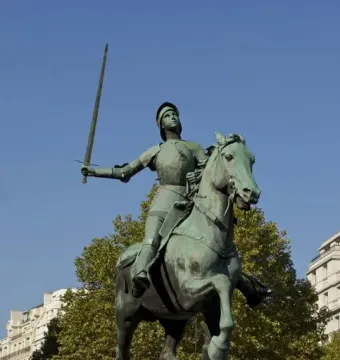
October 2011 © Paul Dubois · CC0
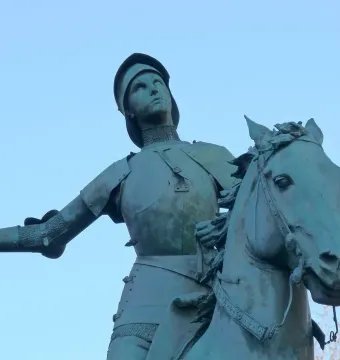
© Siren-Com · CC BY-SA 3.0
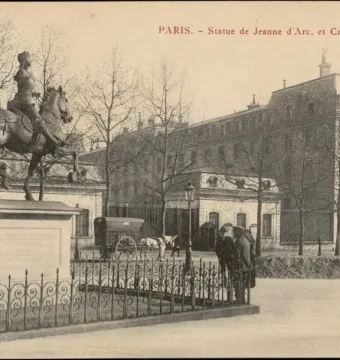
© [s. n.] · CC0
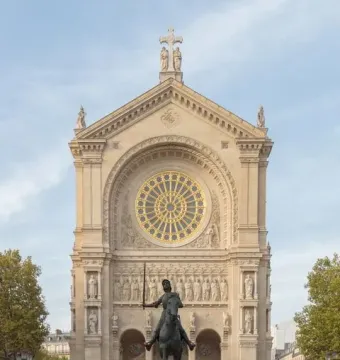
October 2022 © Diego Delso · CC BY-SA 4.0
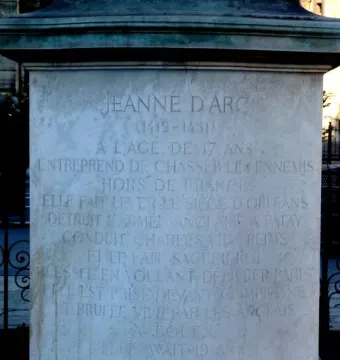
December 2010 © Siren-Com · CC BY-SA 3.0
Identification | |
| Title | Joan of Arc |
| Subject | Joan of Arc |
| Type | Bronze equestrian statue |
Creator | |
| Artist | Paul Dubois |
| Artist nationality | French |
Iconography and meaning | |
| Artistic intention | Dubois sought to give the figure a mystical expression |
| Depiction | Joan of Arc shown as a warrior and divinely inspired visionary |
| Comparison with Emmanuel Frémiet | Unlike Emmanuel Frémiet's 1874 equestrian portrait at Place des Pyramides, Dubois shows Joan of Arc brandishing a sword instead of holding a standard |
| Pose and attitude | Riding a horse at a trot, torso slightly turned, head turned toward the sky |
| Gesture | She brandishes a sword in her right hand; the Washington version holds the horse's reins in her left hand with the right arm raised behind her |
Historical context | |
| Historical interpretation | In the late 19th century, Joan of Arc's exaltation also had symbolic and political significance linked to the loss of Alsace-Lorraine after the Franco-Prussian War of 1870 |
| Original plaster presented at | the Salon in 1889 |
| Purpose of commission | To create a monument to Joan of Arc |
| Contract signed | Paul Dubois, architect Alphonse Gosset, and notary Raoul Douce |
| Public subscription launched | 1888 |
| Commissioned by | the city of Reims / the Académie nationale de Reims |
| Commission date | 1887 |
Materials | |
| Model version | Non-final plaster version |
| Material | Bronze |
| Model material | Plaster |
Technique | |
| Casting process | Lost-wax process |
Discovery and provenance | |
| Third exemplar date | 1897 |
| Washington replica initiative | First proposed in May 1916 by Polifème to the Fine Arts Commission to celebrate French-American friendship |
| Washington replica | Completed in Paris in 1922 for Washington, D.C. |
| Other bronze cast program | Included in the Smithsonian Institution's program in 1994 |
| Other bronze cast | A bronze cast by Eugène Rudier, signed Alexis Rudier |
| Third exemplar original inauguration location | Garden of the Palais du Rhin, Strasbourg |
| Washington replica donor | Offered by Le Lyceum Société des femmes de France to the women of the United States of America |
| Third exemplar shown at | Exposition Universelle of 1900 |
| Third exemplar quality | Of better quality |
| Second exemplar caster | Edmond Gruet |
| Number of cast exemplars | Three exemplars were made |
| First exemplar commission date | 1890 |
| First exemplar caster | Pierre Bingen |
| First exemplar completion date | 1896 |
| First exemplar location | Place du Cardinal-Luçon, Reims |
| First exemplar donation | Offered to the city |
| Third exemplar material | Bronze |
| First exemplar inauguration | Inaugurated by President Félix Faure |
| Second exemplar exhibited from | 1895 |
| Second exemplar quality | Of poor quality |
| Second exemplar former locations | Peristyle of the Panthéon in Paris; later in front of Saint-Augustin Church, Paris |
| Third exemplar caster | Edmond Gruet |
| Second exemplar ownership | Musée d'Orsay |
History and restoration | |
| Strasbourg statue damage | Broken by the Nazis in 1940 |
| Strasbourg statue inauguration | Inaugurated on an unspecified date; later reinstalled and solemnly inaugurated again after restoration on an unspecified date |
| Strasbourg statue original location | Place de la République, in the Garden of the Palais du Rhin |
| Washington replica condition assessment | A 1994 inspection showed that restoration work was needed |
| Washington replica inauguration date | 6 January 1922 |
| Strasbourg statue wartime preservation | Stored at the Port du Rhin during the war and saved from melting down |
| Strasbourg statue restoration | Restored after 1945, mainly from recovered pieces, especially the head |
| Strasbourg statue missing element | The sword originally held in the right hand was stolen in 1978 |
| Third exemplar reinauguration | Re-inaugurated on an unspecified date |
| World War I history | The statue in Reims was protected during World War I |
| Third exemplar wartime damage | Destroyed during the Second World War |
| Third exemplar reconstruction | Reconstructed after the war |
Location and ownership | |
| Current/known context image location | Place Saint-Augustin, Paris |
| Other bronze cast location | Meridian Hill Park, Washington |
| Paris location | In front of Saint-Augustin Church, Paris, 8th arrondissement |
| Washington replica planned location | Terrace of Meridian Hill Park |
| Washington replica current location | Meridian Hill Park, Washington |
| Third exemplar current location | Parvis of Saint-Maurice Church, Strasbourg |
| Original placement | At the forecourt of Reims Cathedral, facing away from the cathedral to evoke Joan of Arc leaving it after the coronation of Charles VII |
| Current location | Place du Cardinal-Luçon, Reims |
| Strasbourg statue current location | Place Arnold, Strasbourg |
| Model location | Ny Carlsberg Glyptotek, Copenhagen; probably now in the collections of the Musée Camille-Claudel |
Physical characteristics | |
| Pedestal | Granite base with three levels; 1.32 m high and 3.35 m wide |
| Headgear | Helmet with raised visor |
Other | |
| Pedestal inscription | An inscription is present on the pedestal; the Washington replica bears: 'JEANNE D'ARC / LIBERATRICE / 1412-1431 / AUX FEMMES D'AMERIQUE / LES FEMMES DE FRANCE / A NEW YORK / LE 6 JANVIER 1922' |
| Washington replica inauguration attendees | President Harding and the French ambassador, with their wives, were guests of honor |
Significance | |
| Washington replica praise | Henry Bacon wrote that it was one of the most beautiful things in the world and that no setting was too beautiful for it |
| Washington replica critical reception | Artists considered it the most beautiful modern equestrian statue |
| Washington replica commemorative tribute | Paul Claudel paid tribute to it on the anniversary of the martyrdom of Joan of Arc while serving as French ambassador to the United States (1928-1933) |