
Entropa
Entropa is a satirical sculpture by the controversial Czech artist David Černý, commissioned by the government of the Czech Republic for its presidency of the Council of the European Union. Presented on 12 January 2009 and exhibited at the Justus Lipsius building in Brussels, its moving and multimedia elements were activated on 15 January. The work was first believed to be by 27 artists and groups from EU member states, but it was soon revealed that Černý created it with only two or three assistants. Its stereotypes of the 27 EU countries provoked reactions, especially from Bulgaria and Slovakia. The sculpture was removed early on 14 May 2009 and later reinstalled at DOX Centre for Contemporary Art in Prague.
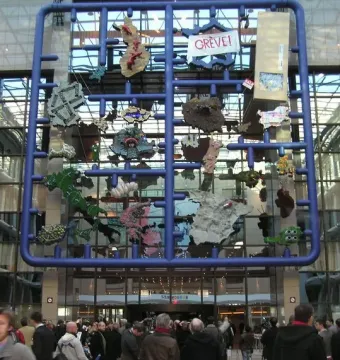
© Blahma · CC BY-SA 4.0
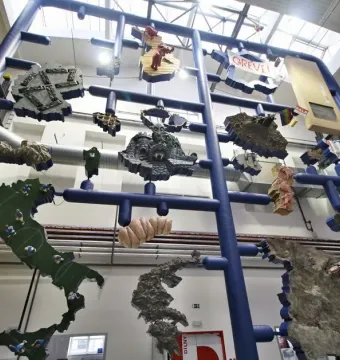
October 2018 © VitVit · CC BY-SA 4.0
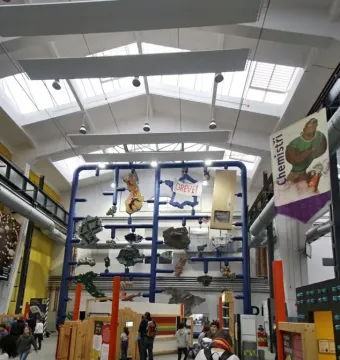
October 2018 © VitVit · CC BY-SA 4.0
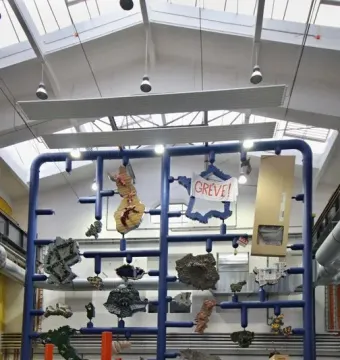
October 2018 © VitVit · CC BY-SA 4.0
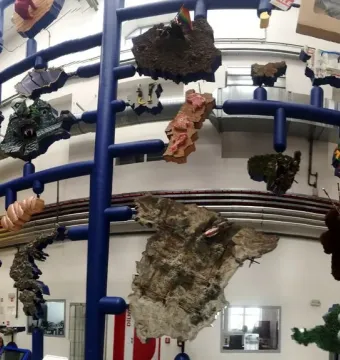
July 2018 © EElizka · CC BY-SA 4.0
Identification | |
| Type | satirical postmodernist sculpture |
| Title | Entropa |
Creator | |
| Artist | David Černý |
| Artist nationality | Czech |
Historical context | |
| Commissioned by | the government of the Czech Republic |
| Commission purpose | to mark the Czech Republic's presidency of the Council of the European Union |
| Council context | the Council of the European Union has a rotating presidency every six months among member-state governments |
| Display custom | the presiding country normally places a symbolic exhibit in the Justus Lipsius building, usually a non-controversial installation |
| Preceding presidency country | France |
| Previous presidency display example | France erected a large balloon in the French national colours |
Discovery and provenance | |
| Brochure claim | a brochure claimed that 26 national artists worked on the work and that Černý was the curator |
| Cost | an unspecified amount of euros |
| Hoax | the work was presented as a collaboration but was actually a hoax |
| Fake collaborator information | Černý and his accomplices invented the names, biographies, websites, and supposed contributions of the other artists |
| Actual creators | David Černý alone, with two or three assistants |
| Initial attribution | initially presumed to have been created by 27 artists and artistic groups from EU member states |
Physical characteristics | |
| Dimensions | about 8 m high and 8 m long; about 16 m wide |
| Weight | about 8 tons |
| Overall form | a kit-like plastic model puzzle with countries arranged like parts in a sprue frame |
| Arrangement | the 27 European Union member states were arranged randomly at a constant scale, with the United Kingdom position left empty |
| Interactive features | some elements were interactive |
Materials | |
| Color of connecting parts | cobalt blue |
Technique | |
| Components | mobile and multimedia components |
Iconography and meaning | |
| Depiction of Poland | Catholic monks raising a rainbow flag in the style of the Iwo Jima flag-raising photograph |
| Interpretive status | no official explanations were provided, so many figures may have more than one interpretation |
| Depiction of the United Kingdom position | empty |
| Themes | critique of issues, prejudices, and stereotypes about EU countries |
| Depiction of the Netherlands | submerged under water with minarets sticking out and muezzins shouting |
| Title meaning | a pun on entropy and Europa |
| Depicted subject matter | the 27 EU member states, represented through stereotypes and prejudices, sometimes in controversial ways |
| Depiction of Bulgaria | a collection of toilets connected by pipes, described as 'Turkish toilets' and later covered with a black cloth |
Location and ownership | |
| Original display location | the atrium of the Justus Lipsius building, Brussels |
| Original display context | installed for the Czech Republic's EU Council presidency in 2009 at the seat of the Council of the European Union |
| Later exhibition location | Techmania Science Center, Plzeň |
| Later exhibition dates | September 2010 to March 2012 |
| Planned copy location | Nová Scéna cafe in the National Theatre in Prague |
| Current location | an art gallery in the outskirts of Prague |
History and restoration | |
| Slovak response | Slovakia also requested removal |
| Artist response | Černý said the work was meant humorously and apologized only for offending some nations, saying it was intended to highlight the negative effects of national stereotypes |
| Presidency response | the Czech presidency decided to present the work, apologized to the affected countries, and offered to replace or remove the most controversial motifs if requested |
| Public reaction | the work caused strong reactions, including astonishment, surprise, discomfort, and applause |
| Public unveiling date | 12 January 2009 |
| Bulgarian response | Bulgaria objected to its depiction as offensive and in bad taste and requested removal or covering; the motif was covered at Bulgaria's choice from 19 January |
| Removal reason | removed early at Černý's request as a protest against the fall of Mirek Topolánek's government |
| Removal date | May 2009 |
| Admission of hoax | 13 January 2009 |
| Official opening date | 15 January 2009 |
| Official confirmation | Vice Prime Minister Alexandr Vondra confirmed that the information about the fabricated artists was true and said he was unpleasantly surprised |