
Victory Arch
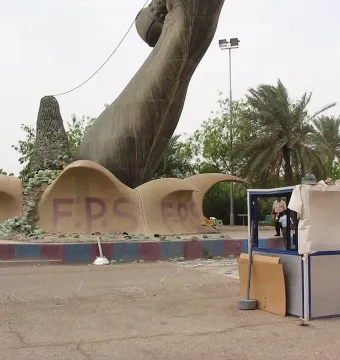
Victory Arch is a 1989 monument in Baghdad made up of two matching triumphal arches set about 650 meters apart at either end of a major parade street. Each arch consists of two 43-meter steel swords held by arms rising from the ground and crossing near their tips at a height of 40 meters. The monument alludes to the Muslim Arab victory over the Sassanids at the Battle of al-Qadisiyyah. The four swords were cast from remains of Iraqi weapons and tanks from the First Gulf War, with major parts produced by a German company and other elements cast in England. The bases are decorated with 2,500 helmets of Iranian soldiers, and the monument stands in Baghdad’s Green Zone.
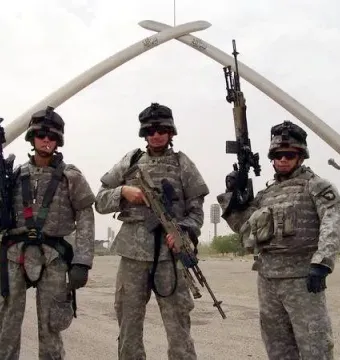
© WHATaintNOcountryIeverHEARDofDOtheySPEAKenglishINwhat · CC BY-SA 3.0
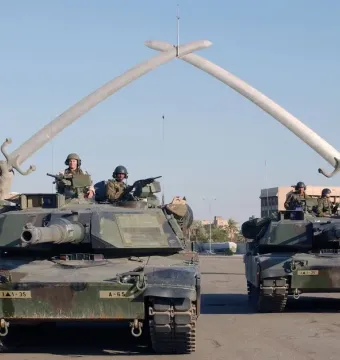
November 2003 © Technical Sergeant John L. Houghton, Jr., United States Air Force · Public domain
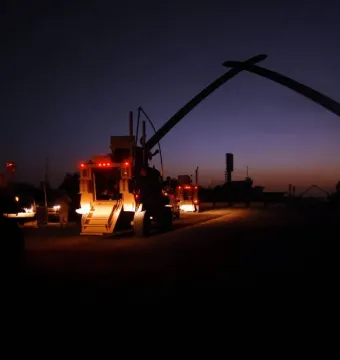
© U.S. Navy photo by Mass Communication Specialist 1st Class Tiffini M. Jones · Public domain
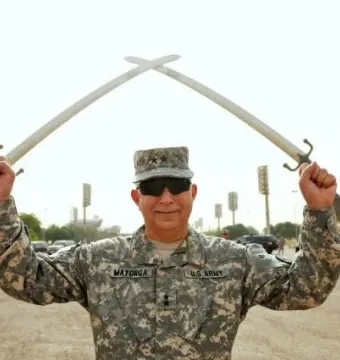
May 2010 © The National Guard · CC BY 2.0
© NetSerfer · Public domain
Identification | |
| Title | Victory Arch |
| Alternative names | Hands of Victory; Crossed Swords; Les Mains de la victoire; Espadas de Qādisiyya; Arc of Triumph; Las Manos de la Victoria |
| Type | Pair of triumphal arches |
| Official name | Swords of Qādisiyyah |
Historical context | |
| Construction began | 1986 |
| Completed | 1989 |
| Opened to the public | 8 August 1989 |
| Official inauguration | 1990 |
| Commemorates | The Iran-Iraq War |
| Commemorative purpose | Built to commemorate Iraq's claimed victory in the Iran-Iraq War |
| Historical reference in name | Alludes to the Battle of al-Qadisiyyah in 636 CE, when Arab armies defeated the Sasanian Empire |
| Historical interpretation | The claimed Iraqi victory is regarded by most international observers as a defeat or stalemate for Iraq |
Creator | |
| Based on | Sketches by Saddam Hussein |
| Design collaboration | Worked in close collaboration with Saddam Hussein |
| Completed by | Mohammed Ghani Hikmat |
| Designer | Adil Kamil |
Discovery and provenance | |
| Manufactured by | An international consortium led by the German company H+H Metalform, with collaboration from Morris Singer Founders |
| Hands cast by | Morris Singer Founders in the United Kingdom |
| Construction involvement | The German company H+H Metallform from Drensteinfurt, Westphalia, was significantly involved in implementation |
Location and ownership | |
| Surroundings | A large reflecting pool and lawns used for military parades |
| Museum location | Ground floor of the grand reviewing pavilion |
| Associated facilities | A Presidential Gifts Museum and a performing arts center |
| Arrangement | The two arches stand at opposite ends of a parade avenue and mark the entrances to Grand Festivities Square and the parade ground |
| Nearby landmark | Near the Monument to the Unknown Soldier |
| Site | The Green Zone, at Grand Festivities Square (also called Great Celebration Square / Grand Carré des Festivités) in Zawra Park near the presidential palace complex |
| Current location | International Zone of Baghdad |
| Location | Central Baghdad, Iraq |
Physical characteristics | |
| Base material | Concrete |
| Sword weight | 24 tonnes each |
| Sword length | About 43 meters each |
| Number of swords | Four |
| Swords meet at height | About 40 meters |
| Structure | Each arch consists of two massive hands rising from the ground and crossing swords near their tips |
| Height | About 40 meters |
| Number of arches | Two |
| Distance between arches | About 650 meters |
Materials | |
| Sword material | Stainless steel |
| Sword source material | Metal from captured Iraqi and Iranian military equipment, including weapons and tanks from the Iran-Iraq War |
| Hand material | Bronze |
| Hand framework material | Steel support framework |
| Bronze casting location | England |
| Hand design basis | Photographs and plaster casts of Saddam Hussein's hands and forearms |
| Thumbprint detail | Saddam Hussein's thumbprint was reproduced in one of the thumbs |
Appearance | |
| Flagpole | A small flagpole stands where the swords meet |
| Original decoration | Originally displayed about 5,000 Iranian soldiers' helmets in nets between the swords and scattered on the ground |
| Helmet placement | About 2,500 captured Iranian helmets on each concrete pedestal at the base |
| Helmet condition | Some helmets were partly perforated by bullets |
Iconography and meaning | |
| Possible dedication allusion | Possibly alludes to Husayn ibn Ali, the Shi'a martyr killed at Karbala in 680 |
| Symbolism | One of the main symbols of Iraq |
| Dedication meaning | A triumphalist symbol of the Saddam Hussein era |
| Broader symbolism | Represents Iraqis who fell in wars throughout the country's history |
History and restoration | |
| Restoration | Restoration of the swords began in February 2011 |
| Demolition plans | The Iraqi government initially planned to demolish the monument, but later abandoned the plan |
| Demolition attempt | Demolition began on 20 February 2007 but was blocked on 21 February 2007 and postponed |
| Damage during demolition | Chunks had been cut out of the bronze monument |
| Public response | Iraqi and preservationist groups protested the dismantling |
| Survival | It was not destroyed during the 1991 Gulf War and remained standing in 2005 |
| Preservation during invasion | It nearly disappeared during the invasion of Baghdad but was saved through intervention by Iraqi artists with coalition forces |
Significance | |
| Tourism | One of Baghdad's main tourist attractions |
| Site significance | Built on the site associated with the Arab victory over the Sasanians and the beginning of Islamic domination of the region |
| Relationship to other monuments | Forms a unit with the Monument to the Unknown Soldier and the Al-Shaheed Monument |
| Related monuments | Monument to the Unknown Soldier (1982) and Al-Shaheed Monument (1983) |
| Purpose in Baghdad public works | Part of Baghdad's beautification and public works program to instil national pride |