
Fuente de la India
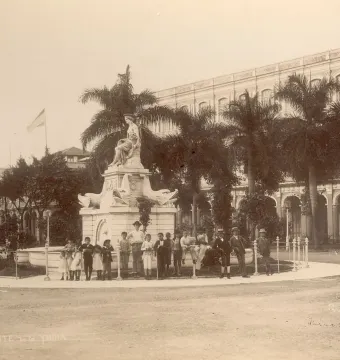
Fuente de la India is a fountain by Giuseppe Gaggini in Havana, Cuba, located at the southern end of Paseo del Prado, about 100 meters south of the Capitol, between Monte and Dragones streets. The figure depicts an Indian woman, “Havana,” after whom the city was named. It was first installed in 1837 outside the city walls, at the end of the Alameda, where a statue of King Carlos III had stood since 1803. Its unveiling was an important event for the young city of San Cristóbal. The fountain was later moved to Central Park in 1863, returned to its original site in 1875, and rotated again in 1928 to face the new Capitol building.
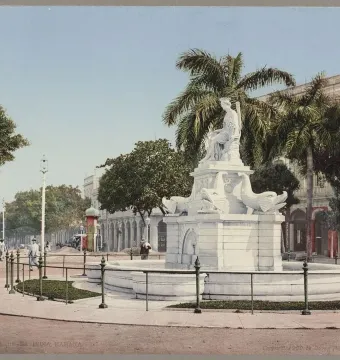
1900 © Detroit Photographic Co., publisher · Public domain
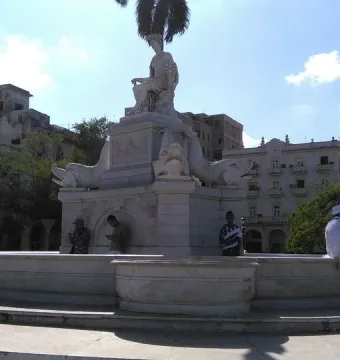
March 2016 © Aniol · CC BY-SA 4.0
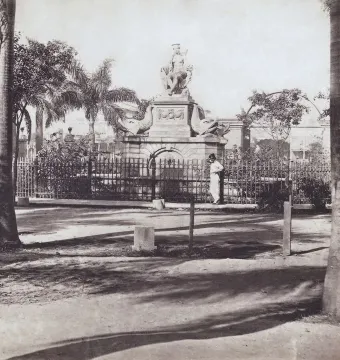
© George N. Barnard · Public domain
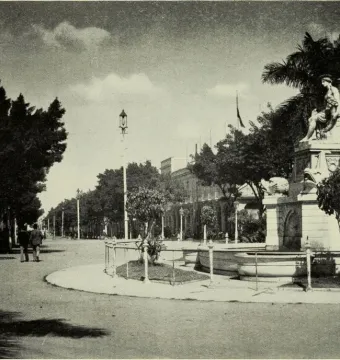
1899 © Internet Archive Book Images · No restrictions
© José Gómez de la Carrera · CC BY 4.0
Identification | |
| Title | Fuente de la India |
| Type | Fountain |
| Alternative name | Fuente de la Noble Habana |
| English translation | Fountain of the Indian woman |
| Original-language name | Фуэнте-де-ла-Индия |
Historical context | |
| Style | Neoclassical |
Creator | |
| Artist | Giuseppe Gaggini |
| Commissioned by | Claudio Martínez de Pinillos, 2nd Count of Villanueva |
Discovery and provenance | |
| Return date | 1875 |
| Adjacent area change | The adjacent area became Plaza de la Fraternidad |
| Reorientation | Rotated 90 degrees to face the new Capitol building |
| Reorientation date | 1928 |
| Return location | Its original site on Paseo del Prado |
| Previous object at site | A statue of King Carlos III stood there from 1803 until the fountain was installed |
| Relocation destination | Central Park (Parque Central) |
| Relocation date | 1863 |
| Initial installation location | Outside the city walls at the eastern end of the Alameda, now Paseo del Prado |
| Brought from Italy | 1837 |
| Modeling location | Carrara, Italy |
| Initial installation date | 1837 |
Physical characteristics | |
| Base | Quadrilateral base with large shells |
| Support figures | Four dolphins, one at each corner of the pedestal |
| Pedestal | Rectangular pedestal |
| Height | About 3 meters |
Materials | |
| Material | White Carrara marble |
| Material | White marble |
Appearance | |
| Subject | A young Indian woman named Habana |
| Pose | Sitting on a rock and looking east as if searching for something on the horizon |
| Facial features | Indian face with a typical Greek female profile |
| Head adornment | Feather crown |
| Shoulder adornment | A quiver of arrows fastened to her left shoulder |
| Right-hand attribute | An oval shield with the original symbols of Havana |
| Left-hand attribute | The cornucopia of Amalthea filled with Cuban fruits and topped with a pineapple |
| Pedestal decoration | Laurels and garlands |
Technique | |
| Water feature | Water flows from the mouths of the four dolphins onto the shells at the base |
Iconography and meaning | |
| Represented figure | The Indian woman Habana, wife of the cacique Habaguanex |
| Named after | The Indian woman Habana, after whom Havana was named |
| Historical interpretation | Habaguanex was the pre-Columbian ruler of the area, and the capital of Cuba is believed to take its name from him |
| Opening significance | Its unveiling was an event in the then-young city of San Cristóbal de La Habana |
| Artistic criticism | The statue’s Greek profile was one of the strongest criticisms of the creator |
Significance | |
| Possible earliest photograph | Some historians say it was the first image captured by a photographer in the city |
| Associated photographer | Antonio Rezzonico |
| Photograph date | Believed to have been taken in the fourth decade of the 19th century |
Location and ownership | |
| Current location | Southern end of Paseo del Prado, Havana, Cuba |
| Orientation | Facing due north |
| Lighting effect | The statue’s face is always in shadow |
| Nearby buildings and areas | About 100 meters south of the Capitol, between Monte and Dragones streets; near Palacio de Aldama and Hotel Saratoga; Campo de Marte in historical images |