
Bartholdi Fountain
Bartholdi Fountain is a monumental public fountain designed by Frédéric Auguste Bartholdi, later the creator of the Statue of Liberty. It was originally made for the 1876 Centennial Exposition in Philadelphia and cast by the Durenne foundry in France. Bartholdi offered the fountain to the exhibition for free, intending to sell it afterward, but after the fair closed it had no buyers. The U.S. Congress purchased it in 1878 and it was installed at Capitol Hill in Washington, D.C. The fountain was removed in 1926, then placed in its current location at the United States Botanic Garden in 1932. A full restoration began in 2008, and the fountain returned to Bartholdi Park in spring 2011.
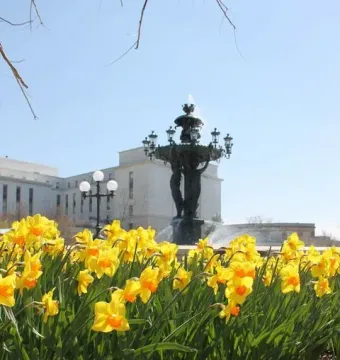
April 2013 © USCapitol · Public domain
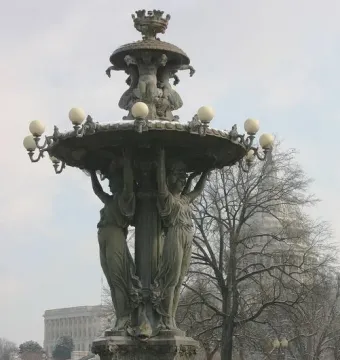
March 2005 © David · CC BY 2.0
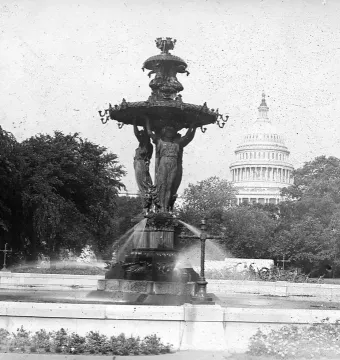
April 2009 © DC Public Library Commons · No restrictions
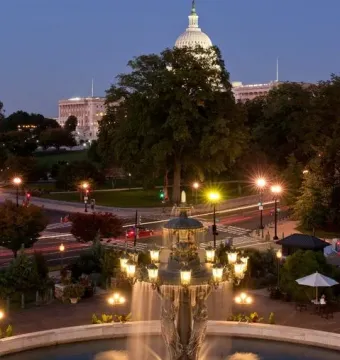
April 2012 © USCapitol · Public domain
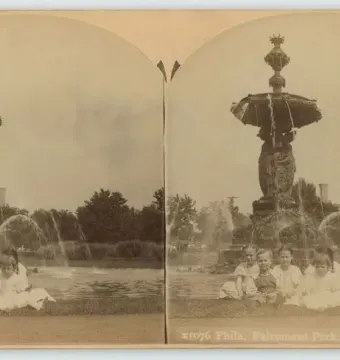
June 2013 © Library Company of Philadelphia · No restrictions
Identification | |
| Title | Bartholdi Fountain |
| Type | monumental public fountain |
| Alternative name | The Fountain of Light and Water |
Creator | |
| Designer | Frédéric Auguste Bartholdi |
| Designer note | later created the Statue of Liberty |
| Sculptor nationality | French |
Historical context | |
| Year created | 1876 |
| Created for | the Centennial Exposition in Philadelphia, celebrating the 100th anniversary of the adoption of the Declaration of Independence |
| Original purpose | made for the Philadelphia World's Fair and intended to be sold afterward |
| Original location | center of the esplanade near the main entrance to the exposition |
Discovery and provenance | |
| Purchased by | the United States Congress in 1878 for $6,000, half of Bartholdi's original asking price |
| Removed and stored | removed and stored in 1926 to facilitate completion of the George Gordon Meade Memorial and landscaping improvements around the Ulysses S. Grant Memorial |
| Relocation proposal | in 1881, Secretary of State James Blaine suggested moving it to Dupont Circle near his new mansion, but the plan was dropped after James Garfield's assassination interrupted the discussions |
| Initial placement in Washington, D.C. | at the base of Capitol Hill in 1878 |
| Offered to the exposition | offered for free |
| After the exposition | Bartholdi found no buyers |
| Historic note | one of the cast-iron fountains by Durenne that won prizes at international exhibitions in 1862, 1867, and 1873 |
| Cast by | the Durenne foundry in France |
| Foundry | Durenne foundry, France |
Location and ownership | |
| Returned to | Bartholdi Park in spring 2011 |
| Placed at current location | 1932 |
| Current location | United States Botanic Garden, on the grounds of the United States Capitol, Washington, D.C., United States |
Physical characteristics | |
| Central figures | three kneeling tritons |
| Components | a series of basins supported by sculptures of classical figures |
| Water feature | water spouts from a crown at the top, cascades to the smaller basin, then to the larger basin, and finally spills into the main basin |
| Upper basin | a smaller, higher basin supported by the tritons |
| Lighting | initially illuminated by gas lamps, later replaced by electric bulbs |
| Lower basin ornamentation | a circle of twelve lamps |
| Pedestal decoration | ornamental seashells and three reptiles spouting water |
| Lower basin support | three standing female figures on a triangular pedestal |
| Location | in the center of a large circular marble pool |
Materials | |
| Material | cast iron coated with bronze |
History and restoration | |
| Restoration began | 2008 |
| Restoration authority | the Architect of the Capitol |
| Restoration scope | complete restoration of the fountain and its basin; first complete deconstruction and restoration since 1927 |
| Restoration repairs | repaired deterioration to the metals inside and out |
| Restoration upgrades | added modern pumps and motors, a new water treatment and filtration system, and a zinc coating to preserve the original cast iron |
| Return date | spring 2011 |
Significance | |
| Historical significance | one of the first monuments in Washington, D.C. to be illuminated at night |
| Popularity | a popular nighttime destination in the 1880s |