
Nicolaus Copernicus Monument in Kraków
The Nicolaus Copernicus Monument in Kraków is a memorial to the astronomer and former student of the Kraków Academy. Created by sculptor Cyprian Godebski in 1899, it was unveiled on 8 June 1900 in the courtyard of Collegium Maius, the oldest building of Jagiellonian University. In 1953, it was moved to Kraków Planty and placed in front of the Jagiellonian University building, where it stands today. The bronze figure shows Copernicus dressed as a student, holding an astrolabe and standing on a granite pedestal with four marble reliefs and Latin inscriptions. The monument was originally conceived as a fountain and was commissioned through the efforts of art historian Marian Sokolowski.
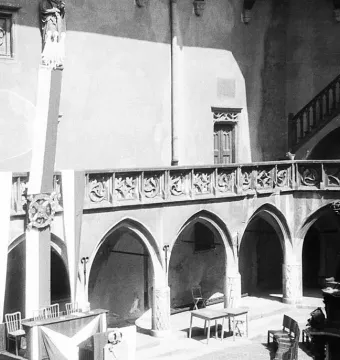
May 1947 © Babcia Hania · CC BY-SA 3.0
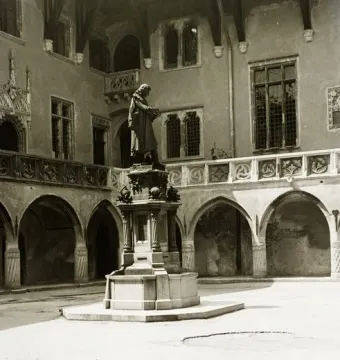
1934 · CC BY-SA 3.0
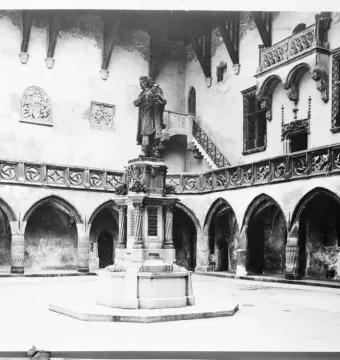
1934 © Willem van de Poll · CC0
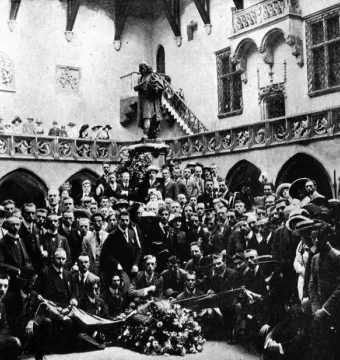
1912 © Edward Pierzchalski (foto el la studio "Tadeusz Jabłoński i Spółka") · Public domain
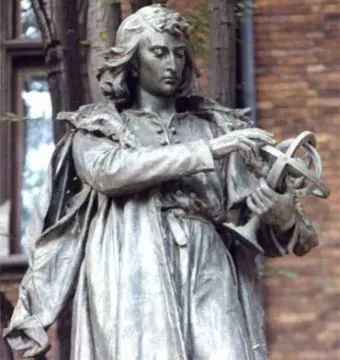
© Gouwenaar · Public domain
Identification | |
| Title | Nicolaus Copernicus Monument in Kraków |
| Subject | Nicolaus Copernicus |
| Alternative name | Monument to Nicolaus Copernicus |
| Type | Monument, sculpture |
| Original Polish name | Pomnik Mikołaja Kopernika |
Historical context | |
| Completion year | 1899 |
| Commemorates | Copernicus, who studied at the Kraków Academy and whose father came from Kraków, then the capital of Poland |
| Unveiling occasion | The second day of the Jagiellonian University quincentenary celebrations, marking the 500th anniversary of the university’s renewal |
| Unveiling date | 8 June 1900, at 11:00 a.m. |
Creator | |
| Artist | Cyprian Godebski |
| Initiator | Marian Sokołowski |
| Commissioned by | The Jagiellonian University Senate, following a proposal by Marian Sokołowski |
| Design and construction | Designed in 1896; contract signed in March 1897; completed in 1898 or 1899; sent from Paris |
Discovery and provenance | |
| Why the paintings were not made | Jan Matejko died before they were created |
| Original intended use of funding | Purchase of paintings on the history of the Jagiellonian University by Jan Matejko |
| Funding | Paid from part of an Austrian government and Emperor Franz Joseph I grant originally intended for Jan Matejko’s planned paintings about the history of the Jagiellonian University |
Location and ownership | |
| Temporary location after relocation | In front of Collegium Physicum (Witkowskiego) |
| Later visual documentation | Shown on postcards before World War I, in interwar Poland, and during the German occupation (1939–1945); also on a 1943 General Government postage stamp and a special 1946 Polish Post issue |
| Ownership and care | The monument stands on city land; care for it is the city’s responsibility |
| Relocation proposal not implemented because | The professors’ garden was often used for other needs, mainly as a storage area for construction and renovation work |
| Supporters of relocation | The City Council Art Council, the provincial monument conservator, and the cultural and arts commission of the Municipal National Council |
| Proposed permanent location after relocation | The professors’ garden, together with other sculptures from the neo-Gothic decoration of Collegium Maius |
| City | Kraków |
| Relocated | Moved from Collegium Maius courtyard to Planty Park in 1953 |
| Original orientation | The statue faced the main entrance to Collegium Maius from św. Anny Street |
| Original placement | In the center of the Collegium Maius courtyard, over an old well dug in 1517, after the well was filled in |
| Original location | The courtyard of Collegium Maius, the oldest building of the Jagiellonian University |
| Country | Poland |
| Current location | In Planty Park in Kraków, in front of Collegium Witkowskiego / the Jagiellonian University building, in the University Garden area |
History and restoration | |
| Return proposals | A return to Collegium Maius was proposed in 1956–1957 but not implemented; the proposal was renewed by Aleksander Skotnicki in 2014 and again in late June 2023 |
| 2023 response | Mayor Jacek Majchrowski rejected moving it back to Collegium Maius, saying it fits Planty better than the courtyard |
| 2014 discussion | On 11 September 2014, most participants opposed relocation but supported restoration and better care |
| Restoration | Restored in 1987 by B. Lambor, A. Kamska, and J. Kowalski |
| Maintenance | Cleaned and repaired between early September and late October 2015, costing about 68,000 złotys |
| Removal year | 1953 |
| Reason for removal | Some accounts say it was removed because of rebuilding of the building; Karol Estreicher also repeatedly tried to move it after 1946 because he considered the work artistically weak |
| Controversy after relocation | The move caused major controversy and protests from some Jagiellonian University lecturers, and increased hostility toward Estreicher |
Physical characteristics | |
| Figure depicted | Nicolaus Copernicus shown as a student |
| Pose | Standing with a slight stride, head slightly turned to the left |
| Facial expression | Contemplative, thoughtful expression |
| Attire | Scholar’s dress with a voluminous heavily pleated cloak, wide sleeves, and boots with shafts |
| Attribute | Astrolabe held in the left hand and touched by the right hand |
| Pedestal form | Granite pedestal with a marble polygonal base, shaped like a truncated tetrahedron and resembling a cistern or basin with four small water reservoirs and drains |
| Pedestal decoration | Four marble columns, four red marble plaques with Latin inscriptions, four spheres wrapped in golden laurel at the corners, and ivy branches at the base of the statue |
| Proportions | Adapted to the courtyard of Collegium Maius |
Materials | |
| Statue material | Bronze |
| Pedestal material | Granite with a marble polygonal base |
| Decorative materials | Marble columns and plaques |
| Corner ornaments | Golden laurel |
Technique | |
| Fountain design | Originally designed as a fountain, with water drainage devices at the bottom of the pedestal and small water reservoirs and drains |
| Original intended setting | The monument was intended to be surrounded by ornamental plants |
Appearance | |
| Stylistic features | Typical of the second half of the 19th century, combining Romanticism with references to Renaissance Florentine sculpture |
| Stylistic classification | Romantic historicism of the late 19th century |
| Architectural relation | The marble columns were matched to the Neo-Gothic decor of Collegium Maius |
| Meaning of corner ornaments | The golden laurel spheres symbolize the scholar’s fame |
| Meaning of ivy decoration | The ivy branches emphasize Copernicus’s strong bond with the Kraków university |
| Inscriptions | Four Latin inscriptions on red marble plaques referring to Copernicus |
| Unveiling decoration | The pedestal was covered with flowers on the day of unveiling |
| Later decoration | Photographs from about 1910 to 1912 show the pedestal columns wrapped in climbing plants, usually ivy, sometimes with potted flowers below |
Significance | |
| Reception after unveiling | Generally positive, though not especially enthusiastic |
| Press interest | It attracted significant interest from French journalists because the sculptor lived and worked in France |
| Notable status | A notable landmark of Kraków |
| Other monuments in Kraków | Kraków has two other monuments to Nicolaus Copernicus |