
The Departure of the Volunteers of 1792
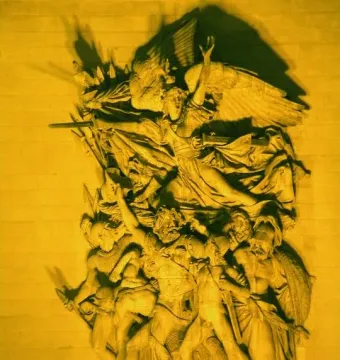
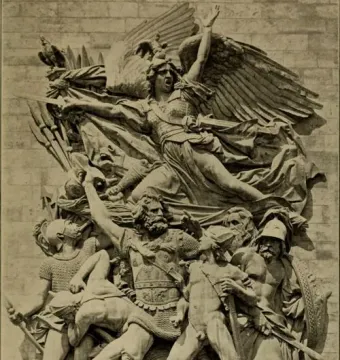
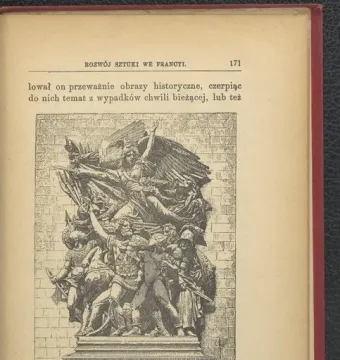
The Departure of the Volunteers of 1792, also known as La Marseillaise or Chant du départ, is a monumental stone high relief created by the French sculptor François Rude between 1833 and 1836. It is located on the east facade of the north base of the Arc de Triomphe de l’Étoile in Paris. The work is one of the four sculptural groups at the base of the arch, alongside The Triumph of 1810, The Resistance of 1814, and The Peace of 1815. It is especially noted for the passionate movement of the group.
August 2013 © flightlog · CC BY 2.0
April 2009 © Vitold Muratov · CC BY-SA 4.0
1904 © Sturgis, Russell · No restrictions
August 2019 © Un manchot rame en rond · CC BY-SA 4.0
© Elie Jean Pécaut · Public domain
Identification | |
| Title | The Departure of the Volunteers of 1792 |
| Original French title | Le Départ des volontaires de 1792 |
| Alternative titles | La Marseillaise; Le Chant du départ; Der Auszug der Freiwilligen von 1792; La partenza dei volontari del 1792 |
| Type | Monumental stone high relief |
Creator | |
| Artist | François Rude |
Historical context | |
| Date of creation | 1833–1836 |
| Commissioned by | Louis-Philippe I, through his minister Adolphe Thiers |
| Subject | An allegorical depiction of the national volunteers' efforts against the armies of the First Coalition in 1792 during the French Revolution |
| Historical meaning of title | The title La Marseillaise refers to the French national anthem's name, which at the time of the work was still only a revolutionary song |
Physical characteristics | |
| Winged figure physique | Powerful arms and pectorals, with thighs and legs of correct proportions |
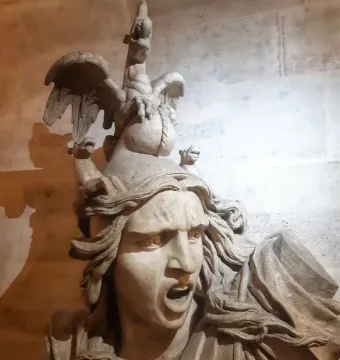
| Winged figure expression | Strong male accents in the mouth, an irresistible sword gesture, accentuated virility, and grace interpreted as ease, flexibility, and harmony of the body |
| Composition | A group composition with passionate movement |
| Style | Romantic |
| Material | Stone |
Iconography and meaning | |
| Depicted volunteers | Shown in an antique/classical style, advancing to the left and wearing Greco-Roman armor; armed with spears, swords, and shields |
| Central allegorical figure | A winged allegory of Victory urging the volunteers into battle and dominating them |
| Victory figure appearance | Her torso is covered by a fitted cuirass and she wears a large flowing cloak |
| Victory figure gesture | She points the direction to take with a sword |
| Horse detail | The head of a horse appears behind Victory's thigh, held by another character with the reins |
| Lower central figures | A Greek warrior and his young ephebe are shown in the lower center |
| Greek warrior action | He raises his helmet toward Victory with one hand |
| Banner detail | At the top are the tips of several spears and a banner topped by a rooster and marked with the initials R.F. |
| Rooster symbolism | The rooster is the national animal of the French Republic |
| Model for Victory's face | Sophie Rude, the artist's wife |
Location and ownership | |
| Location | East facade of the north pedestal of the Arc de Triomphe de l'Étoile, at Place Charles-de-Gaulle, Paris, France |
| Current original-work location note | Paris, France |
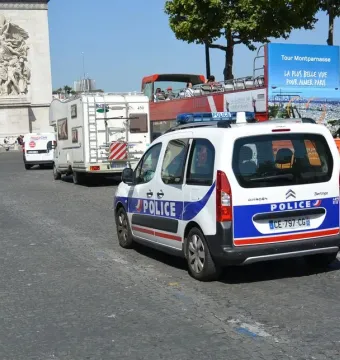
| Proximity note | A few meters from the Tomb of the Unknown Soldier at the center of the Arc de Triomphe |
| Part of | One of the four sculptural groups at the base of the Arc de Triomphe |
History and restoration | |
| Critical assessment | Considered Rude's masterpiece |
| Restoration | In the following months, the plaster cast of Victory and other cultural assets vandalized by the Yellow Vests were restored |
| Vandalism event | A plaster cast of Victory displayed inside the Arc de Triomphe was damaged during Yellow Vest protests |
| Vandalism date | 1 December 2018 |
| Reason for full cast | Made in 1938 from fear that aerial bombardments in a new war would destroy the Arc de Triomphe |
| Full cast date | 1938 |
| Full cast location | Musée Rude, Dijon |
| Plaster cast location | Ny Carlsberg Glyptotek, Copenhagen |
| Bronze reduction variation | Victory wears a Phrygian cap instead of a helmet |
| Bronze reduction location | National Museum of Stockholm |
| Reproductions | Plaster and bronze reductions were made, focusing especially on the faces of some characters, notably Victory |
| Influence | Said to have influenced Soviet artworks such as Worker and Kolkhoz Woman and The Motherland Calls |
| Reception | It quickly entered the allegorical repertoire of the French nation and became a patriotic symbol |
Other | |
| Related artwork | A painting by Joseph-Noël Sylvestre depicts François Rude seated on the scaffold at the Arc de Triomphe while working |
| Quote source | D. Strohl, Revue l'éducation Physique No. 21, January 1932 |
| Attribution in quote | The quoted definition of grace is attributed to Georges Hébert |