
Mephistopheles and Margaretta
Mephistopheles and Margaretta is a 19th-century wooden double sculpture displayed in the Salar Jung Museum in Hyderabad, India. Carved on opposite sides, it shows Mephistopheles on the obverse and Margaretta on the reverse, with a mirror placed behind it so both figures can be seen at once. The work draws on Johann Wolfgang von Goethe’s 1808 play Faust and reflects its themes of good and evil. It was presumably made in the late 19th century by an unknown French sculptor and acquired by Salar Jung I in 1876 during his travels in France. It is one of the European Art Section’s major attractions and among the museum’s most photographed exhibits.
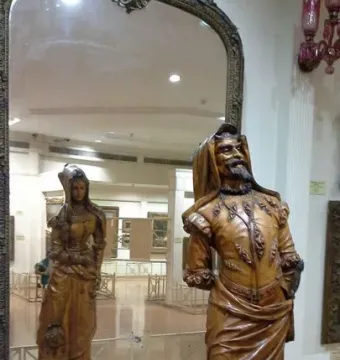
July 2016 © NAGASREENIVASARAO PUPPALA · CC BY-SA 4.0
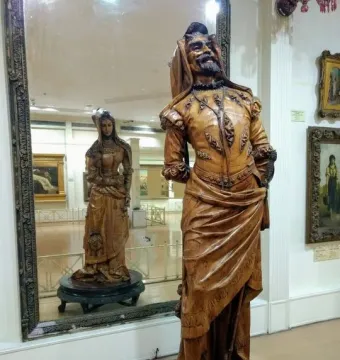
July 2018 © Ahmed3111 · CC BY-SA 4.0
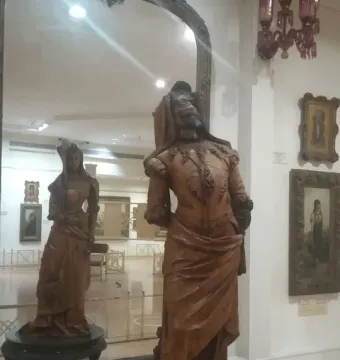
September 2021 © The Wanderer 21 · CC BY-SA 4.0
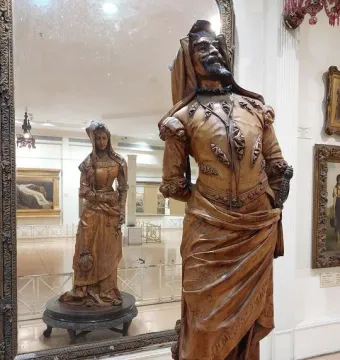
May 2023 © Pinakpani · CC BY-SA 4.0
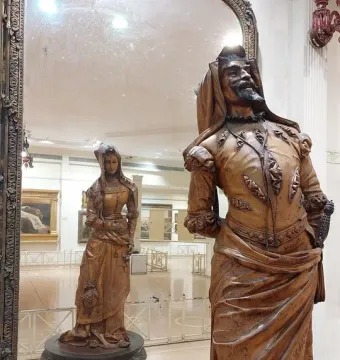
May 2023 © Pinakpani · CC BY-SA 4.0
Identification | |
| Title | Mephistopheles and Margaretta |
| Original title | Mephistopheles und Margaretta |
| Type | double sculpture |
| Form | double human figure |
Historical context | |
| Date of creation | Presumably created in the late 19th century |
Creator | |
| Artist | Unknown French sculptor |
Physical characteristics | |
| Height | 177.2 cm |
Materials | |
| Material | Single block of sycamore wood |
Technique | |
| Construction | Carved from a single wooden block |
Iconography and meaning | |
| Historical interpretation | The choice of Faust reflects the growing interest in German subjects in late 19th-century France |
| Narrative context | Mephistopheles helps Faust seduce Gretchen; Gretchen bears Faust's illegitimate child, drowns it after he abandons her, and is imprisoned for murder |
| Literary source | Johann Wolfgang von Goethe's Faust |
| Symbolic contrast | The innocence of Margaretta contrasted with the evil of Mephistopheles |
| Theme | Good and evil |
| Subject on reverse | Gretchen, head bowed, with downcast eyes and a prayer book |
| Subject on obverse | Mephistopheles, wearing a hood and boots, with a confident, arrogant expression and a smirk |
| Depicts | Mephistopheles and Gretchen (Margareta) from Goethe's Faust |
Location and ownership | |
| Current location | Salar Jung Museum, Hyderabad, India |
| Museum section | European Art Section, Gallery No. 16 |
| Display method | Displayed with a mirror behind it so both sides can be seen simultaneously |
| Acquired by | Salar Jung I, former Prime Minister of Hyderabad |
Discovery and provenance | |
| Acquisition year | 1876 |
| Place of acquisition | France |
| Acquisition context | Acquired during his travels in France |
History and restoration | |
| Museum opening date | 1951 |
Significance | |
| Museum status | One of the major attractions of the Salar Jung Museum's European Art Section and one of the museum's most photographed exhibits |
| Critical assessment | Noted for its realism and the high professionalism of its unknown creator |