
Angel of the North
Angel of the North is a contemporary sculpture by Antony Gormley in Gateshead, Tyne and Wear, England. Completed in 1998, it is made from COR-TEN weathering steel, which gives it a distinctive rusty, oxidised appearance. The sculpture is based on Gormley’s own body and features vertical ribs on its body and wings that act as an external skeleton. Commissioned by Gateshead Council, it was manufactured and assembled by Hartlepool Steel Fabrications and installed on 14 February 1998. Seen by an estimated 33 million people each year from nearby roads and the East Coast Main Line, it is now widely recognised as an iconic symbol of Gateshead and the North East.
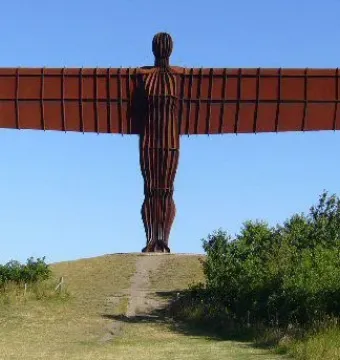
November 1999 © Bah je sais pas, je dirai 2-3 metres? · CC BY-SA 3.0
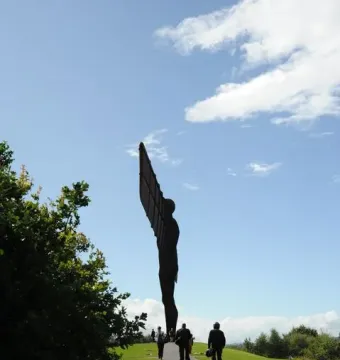
© nikko23_99 · CC BY-SA 3.0
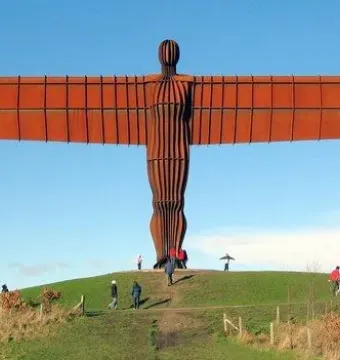
January 2004 © Andrew Curtis · CC BY-SA 2.0
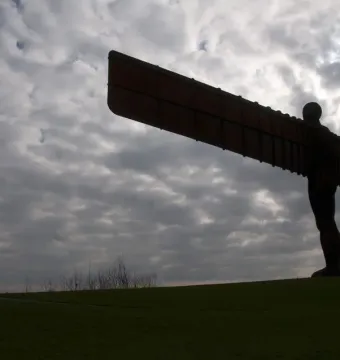
March 2011 © Bryan Ledgard · CC BY 2.0

© RobbieJames · Public domain
Identification | |
| Title | Angel of the North |
| Type | Modern sculpture |
| Original-language title | Der Engel des Nordens |
| Alternative names | Anioł Północy; L'Angelo del Nord; Ангел Севера; The Gateshead Flasher; Gateshead exhibitionist |
Creator | |
| Artist | Antony Gormley |
| Artist nationality | English |
| Designer | Antony Gormley |
Historical context | |
| Earlier related project | Brick Man, a proposed brick sculpture in Leeds, was discussed before Angel of the North but never built |
| Educational outreach | A two-year series of educational events with 30 schools and 1,400 children |
| Funding | Mostly funded by the UK National Lottery; additional funding from Arts Council England (£584,000), the European Regional Development Fund (£150,000), Northern Arts (£45,000), and private sponsorship |
| Cost | Close to £1 million |
| Full council approval vote | 41–14 in favour |
| Planning committee vote | 15–5 in favour |
| Planning vote date | 4 January 1995 |
| Reception during planning | Faced opposition |
| Proposed site description | A former colliery overlooking the varied topography of the Tyne and Wear Lowlands National Character Area |
| Site inspiration | After visiting the proposed site, Gormley compared it to a megalithic burial chamber |
| Proposed site | Eighton Lodge |
| Intended meaning | A millennial image and a marker and guardian for the town |
| Planned purpose | To act as a new landmark for the southern approach into Gateshead and Tyneside near the A1 and A167 interchange |
| Project preparation start | 1994 |
| Project start | 1979 |
| Intended completion date | 1996 |
| Commission date | August 1994 |
| Commissioning body | Gateshead Council's Art in Public Places panel, the Libraries & Arts and Planning & Engineering Departments, and Northern Arts |
| Commissioned by | Gateshead Council |
| Date created | 1994–1998 |
| Inspiration | Antony Gormley's series The Case for an Angel |
Discovery and provenance | |
| Transport method | Transported by road to the installation site overnight |
| Official opening date | 15 February 1998 |
| Installation | Erected the next morning after overnight transport |
| Transport date | 14 February 1998 |
| Creation site | Hartlepool, County Durham |
| Fabricated by | Hartlepool Steel Fabrications |
Physical characteristics | |
| Wind resistance | Designed to withstand wind speeds of over 160 km/h |
| Foundation material | 165 tonnes of concrete |
| Foundation weight | 500 tonnes |
| Foundation | Concrete pile foundation anchored 20 metres below the sculpture |
| Structural feature | Vertical ribs on the body and wings |
| Number of parts | 3 |
| Each wing weight | 55 tonnes |
| Body weight | 110 tonnes |
| Mass | 208 tonnes |
| Wingspan | 54 metres |
| Height | 20 metres |
Materials | |
| Material | COR-TEN weathering steel |
| Foundation material | Concrete |
Appearance | |
| Relative size note | Wider than the Statue of Liberty is tall |
| Pose | An angel standing upright with open wings |
| Wing angle | Wings tilted 3.5 degrees forward |
| Appearance | Rusty, oxidised brown colour |
Iconography and meaning | |
| Subject | An angel |
| Design basis | Gormley's own body |
| Wing interpretation | The angled wings are meant to suggest an embrace |
| Intended meaning | To recall the industrial past of Northern England |
Location and ownership | |
| Location | Gateshead, Tyne and Wear, England |
| Specific site | A hill south of Newcastle upon Tyne, at the junction of the A1 and A167 roads |
| Setting | Stands on a hill overlooking the A1 and A167 toward Tyneside and the East Coast Main Line railway |
| Placement | Southern edge of a hill in Low Fell, on the outskirts of the Metropolitan Borough of Gateshead |
| View direction | Overlooks Tyneside and the East Coast Main Line railway |
History and restoration | |
| Initial reaction | Controversial on installation; opposed by some local residents and in the British press |
| Later reception | Gained supporters over time |
Significance | |
| Current recognition | Widely recognised as an iconic public artwork and a symbol of Gateshead and North East England |
| Claimed status | Considered the largest angel sculpture in the world |
| Nickname origin | Derived from its distinctive pose and contrast with the surrounding landscape |