
King Jagiello Monument
King Jagiello Monument is an equestrian monument of Władysław II Jagiełło, King of Poland and Grand Duke of Lithuania, located in Central Park in New York City. It commemorates the Battle of Grunwald, a decisive defeat of the Teutonic Order in 1410. Originally created for the Polish pavilion at the 1939 New York World’s Fair, the monument was permanently installed in Central Park in 1945. Raised on a tall pedestal, it is one of the park’s most prominently placed sculptures.
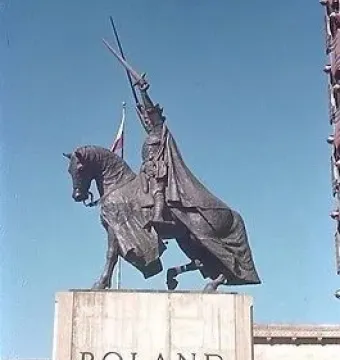
1939 © Unknown author · Public domain
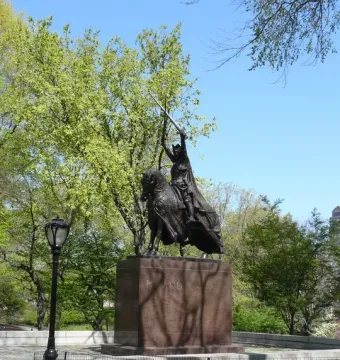
April 2012 © Ad Meskens · Public domain
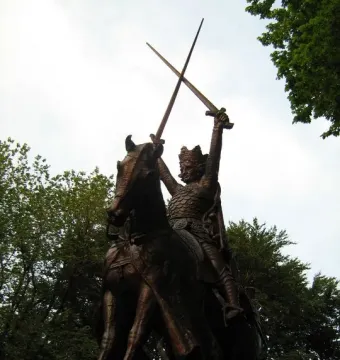
June 2010 © CZmarlin · CC BY-SA 4.0
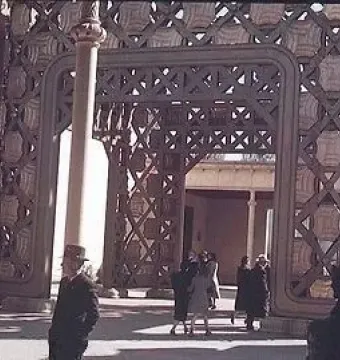
1939 © Unknown author · Public domain
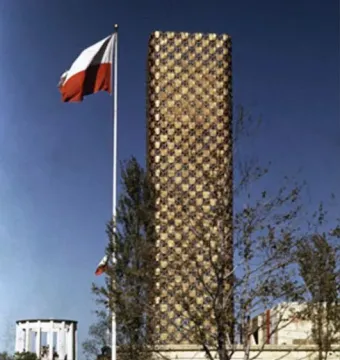
© Unknown authorUnknown author · Public domain
Identification | |
| Title | King Jagiello Monument |
| Alternative names | King Jagiełło Monument; Monument to King Jagiełło in New York; Pomnik Króla Jagiełły |
| Type | Equestrian monument |
Creator | |
| Artist | Stanisław K. Ostrowski (Stanisław Kazimierz Ostrowski, 1879–1947) |
| Pedestal designer | Aymar Embury II (1880–1966) |
Historical context | |
| Realization period | 1937–1939 |
| Creation date | 1939 |
| Original monument fate | The Warsaw monument was melted down by the Germans into bullets after they occupied the city during World War II |
| Replica status | Replica of a monument to King Jagiello in Warsaw |
| Project status | The original project was interrupted by World War I and the first plaster model was destroyed during the war |
| Date first proposed | 1910 |
| Original intended occasion | Originally proposed for the 500th anniversary of the Battle of Grunwald |
| Original purpose | Made for the Polish pavilion at the 1939 New York World's Fair |
| Historical significance | Victory of Polish and Lithuanian forces over the Teutonic Order, with Ruthenian, Czech, and Tatar knights also mentioned in some sources |
| Commemorated event | Battle of Grunwald, 1410 |
| Subject | Władysław II Jagiełło, King of Poland and Grand Duke of Lithuania |
Materials | |
| Statue material | Bronze |
| Pedestal material | Granite |
| Mounting system material | Stainless steel |
Technique | |
| Model | Made from a plaster model |
Physical characteristics | |
| Height | 7 metres total, including a 4-metre pedestal |
| Scale | Larger than life |
Appearance | |
| Swords | The Grunwald Swords |
| Depiction | Jagiełło mounted on horseback, holding two crossed swords over his head |
Iconography and meaning | |
| Sword symbolism | A symbol of defiance and the union of Polish-Lithuanian forces |
| Sword meaning | An ironic invitation to battle offered by Ulrich von Jungingen, Grand Master of the Teutonic Order, to Jagiełło and Vytautas the Great |
Location and ownership | |
| Gifted to | The city of New York |
| Installed with cooperation of | Count Józef Kazimierz Krasicki, last consul of the pre-communist Second Polish Republic in New York |
| Donor | The King Jagiello Monument Committee, with support from the Polish government-in-exile |
| Permanent installation date | 15 July 1945 |
| Original location | Entrance of the 1939 New York World's Fair in Flushing Meadows-Corona Park, Queens, New York |
| Site within park | On the east side of Turtle Pond, opposite Belvedere Castle and the Delacorte Theater, just southeast of the Great Lawn; Cleopatra's Needle is to the northeast and the Metropolitan Museum of Art lies beyond it |
| Current location | Central Park, New York City, United States |
History and restoration | |
| Unveiled by | Count Józef Kazimierz Krasicki |
| Conservation | Conserved in 1986 by the Central Park Conservancy |
| Restoration | Restored in September 2016, including a new stainless steel mounting system and restoration of the statue's patina and protective coating |
| Artist signature | Ostrowski's name is engraved in the front lower right-hand corner |
| Pedestal inscriptions | POLAND appears on both sides of the plinth; the plinth also carries an English inscription identifying Jagiełło as King of Poland, Grand Duke of Lithuania, founder of a free union of the peoples of east-central Europe, victor over the Teutonic aggressors at Grunwald, 15 July 1410 |
Significance | |
| Park status | One of Central Park's most prominently located and most impressive sculptures; described as among the park's twenty-nine most prominent sculptures |
| 2010 commemoration | Held in Central Park on 17 July 2010 for the 600th anniversary of the Battle of Grunwald, with an honor guard, a copy of Jan Matejko's Battle of Grunwald displayed nearby, and participation by American Polonia, Belarusians, and Lithuanians living in New York |
Other | |
| Related note | Some sources say the monument was made in Poland and, after Warsaw was occupied by the Germans, melted down into bullets |