
Emancipation Memorial
Emancipation Memorial, also known as Freedman’s Memorial or Emancipation Group, is a monument in Lincoln Park in Washington, D.C. Designed and sculpted by Thomas Ball and erected in 1876, it depicts Abraham Lincoln as the Great Emancipator freeing an African American enslaved man modeled on Archer Alexander. The former slave is shown kneeling, with a clenched fist, bare-chested and chained at Lincoln’s feet. The statue originally faced west toward the Capitol, but was turned east in 1974 to face the newer memorial to Mary McLeod Bethune. Long the subject of controversy, the monument is part of Washington’s Union memorials and is listed on the National Register of Historic Places.
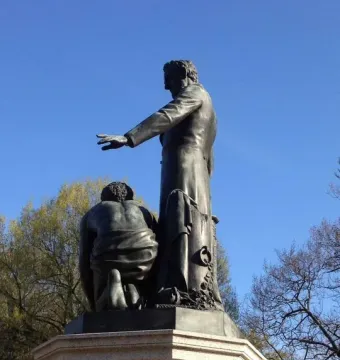
April 2014 © Djembayz · CC BY-SA 3.0
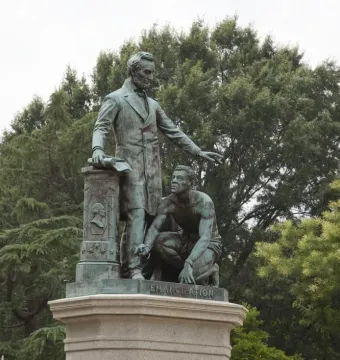
© Carol M. Highsmith · Public domain
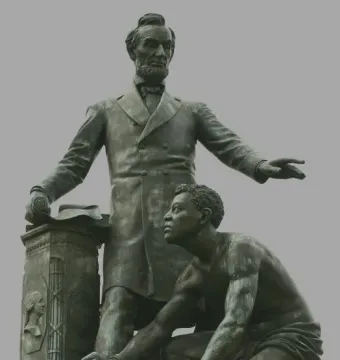
August 2004 © David · CC BY 2.0
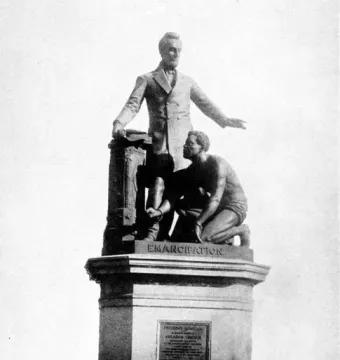
© Thomas Ball, sculpture; Keystone View Company, photograph · Public domain
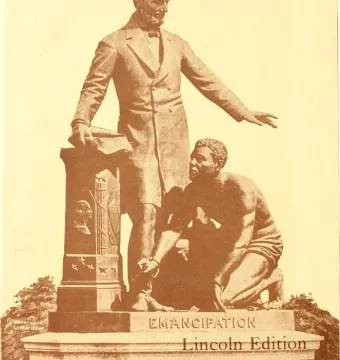
1909 © Internet Archive Book Images · No restrictions
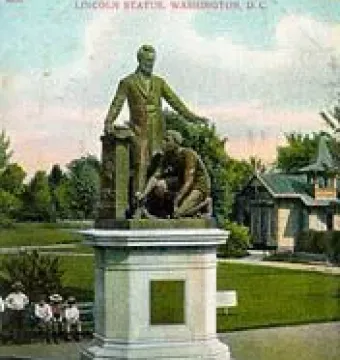
1900 © Unknown authorUnknown author · Public domain
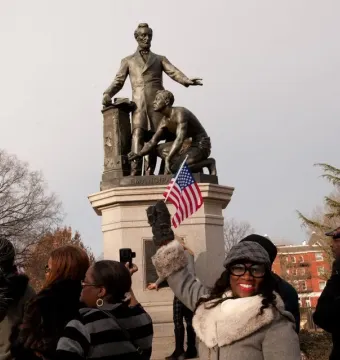
© Tech. Sgt. Eric Miller · Public domain
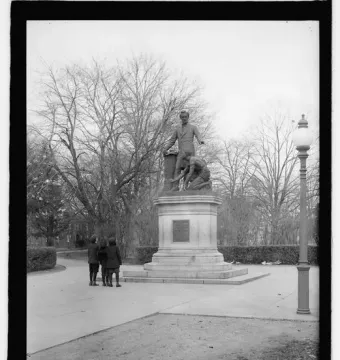
1921 © National Photo Company Collection · Public domain
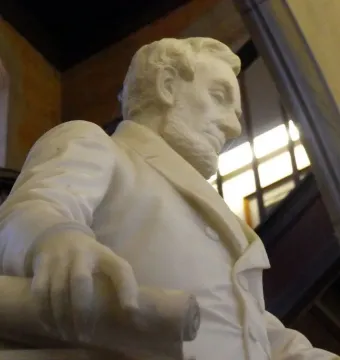
December 2009 © EraserGirl · CC BY-SA 3.0
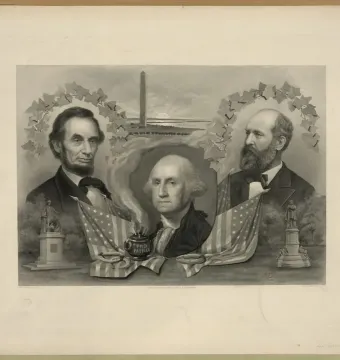
1885 © Popular Graphic Arts · Public domain
Identification | |
| Title | Emancipation Memorial |
| Spanish name | Monumento conmemorativo a la emancipación |
| Type | Monument |
| Alternative names | Freedman’s Memorial; Emancipation Group; sometimes called "Lincoln Memorial" before the current Lincoln Memorial was built |
Historical context | |
| Controversy | Long subject to controversy |
| Subject matter | Union memorial connected to the remembrance of the American Civil War in Washington, D.C. |
| Historical interpretation | Seen by American University as embodying the hopes, dreams, commitment, and ultimate failures of Reconstruction |
| Historical context | The memorial's development began immediately after Abraham Lincoln's assassination and ended, appropriately, near the end of the Reconstruction era in 1876 |
| Date erected | 1876 |
Creator | |
| Designer and sculptor | Thomas Ball |
| Alternative design proposed by | Harriet Hosmer |
Discovery and provenance | |
| Payment source according to the National Park Service | The monument was paid for only by former slaves |
| Reason alternative design was not used | It was ultimately deemed too expensive |
| Alternative design details | A grander monument with Lincoln atop a tall central pillar flanked by smaller pillars topped with black Civil War soldiers and other figures |
| Selected organization | The Freedman's Memorial Association |
| Frederick Douglass position | He disagreed with the school-based educational purpose and thought education was incomparable with memorializing Lincoln |
| Educational purpose proposal | The Colored People’s Educational Monument Association, led by Henry Highland Garnet, wanted the monument to have a didactic purpose as a school where freedpeople could rise through learning |
| Another fundraising group | National Lincoln Monument Association |
| Possible merger of fundraising efforts | There was a brief consideration of merging the original funds with the National Lincoln Monument Association, but this effort soon failed because of conflicting visions |
| Year another group attempted to raise funds | 1865 |
| Announced fundraising goal | $50,000 |
| Amount raised by the Western Sanitary Commission | About $20,000 |
| Fundraising organization | Western Sanitary Commission |
| Funding campaign start | Began with a widely publicized report that $5 was donated by the former slave Charlotte Scott of Virginia, then living with the family of her former master in Marietta, Ohio |
| Funding | Paid for by African Americans; financed with the wages of freed slaves |
Physical characteristics | |
| Final size | Expanded to about 2.7 m high; about nine feet high |
| Original size | Medium-sized; half-life-size |
| Material | Italian marble |
| Final title | Emancipation |
Appearance | |
| Document support | The Emancipation Proclamation rests on a plinth |
| Change from original design | The pedestal or plinth replaced the pile of books in Ball's original design |
| Background element | A whipping post or pillory draped with cloth stands behind the figures |
| Pedestal decoration | Patriotic symbols including the profile of George Washington, the fasces of the American republic, and a shield decorated with the stars and stripes |
| Additional background detail | A vine grows around the whipping post and around the ring where the chain was fastened |
| Freedman figure model | Re-sculpted to resemble Archer Alexander, a formerly enslaved man whose life story was popularized by a biography written by William Greenleaf Eliot; an unnamed former Black slave is also said to have served as the model |
| Freedman figure appearance | Shirtless or bare-chested; bareheaded, with very curly or tightly curled hair; with a clenched or closed fist; not wearing a liberty cap |
| Freedman figure pose | Kneeling on one knee, about to rise |
| Lincoln depiction | Shown in the role of the "Great Emancipator"; holding a copy of the Emancipation Proclamation in his right hand |
| Depicted figures | Abraham Lincoln and a formerly enslaved African American man modeled on Archer Alexander |
| Freedman figure condition | Shackled at the feet of the president, with broken shackles at Lincoln's feet |
Technique | |
| Casting location | Munich |
| Casting date | 1875 |
| Shipping year to Washington | 1876 |
Location and ownership | |
| Congress appropriation | $3,000 for a pedestal |
| Heritage status | Part of the National Register of Historic Places; contributing monument to the Civil War Monuments in Washington, D.C. in the National Register of Historic Places |
| Commissioning body | Freedman's Memorial Association |
| Country | United States |
| Gift recipient | Congress accepted the statue as a gift from the "colored citizens of the United States" |
| Current status | It still stands in Lincoln Park |
| Location | Lincoln Park, Capitol Hill neighborhood, Washington, D.C., United States |
History and restoration | |
| Plaque narrative | Her first earnings in freedom were consecrated by her suggestion and request on the day she heard of President Lincoln's death to build a monument to his memory |
| Charlotte Scott description | A freedwoman of Virginia |
| First contributor | Charlotte Scott |
| First contribution | Five dollars |
| Plaque text about sponsorship | Erected by the Western Sanitary Commission of Saint Louis, Missouri, with funds contributed solely by emancipated citizens of the United States declared free by Lincoln's proclamation of January 1, A.D. 1863 |
| Alternative plaque name | "Freedom's Memorial in grateful memory of Abraham Lincoln" |
| Former popular name | Lincoln Memorial, because of its location before the current Lincoln Memorial was dedicated in 1922 |
| Current orientation | Turned east in 1974 to face the Mary McLeod Bethune Memorial |
| Reorientation date | 1974 |
| Original orientation | Originally faced west toward the Capitol |
| Reason for reorientation | To face the newly erected Mary McLeod Bethune Memorial |
Significance | |
| Douglass's final assessment of Lincoln | Douglass said it was enough that Lincoln led a great movement and was in living and earnest sympathy with it |
| Associated historical figure | Abraham Lincoln |
| Douglass's description of the Black figure | The Black man shown is still kneeling and nude, even though he rises; Douglass wanted him erect on his feet like a man, not kneeling like a four-footed animal |
| Douglass's criticism of the sculpture's design | He criticized the statue's design and said the park could be improved by more dignified monuments of free Black people |
| Letter publication date | April 19, 1876, five days after the dedication |
| Post-dedication letter | After the speech, Douglass immediately wrote a letter to the editor of the National Republican in Washington |
| Frederick Douglass's view of Lincoln | Douglass described Lincoln as complex and said he was not fully "our man or our model"; Lincoln was a white man shaped by his interests, associations, habits of thought, and prejudices |
| Douglass's criticism of Lincoln | He said Lincoln was more motivated to save the Union than to abolish slavery and that Lincoln had told African-American leaders in 1862, "But for your presence amongst us, there would be no war." |
| Lincoln quotation cited by Douglass | "If I could save the union without freeing any slave, I would do it; and if I could save it by freeing all the slaves, I would do it; and if I could save it by freeing some and leaving others alone, I would also do that." |
| Dedication status | Declared a federal holiday |
| Other attendees at dedication | President Ulysses S. Grant, members of his cabinet, Congress, the Supreme Court, and Howard University law school dean John Mercer Langston |
| Dedication speaker | Frederick Douglass |
| Dedication occasion | The eleventh anniversary of Lincoln's death |
| Dedication date | April 14, 1876 |
| Subject | Abraham Lincoln and emancipation, with a formerly enslaved Black man rising from kneeling |