
Cuauhtémoc Monument
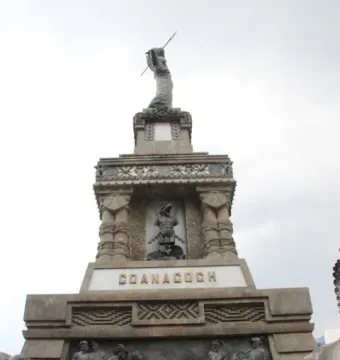
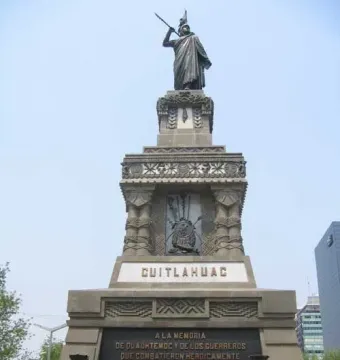
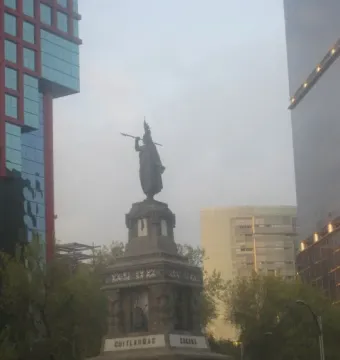
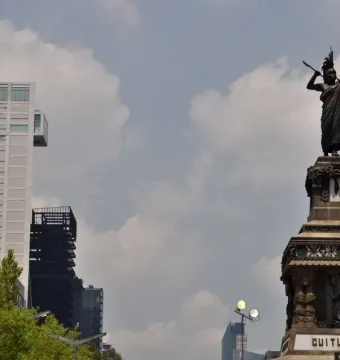
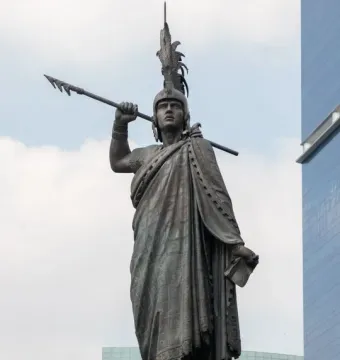
The Cuauhtémoc Monument is a statue inaugurated in 1887 in Mexico City. It is dedicated to Cuauhtémoc, the last Aztec emperor, and stands at the intersection of Insurgentes Avenue and the Paseo de la Reforma. The monument was created by Francisco Jimenez and Miguel Noreña in a neo-Indigenous style. It was proposed as part of an effort to promote the new government of Porfirio Diaz. The sculpture is an outdoor monument in Mexico and is associated with the city’s public art and historical landscape.
July 2012 © Gary Todd · CC0
© Oleksii0 · CC BY-SA 3.0
September 2018 © Daniel Gaspar Velázquez · CC BY-SA 4.0
July 2011 © katiebordner · CC BY 2.0
August 2021 © EneasMx · CC BY-SA 4.0
Identification | |
| Title | Monument to Cuauhtémoc |
| Subject | Cuauhtémoc, the last Mexica ruler (tlatoani) of Tenochtitlan |
| Type | Monument; public sculpture; statue |
Historical context | |
| Purpose | Created to honor Cuauhtémoc and promote the Porfirio Díaz regime as part of a nationalist sculptural program |
| Historical context | Proposed by Vicente Riva Palacio, minister of development under the Porfirian regime |
| Competition year | 1877 |
| First stone laid | 5 May 1878 |
| Inauguration date | 21 August 1887 |
Creator | |
| Design inspiration | Pre-Hispanic Mexican architecture, including Uxmal, Mitla, Palenque, and Tula |
| Commissioned by | Carlos Pacheco, minister of development, who commissioned Miguel Noreña to create the sculptures |
| Competition judges | D. J. S. Bagally; Emilio Dondé; Manuel Gargollo y Parra; Ramón Rodríguez Arangoiti |
| Construction overseer | Ramón Agea, architect and engineer of the National Palace of Mexico |
| Sculptor | Miguel Noreña |
| Designer of the base | Francisco M. Jiménez |
Discovery and provenance | |
| Winning designer | Francisco M. Jiménez |
| Initiated by | Vicente Riva Palacio |
| Site research purpose | To confirm the original site |
| Evidence used to confirm original placement | Remains of green and purple sandstone from Guanajuato found during foundation works at the original site |
Materials | |
| Materials | Volcanic stone, marble, cantera, and bronze |
| Original planned material for leopards | Chiluca stone |
Physical characteristics | |
| Overall form | Pyramidal |
| Zócalo shape | Circular |
| Plan | Octagonal base |
| Weight | 4.2 tonnes |
| Composition | Three truncated pyramidal bodies |
| Height | 4.93 meters |
| Base shape | Octagonal |
Technique | |
| Casting location | Workshop of Jesús Contreras |
| Transport equipment | Four cranes and a mobile platform with 12 axles and 16 wheels |
| Transported weight | About 300 tons |
| Structural investigation | Test pits were made in the ground to understand the pedestal's construction characteristics |
Appearance | |
| Stairway guardians | 8 leopard sculptures with headdresses and jewels |
| Named figures on plaques | Cuitláhuac (east), Cacama (north), Tetlepanquetzaltzin, originally Tetlepanquetzal, (west), and Coanacoch (south) |
| Third body | A third pyramidal body with a serpent frieze supports the sculpture of Cuauhtémoc |
| Zócalo decoration | A frieze with Mesoamerican-inspired grecas |
| Top sculpture style | Resembles Greco-Roman statues |
| Leopard sculpture attribution | Attributed to Indalecio Calvo |
| Top sculpture | Cuauhtémoc |
| Top sculpture pose | Wearing ceremonial clothing, a penacho, and holding a spear |
| Top sculpture garment treatment | The tilma is knotted in the Roman style |
| Top sculpture facial model | According to Arturo Arnaiz y Freg, poet Ignacio Manuel Altamirano was the model for Cuauhtémoc's face |
| Upper body frieze | Frieze with padded armor and shields |
| Name plaques | Marble plaques with names inscribed in bronze on the four sides |
| Niches | Four niches containing sculptures |
| Mexica emblem | Sculptural representation of the coat of arms of Mexico-Tenochtitlan |
| First body reliefs | La entrevista de Cuauhtémoc, prisionero, con Cortés, and El tormento de Cuauhtémoc |
| Niche themes | Arms of the main Mexica military bodies, including eagle and jaguar, and representations of macuilli, macana, and chimalli |
| Architectural influences | Mesoamerican elements with Greco-Latin classicist influence |
| Base decoration | A frieze with Mesoamerican-inspired grecas |
| First body decoration | Two bas-reliefs on the north and south faces |
| Style | Neo-indigenism / academic indigenism |
| First body architectural influence | Talud-tablero complex |
| First body friezes | Inspired by the architecture of Tula, Mitla, Uxmal, and Palenque |
| Upper body form | Pyramidal |
| Columns | Grouped columns of composite order |
| Column decoration | Fustes and remares with Mexicanist elements |
Iconography and meaning | |
| Theme | Memorial to Cuauhtémoc and the warriors who fought in defense of their homeland |
| Historical role of named figures | They were the last military leaders involved in the Conquest of Mexico |
| Ideological context | Linked to nationalist discourse, the expansion of Paseo de la Reforma, and a search for a purely Mexican artistic style |
| Comparative context | Built after the Monument to Christopher Columbus on the same avenue and intended to contrast Mexico’s mestizo character |
| Artistic context | Deliberately made on the same scale as monuments celebrating national heroes from the Mexican War of Independence |
Location and ownership | |
| Current site characteristics | A circular plaza with vegetation, new urban furniture, and two end spires |
| Restoration responsible institution | National Institute of Anthropology and History (INAH) |
| Restoration workshop location | Temporary workshop in Parque Pasteur |
| New site displacement | 79 meters to the northwest of the 1949 location |
| Elevation at new site | Raised by about 1 to 1.8 meters |
| Original location | A landscaped square with cantera benches, a few meters from a French-style house occupied by the University Club |
| Nearby landmarks | Glorieta of the Palm to the west and glorieta de las mujeres que luchan to the east |
| 2004 relocation | Moved back to its original site |
| 1949 relocation | Moved from its original site to the middle of the intersection of Paseo de la Reforma and Avenida de los Insurgentes |
| Outdoor location | Open-air sculpture in Mexico |
| Current location | In the middle of a roundabout on Paseo de la Reforma at its intersection with Avenida de los Insurgentes, Mexico City, Mexico |
History and restoration | |
| Planned urban project | Mario Pani planned a major redevelopment of Paseo de la Reforma and Insurgentes, but it was not completed |
| Condition after 1949 relocation | It remained in a reduced space without pedestrian area |
| 2004 project | Part of the Integral Program for the Tourist and Cultural Corridor Paseo de la Reforma-Centro Histórico of Mexico City |
| Restoration and relocation work dates | 12 April to 12 December 2004 |
| Restoration scope | Base, sculptures, and construction of new environs |
| Restoration work | The bronze sculptures were restored and their original patina was recovered; the pedestal was reinstalled after restoration; a stronger foundation was built for the new site; the concrete skirt was cut for the move; final placement of the Cuauhtémoc sculpture and other sculptures was completed on 10 December 2004 |
| Reason for relocation | To allow a straight continuation of the avenue, improve traffic including Metrobús Line 1 and other bus and vehicle service, and permit construction of the line |
| Opened by | Porfirio Díaz |
| Additional sculpture cost | 37,863 pesos, plus an additional 3,000 pesos for bronze leopards instead of the originally specified chiluca stone |
Significance | |
| Comparable work | Similar to the Mexico Pavilion in Paris made in 1889 |