
Stalin Monument in Budapest
The Stalin Monument in Budapest was a central sculptural work in the Hungarian capital until 1956. Installed in December 1951 as a gift from the Hungarian people for Joseph Stalin’s seventieth birthday, it stood on Dózsa György Avenue near the city park. Created by Hungarian sculptor Sándor Mikus in the classical period of socialist realism, the monument rose 25 meters with its pedestal, and the bronze statue of Stalin was eight meters high. He was shown as an orator, with reliefs on the pedestal symbolizing the Hungarian people greeting him. The monument was destroyed by protesting crowds on 23 October 1956 during the Hungarian Uprising. In 2006, a reduced reconstruction of the brick pedestal and Stalin’s boots was installed in Memento Park in Budapest.
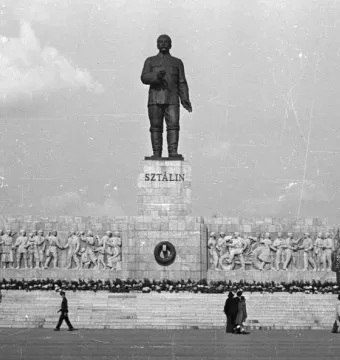
January 1953 © Gyula Nagy · CC BY-SA 3.0
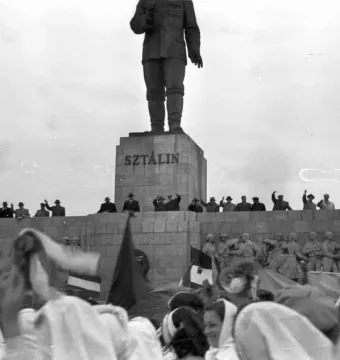
1955 · CC BY-SA 3.0
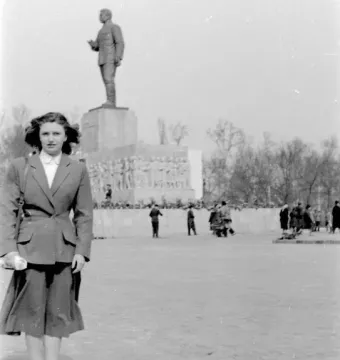
1952 · CC BY-SA 3.0
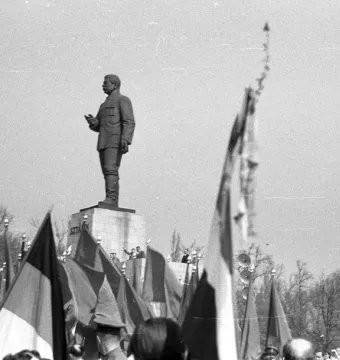
1955 · CC BY-SA 3.0
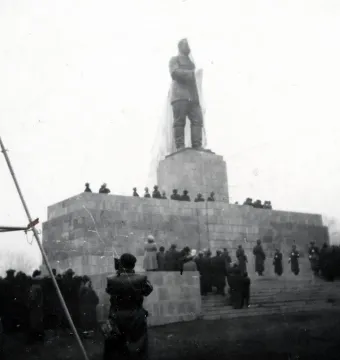
December 1951 · CC BY-SA 3.0
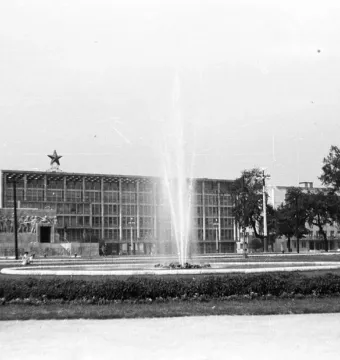
1955 · CC BY-SA 3.0
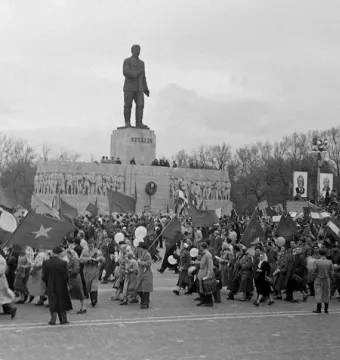
1952 · CC BY-SA 3.0
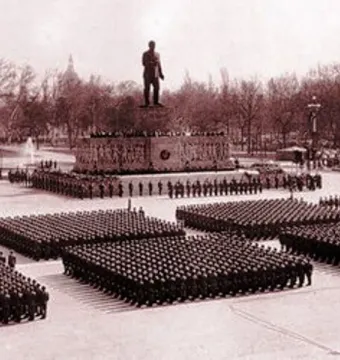
© Tambo · CC BY-SA 3.0
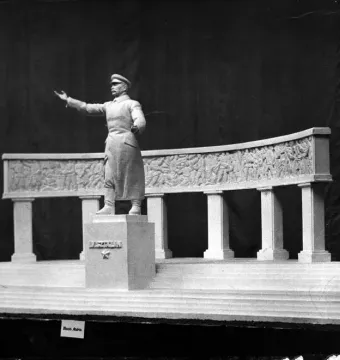
1950 · CC BY-SA 3.0
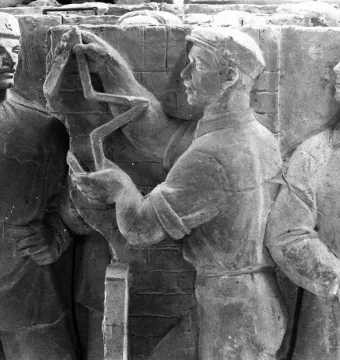
1990 · CC BY-SA 3.0
Identification | |
| Title | Stalin Monument |
| Alternative title | Stalin Monument in Budapest; Пам'ятник Сталіну в Будапешті; Stalin-Denkmal |
| Type | Monument; statue |
Creator | |
| Sculptor | Sándor Mikus |
| Sculptor nationality | Hungarian |
| Award to sculptor | Kossuth Prize / Kossuth Order, the highest distinction a Hungarian artist could receive at the time |
Historical context | |
| Historical context of destruction | Destroyed during the Hungarian Revolution of 1956; in the context of the Polish October, demands for political liberalization, and support for reforms in Poland; revolutionaries acted against the communist dictatorship and the Soviet occupation |
| Political significance | Demonstrated Stalin's power and also the power of the Hungarian Workers' Party; a Budapest journalist remarked on this after completion |
| Cultural interpretation | A cult object presenting Stalin as having almost mystical powers |
| Function and significance in Socialist Realism | An official art form of Stalinism intended to instill Party ideology in the people; realistic and didactic; celebrated the hard-working proletariat and the cult of personality around Vladimir Ilyich Lenin, Stalin, and other Eastern European communist leaders; depicted leaders of communism in a personality-cult setting surrounded by the proletariat |
| Historical context | Stalin statues appeared across Eastern Europe from the 1930s to the 1950s; after Stalin's death in 1953, Socialist Realism began to decline; the decline was connected to political changes initiated by Nikita Khrushchev in 1956 at the 20th Congress of the Communist Party of the Soviet Union; Khrushchev denounced Stalin's cult of personality in 1956; de-Stalinization ended the cult of Stalin's personality and affected his monuments |
| Associated ideology | Stalinism |
| Art movement and style | Socialist Realism; classical period of Socialist Realism; classical Socialist Realism |
Discovery and provenance | |
| Dedication / presentation | Presented as a gift from the Hungarian people to Joseph Stalin for his seventieth birthday (21 December 1949); a smaller analogous replica was sent to Stalin for his birthday; made retrospectively for Stalin's 70th birthday in 1948 |
| Commemorated person | Joseph Stalin |
| Commemorative occasion | Stalin's seventieth birthday; 21 December 1949 |
Location and ownership | |
| Location | Budapest, Hungary; Felvonulási tér (Parade Square), at the edge of City Park / Városliget (Stadtwäldchen), Budapest, Hungary; later the reconstructed remains were in Memento Park, Budapest |
| Site | Dózsa György Avenue; on the edge of the city park; the parade ground at the edge of City Park; directly opposite MÉMOSZ, the headquarters of the construction workers' union |
| Nearby building | MÉMOSZ, the headquarters of the construction workers' union; condemned for its modernist architecture, which was said to bear Western influence |
| Role in city | Central sculptural work of the capital of Hungary until 1956 |
Physical characteristics | |
| Base width | 18 metres |
| Statue height | 8 metres |
| Height | 25 metres total; 25 metres including the pedestal; 25 metres tall |
| Base height | 4 metres |
Materials | |
| Statue material | Bronze |
| Base material | Limestone |
| Inscription material | Bronze |
Appearance | |
| Depicted figure | Joseph Stalin |
| Pose | Standing tall and rigid with his head raised and his right hand on his chest; portrayed as an orator / speaker |
| Pedestal decoration | Relief sculptures on the sides of the pedestal showing the Hungarian people greeting, cheering, or welcoming Stalin |
| Inscription | "Leader, teacher and best friend of the Hungarian people"; the bronze-inscribed name and epithet were torn from the pedestal |
History and restoration | |
| Final dismantling | The remains of the pedestal-tribune / pedestal-podium were completely dismantled in the early 1990s |
| Associated slogan | "Russia go home!" was chanted while the statue was being pulled down; a protest sign over Stalin's mouth read "Russians, when you run away don't leave me behind!" |
| Associated account | According to Sándor Kopácsi, head/chief of the Budapest police, who reported and narrated the incident; he described the statue as 25 metres tall and said it fell about an hour after work began |
| Reconstruction | In 2006, a reduced-scale reproduction of the brick pedestal and the lower part of the sculpture, Stalin's boots, was made; reconstructed in Memento Park in Budapest, the park of sculptures of the socialist era |
| Date destroyed | 23 October 1956; October 24, 1956; at the beginning of the Hungarian uprising of 1956; 21:37 on 23 October 1956 (according to other accounts) |
| Post-destruction use | The empty pedestal was reconstructed and used for a long time as a government tribune/podium for festive processions, parades, and demonstrations |
| Aftermath of destruction | Only Stalin's boots/shoes remained on the pedestal; parts remained on the streets for several days; a Hungarian flag was placed in the boots; insulting remarks such as "W.C." were scrawled on the fragmented remains; a sign reading "Russians, if you flee, don't leave me behind!" / "RUSOS, CUANDO HUYÁIS NO ME DEJÉIS AQUÍ!" was placed over Stalin's mouth; the bronze image titled "Leader, teacher and best friend of the Hungarian people" was torn off the pedestal; Stalin's name on the pedestal was ripped off / erased; the statue was destroyed, leaving only the boots |
| Destruction method | Pulled down using a thick steel cable/rope around the neck; oxygen cylinders, welding equipment, metal cutting blowpipes, and trucks were used; it fell from its pedestal about an hour after work began |
| Destroyed by | A crowd of protesting, rebelling, or revolutionary Hungarians; about 100,000 Hungarian revolutionaries; around 200,000 Hungarians gathered in Budapest |
| Date completed / installed | December 1951; 1951 |
| Associated proposal | Students of the Budapest University of Technology demanded a monument to the Hungarian Revolution of 1848/1849 in place of the Stalin Monument |