
Memorial to the Murdered Sinti and Roma of Europe
Memorial to the Murdered Sinti and Roma of Europe is a memorial on the Simsonweg south of the Reichstag in Berlin-Tiergarten. Designed by architect Dani Karavan, it honors Roma and Sinti victims executed during the Porajmos in World War II. The memorial was inaugurated in the presence of Chancellor Angela Merkel and President Joachim Gauck, and was funded by the German state for 2.8 million euros. Its design features a circular pool surrounded by broken stone slabs, with a triangular platform in the center holding a single rose. Once a day, the platform sinks below the water and reappears with a fresh flower. Around the memorial, Santino Spinelli’s poem “Auschwitz” is engraved in bronze letters.
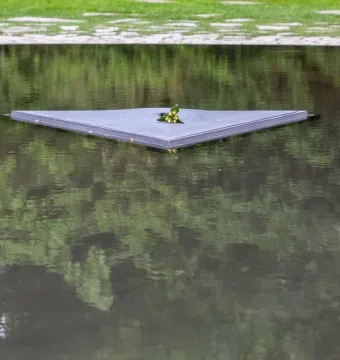
© Dietmar Rabich · CC BY-SA 4.0
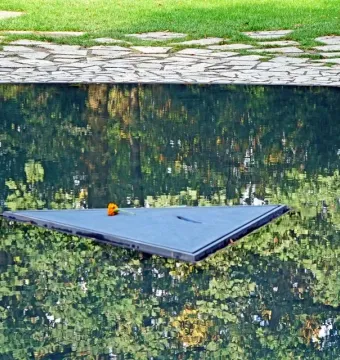
© Dennis G. Jarvis · CC BY-SA 2.0
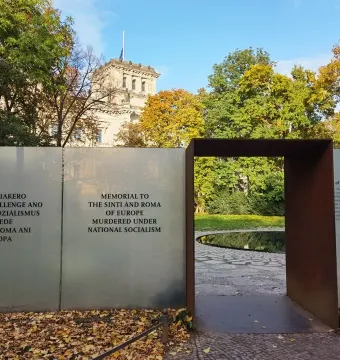
· CC BY-SA 4.0
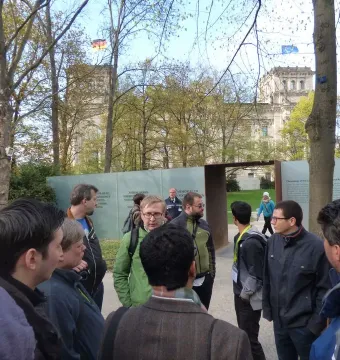
April 2016 © Luis Alvaz · CC BY-SA 4.0
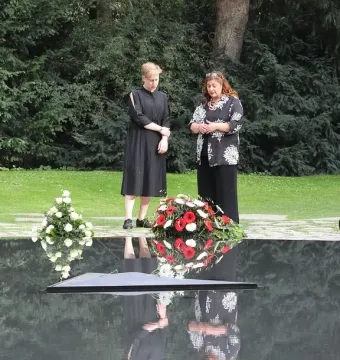
August 2022 © usbotschaftberlin · Public domain
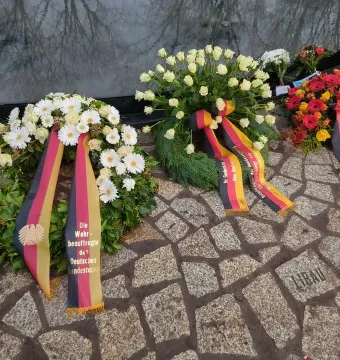
January 2025 · CC BY-SA 4.0
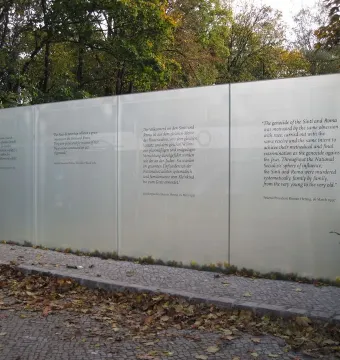
© Asio otus · CC BY-SA 3.0
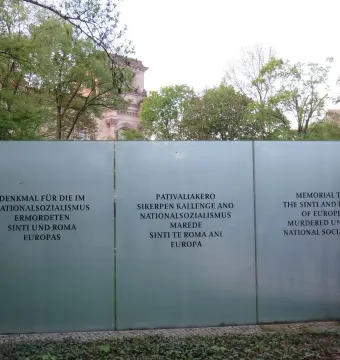
April 2018 © Paulo SP/ Wikimedia · CC BY-SA 4.0
May 2014 © AwkwardChester · CC BY-SA 4.0
February 2013 © World3000 · CC BY-SA 3.0
Identification | |
| Title | Memorial to the Sinti and Roma victims of National Socialism |
| Alternative title | Memorial for the Sinti and Roma of Europe murdered under National Socialism; Le Mémorial aux Sintés et aux Roms européens assassinés pendant le nazisme |
| Original French title | Le Mémorial aux Sintés et aux Roms européens assassinés pendant le nazisme |
| Title | Memorial to the Sinti and Roma victims of National Socialism |
| Sculpture title | Memorial to the Sinti and Roma victims of National Socialism |
| Type | Memorial; monument; installation; permanent memorial |
Creator | |
| Designer / artist | Dani Karavan (Israeli artist); architect Dani Karavan |
Historical context | |
| Historical event commemorated | Porajmos; the Nazi genocide of the European Sinti and Roma peoples; the genocide of the Sinti and Roma |
| Dedicated to | The memory of the 220,000–500,000 people murdered in the Porajmos; victims of the genocide of Roma by the Nazis; all Roma and Sinti murdered during the Porajmos |
| Estimated number of victims | 220,000–500,000; up to 500,000 men, women, and children |
| Victim count status | Estimation in progress; new discoveries are made regularly |
| Historical period | National Socialism; 1933 to 1945 |
| Subject | Sinti and Roma persecuted under the collective label "Gypsies"; Sinti and Roma victims of the Nazi regime |
Location and ownership | |
| Managing institution | Stiftung Denkmal für die ermordeten Juden Europas |
| Site | Tiergarten; a plot of land on Simsonweg or Scheidemannstraße in the Berlin district of Tiergarten |
| Land provided by | The State of Berlin |
| Proximity to landmarks | South of the Reichstag; near the Brandenburg Gate; directly opposite the Reichstag building |
| Country | Germany |
| City | Berlin |
| Location | Simsonweg in the Großer Tiergarten / Tiergarten park, Berlin, Germany; south of the Reichstag; near the Brandenburg Gate; near the Memorial to the Murdered Jews of Europe, the Memorial to Homosexuals persecuted under National Socialism, and the memorial and information site for the victims of the Nazi "euthanasia" murders |
Discovery and provenance | |
| Construction start date | 19 December 2008 |
| Construction start occasion | The Day of Remembrance of the Victims of the Porajmos; the commemoration day for victims of the Porajmos; the official commemorative day of the Federal Council for the victims of the genocide of the Roma |
| Original proposed location | Marzahn, a less prominent district of Berlin |
| Final location decision | In 2001 it was decided to place the memorial in Tiergarten, close to other Holocaust memorials; near other central memorial sites at the Großer Tiergarten in Berlin |
| Reason for original location | Marzahn was where Roma and Sinti had lived since 1936 in terrible conditions; hundreds of Roma and Sinti were held there; centuries of Sinti and Roma were detained there in terrible conditions from 1936 |
| Planning history | The memorial faced years of delay and controversy over its design and location; disputes arose over the memorial's location and design; the project was controversial for many years and faced resistance |
| Government approval | In 1992, the federal government agreed to build a monument; the project was approved by the government in 1992; the Federal Government agreed to a proposal by the Federal Ministry of the Interior |
| Commissioning request | A long-standing request of the Central Council of German Sinti and Roma; the German Sinti Alliance; the Representation of Sinti and Roma in Germany |
History and restoration | |
| Other involved organizations | Sinti Alliance Germany; Jenisch Union in Germany and Europe e.V.; Federal Government; Institute of Contemporary History in Munich; NS Documentation Center of the City of Cologne; Cultural State Minister's office; Stiftung Denkmal für die ermordeten Juden Europas |
| Historical criticism mentioned | Hermann Arnold, a former adviser to Chancellor Adenauer, argued in 2004 that Sinti and Roma were not victims of Nazi racism and that compensation was inappropriate |
| Additional dispute | How to compare the genocide of the Roma minority with the genocide of the Jewish minority |
| Main dispute over inscription | Whether the victims should be referred to as "Zigeuner" (a term the Central Council rejected as undignified and unreasonable) |
| Initial planned dedication text | "Denkmal für die Opfer des nationalsozialistischen Völkermordes an den Sinti und Roma" (Memorial for the victims of the National Socialist genocide of the Sinti and Roma) |
| Reaction to later S21 plans | The Central Council of German Sinti and Roma expressed outrage and opposition |
| Further compromise | The surface of the memorial grounds would be fully protected; an open construction pit would exist only in front of and behind the memorial area |
| Chronology text | A "chronology of the genocide of the Sinti and Roma" was created instead of a dedication text; prepared under the leadership of the Cultural State Minister's office by the Institute of Contemporary History in Munich and the NS Documentation Center of the City of Cologne; unanimously adopted by the Federal Council on 20 December 2007; it distances itself from victim- and minority-political positions and reflects the state of research; it was said to take the concerns of the victim organizations into account as much as possible |
| Originally planned impact of S21 project | The memorial would have been completely dismantled |
| Symbolic construction start | 19 December 2008 |
| Original planned completion | 2009 |
| Actual completion delay | Construction continued until 2012, mainly because of conflicts between the commissioned artist and those responsible for implementation |
| Later transport-related issue | Deutsche Bahn planned a new S21 S-Bahn line in a tunnel directly under the memorial |
| Construction / site management | Construction execution and site management were handled by the State of Berlin |
| Later S21 plan | The memorial area would be temporarily removed or partially closed |
| Inauguration date | 24 October 2012 |
| Inaugurated by | Angela Merkel; German Chancellor Angela Merkel; Chancellor Angela Merkel, Chancellor of Germany |
| In presence of | Joachim Gauck; President Joachim Gauck; President Joachim Gauck, President of Germany; Federal President Joachim Gauck |
| Funding | Financed by the German state; built with federal funds |
| Reason for funding | It was classified as a memorial site of national and international importance |
| Funding amount | 2.8 million euros |
Appearance | |
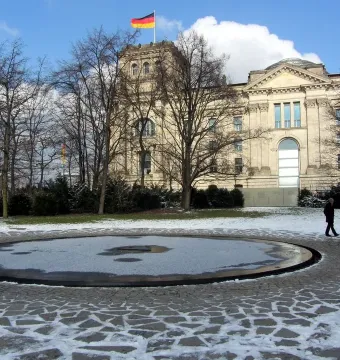
| Main form | A dark circular pool of water with a triangular stone at its center; a dark, circular pool of water with a triangular stone at the center; a circular water basin with a triangular stone stele placed in the center of the basin; circular water basin surrounded by slabs of broken stone; a dark, circular pool of water with a triangular stone at its center |
| Central element | Triangular stone; triangular platform; triangular stone stele |
| Surrounding surface | A carpet of individually irregularly shaped white stone slabs |
| Surrounding stone band width | About three meters wide |
| Entrance | A narrow gate leads through the glass wall into the memorial site |
| Glass wall material | Milky-glass-colored glass plates |
| Information panels | Glass information panels surround the site; information boards surround the memorial and provide a chronology of the genocide of the Sinti and Roma |
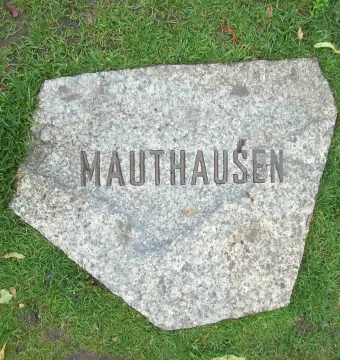
| Embedded stones | At irregular intervals, stones with engraved names of concentration camps are included; examples include Neuengamme and Auschwitz |
| Sound installation | Speakers play the melody Mare Manuschenge composed by Romeo Franz for the memorial |
Materials | |
| Inscription material | Bronze letters |
Iconography and meaning | |
| Water symbolism | The water in the round basin symbolizes tears |
| Water function according to artist | The water was intended to protect the central plant |
| Interpretation of fountain symbol | Karavan said the fountain symbolizes that, in confronting the memory of Nazi crimes, those involved should act with contemplation rather than conflict |
| Reflection in water | Karavan noted that the Reichstag facade reflects in the basin's water, which he did not intend and which frightened him |
| Grave context | Many Sinti and Roma were shot in open fields and then buried in mass graves; those graves were also the sites of the crimes |
| Origin of concept | Karavan stated that flowers were the starting point of the work |
| Inscribed text | The poem "Auschwitz" by Roma poet Santino Spinelli; the poem "Auschwitz" by the Italian Rom Santino Spinelli (artist name "Alexian") |
| Poet | Santino Spinelli |
| Poet identity | Roma poet; Italian artist; Italian Rom |
| Poem languages | English, German, Vlax Romani, Sinte Romani, and Romani |
| Poem excerpt | Gaunt face; dead eyes; cold lips; quiet; a broken heart; out of breath; without words; no tears; "Cara / demacrada, ojos muertos, / labios fríos, / silencio, / un corazón roto sin / aliento / sin palabras, / sin lágrimas"; "Emaciated face / extinguished eyes / cold lips / silence / a torn heart / without breath / without words / no tears" |
| Daily ritual | A fresh flower is placed upon the stone daily; a fresh flower is placed on the stone every day; once a day, the platform sinks below the surface and reappears with a fresh flower; a flower rests on the stele and is replaced with a new one when it loses freshness |
| Floral element | A single rose is planted on the triangular platform |
| Basin shape symbolism | The circular shape is said to express equality |
| Symbolism of central stone shape | The triangular shape refers to the badges / insignia / angle (winkel) that concentration camp prisoners had to wear on their clothing |
| Flower symbolism | A symbol of life, grief, and remembrance; the central flower symbolizes wildflowers that grew on the graves of the Sinti and Roma |